


People often use the phrase ‘the miracle of life’ and, indeed, there seems to be a lot of truth in it when it comes to babies. Hidden within the evolution of these little beings are some facts and figures that many will find surprising. Some sound incredible until one delves deeper, and that’s exactly what we’re going to do in today’s Crazy Baby Facts exploration. So, perhaps grab a warm drink, take a seat for a few minutes, and get ready to be surprised…
Early Signs of Right-Handedness
 Did you know that the position newborn babies prefer to face when lying on their backs may be an indicator of whether they’ll be left- or right-handed? The thumb they suck is, of course, a similar indicator. The 85% of them who prefer to face right in the first few months and the 90% who suck their right thumb generally turn out to be right-handers — the same kinds of percentage of adults who are right-handers.
The Age From Which Infants Have Memories
How old are you in your earliest memory? The memory of infants is interesting in that their ability to remember long-term, ‘autobiographical’ memories of events — including what will later become their earliest memories — doesn’t occur until they’re around 3 to 4 years of age. Although they may be able to form memories of events, particularly emotional ones, a little earlier between the ages of 2 and 3, those memories tend to fade. We should mention, of course, that shorter-term memories, such as recognising caregivers and remembering where toys are, come much earlier.
Newborn Babies’ Hearts Race
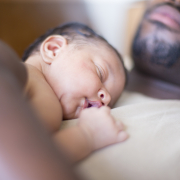
While it’s common knowledge that adults have a typical resting heartbeat rate of about 60 to 100 beats per minute (bpm), for newborn babies in their first month, it’s much higher at 100 to 160 bpm. That said, it can be higher or lower — 70 to 190 bpm while awake — without necessarily meaning there is a problem. The range is usually lower while asleep, typically ranging between 90 and 160 bpm. As the child grows older, the range decreases further, with a typical rate being between 70 and 110 bpm by the time they’re around 7 to 9 years of age. [Source]
Should there be any concerns, it’s important, of course, to seek professional medical advice.
How Many Babies Are Born Every Hour?
Here’s another crazy baby fact: 15,981 babies are born every hour across the world. That equates to >266 new babies every minute, and 4.44 every second! It’s no wonder that the world’s population is growing (at +0.9% annually). [Source]
Where 53% of All Births Occur
 The locations where babies are born around the world are also very interesting. 5% of the world’s babies are born in Europe. What about the other 95%? Well, a staggering 52.9% of all babies are born in the continent of Asia, 30.7% across Africa, 10.7% in the Americas, and just 0.7% across Oceania.
Do Foetuses Really Have Gills?
There is some debate as to whether foetuses have gills at some point while they’re growing. The answer is sort of because they do grow pharyngeal arches, which look rather like gill folds, while in the womb. They’re not true gills, as such, however; it’s thought they may be a throwback to our very distant evolution from fish. What we do know is that what appear to be gill slits during the foetus’s early stages eventually evolve into parts of the baby’s mouth and jaw. [Source]
Foetuses Do Have Tails
We’re all born with a coccyx, the tailbone at the end of our spine. However, did you know that foetuses have tails with vertebrae during the early stages of development in the womb? These fuse together around the 7th to 8th week of gestation, the tail disappears, and only the coccyx is left by the time babies are born.
Foetuses Really Have Fur
While many parents are familiar with Vellus hair, the soft “peach fuzz” that newborn babies often have, many will not be aware that they were even more furry in the womb. Lanugo hair is a soft, fine, and usually colourless ‘fur’ that covers babies while in the womb, alongside vernix caseosa, the creamy covering that babies have when they’re born. Both protect the foetus and help to regulate its temperature while in the womb. However, the Lanugo hairs are usually shed before birth, around week 35, although a few babies are born with some, particularly if they’re born prematurely. [Source]
Taste Bud Superpowers
 Babies are born with many more taste buds than adults. They’re not only on the tongue either. Spread on the roof and sides of the mouth, tonsils, and throat, as well as on the tongue, it’s thought they’re super-abundant in babies to help them experience tastes in a highly sensitive way. This could be an evolutionary mechanism to help them identify safe and unsafe food sources. Some estimates put the number of babies’ taste buds as high as three times more than adults, although we have found conflicting reports about the exact numbers. Whatever the number, it decreases by the time a child reaches adulthood. Interestingly too, babies can’t taste salt until the age of about 4 months.
Bone Bonuses for Babies
Adults have 206 bones in their bodies. What you may not know, however, is that babies are born with somewhere between 275 and 300! As they grow older, some of these fuse together to become stronger and more solid, hence the number of bones reducing to 206 by adulthood. The bones in the skull are a great example.
No Tears for Newborns
The moment a newborn first cries is one that a parent never forgets. However, did you know that they don’t cry actual tears until they’re between one and three months old? Until then, it’s rather more like ‘dry crying’ than crying liquid tears, simply because their tear ducts take that long to mature.
Rapidly Expanding Brains
 Did you know that babies’ brains double in size in the first year alone, and triple in size by the time children are 5? Some experts believe that boys’ brains grow faster than girls’ brains in the first three months, but it’s inconclusive. Either way, brains don’t finish developing fully until the age of 21 and, even then, there is some scientific debate as to whether they continue developing even longer.
The Most & Least Popular Date for Births
More babies in England and Wales are born in September than in any other month, with 28 September being the most popular birth date of the year. In fact, it has appeared in the top ten dates for births for several years.
Boxing Day, on the other hand, is the year’s least popular day for births, with fewer babies being born on that date than on any other in the year. According to the Office for National Statistics (ONS)*, this has been the case for well over ten years.
How Many Children Mothers Have on Average
According to ONS data* for 2024 (the latest available at the time of writing), women in England and Wales have, on average, 1.41 children in their lifetimes. This is slightly lower than the preceding year and, indeed, there has been a downward trend for several years. That said, there are regional variations, with the West Midlands seeing the average number of children higher at 1.59 children, while the equivalent for London mothers is lower at just 1.35.
The Average Age of New Parents
Interestingly, the standardised mean age (SMA) of parents has gradually increased over the last two decades — parents are getting older, in other words. This increase in the age of parents has grown by just under 2 years for fathers, and just over 2 years for mothers, during those two decades. Latest ONS data*, at the time of writing, is for 2024, and shows the SMA for fathers in England and Wales at 33.9 years of age, and 31 for mothers. For just the first born child specifically, mothers gave birth at the age of 29.4 on average, although in London, it was higher at 31.1 years — the only region higher than the average age for England and Wales as a whole (31).
Incredible Breastfeeding Fact
 As well as many other benefits associated with breastfeeding, statistics show that babies who are breastfed for at least two months are half as likely to be at risk of Sudden Infant Death Syndrome (SIDS). As well as that, breastmilk passes on important antibodies to the infant, helps protect it from certain diseases and allergies, and even adapts to supply the exact calorific content the baby requires over time. Incredible!
Little Acorns Nursery
Are You Looking for High-Quality Childcare Services in Hindley Green, Wigan?

Today’s amazing baby facts were brought to you by the team at Little Acorns, a nursery in Hindley Green, near Wigan. As well as providing childcare services in Hindley Green and Wigan, we may suit families living nearby in places like Bolton, Ince-in-Makerfield, Platt Bridge, Westhoughton, Atherton, Leigh, Bickershaw, and Tyldesley. Free childcare hours are available here for eligible families aged from 9 months to 4 years.
Get in touch to start your child’s early years education at Little Acorns Nursery — ask a question, come for a guided visit, or start your child’s application today — we can’t wait to meet you and your little one!
* ONS data referenced in this article is available here.


