
Summer is a wonderful time of year when children can get outdoors to play, explore, discover, and enjoy the freedom of nature. It’s also a time of great abundance, with nature’s riches everywhere we look. Nature’s gifts can be beautiful, fascinating, educational, stimulating, and hugely enriching for little ones. Whether it’s a delightful butterfly flitting through the air, a super-cute bumblebee searching for nectar, or a patch of colourful wildflowers growing in a meadow, nature really is rather magical — and that’s especially so for young children. With that in mind, today’s Summer Nature Hunt activity encourages children to get closer to nature* to discover some of its many delights. When children and adults take time to properly look, nature’s wonders really are incredible. Our suggested activity today comes with a free, downloadable reference poster that highlights 20 wonderful things for little ones to look out for during the summer months. From caterpillars and dragonflies to winged seeds and slow worms, there is a lot for children to discover during this abundant time of year. A summer nature hunt will open their eyes and teach them about the natural world around them, as well as being a fun adventure — enjoy!
Summer — Dates
Summer in the UK is generally the warmest part of the year, but the exact dates vary from year to year depending on whether you are using the meteorological or astronomical calendar.
- According to the astronomical calendar, summer starts on Sunday 21 June for 2026 (the longest day of the year or ‘Summer Solstice’) and ends on Wednesday 23 September (2026’s ‘Autumnal Equinox’ when the day is the same length as the night). The exact date varies a little each year because the solstice and equinox sometimes fall on alternative days due to the Earth’s path as it travels around the Sun.
- According to the meteorological calendar, summer starts at the very beginning of June and ends at the very end of August every year. This particular calendar keeps things simple, using full months. It is used for such things as weather forecasting and, being based on full calendar months, allows scientists to more easily compare climate data from year to year.
Download Your Free Summer Nature Hunt Reference Poster
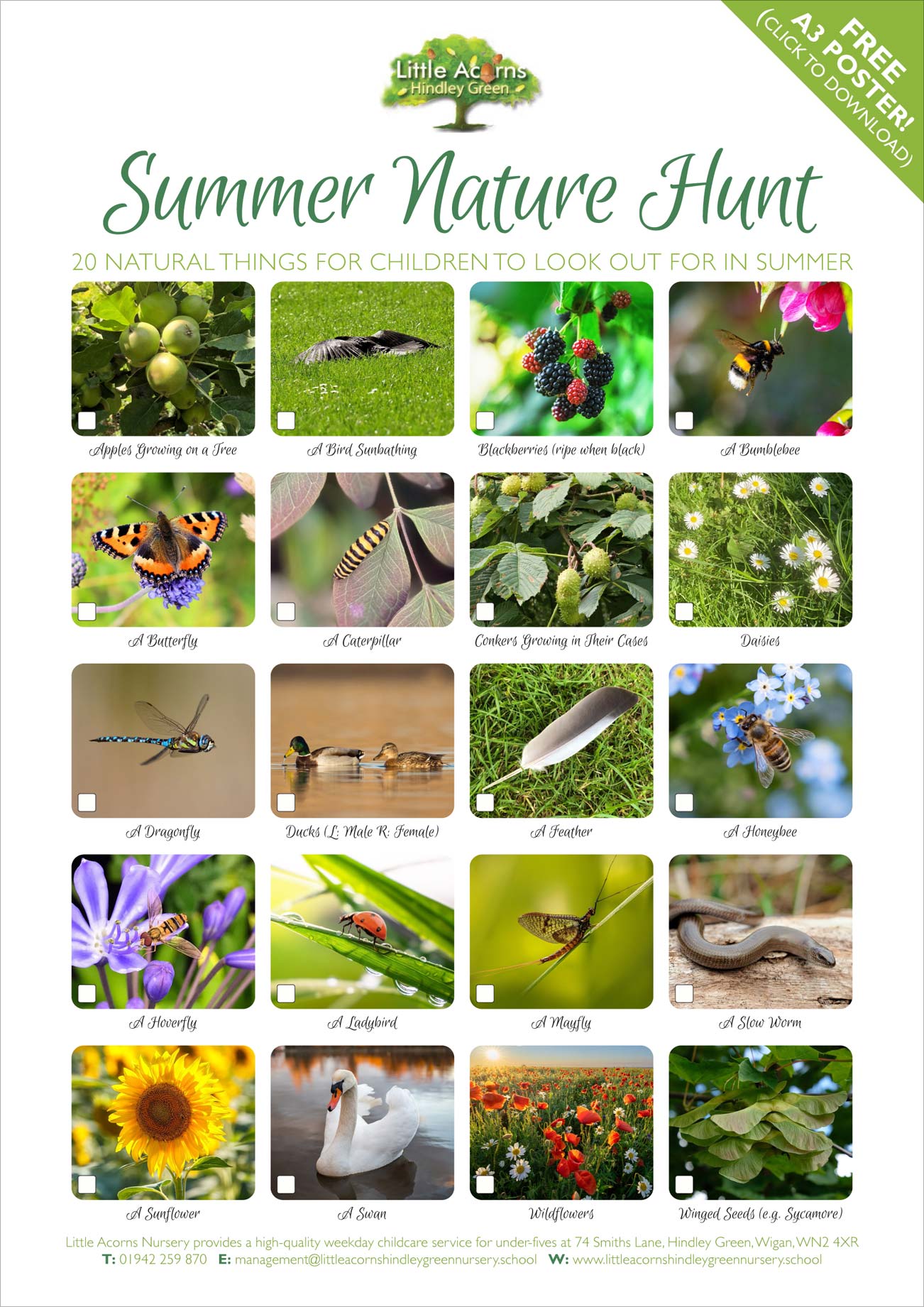
Download your child’s free Summer Nature Hunt reference poster below. Simply click the large preview image to view or download it in high-resolution Acrobat format. We recommend printing it out using your printer’s best settings and paper for the highest-quality results. Posters can be printed at A4 or even A3. For handouts for your child to take with them on a nature hunt, A4 or A5 may suit best. Children can use the little tick boxes to indicate which natural item they have seen during their excursion into the natural world. The activity combines a challenging quest with exploration, discovery, learning, and fun!
How Many Can Your Child Spot?
Can your child find a winged seed, like those from a sycamore tree? Perhaps show them how such seeds spin and travel, often long distances, when falling through the air on the wind — a great example of just one of nature’s magical tricks. Can your little one spot wildflowers, daisies or a wonderful sunflower? How about a bird’s feather, apples growing on a tree, or blackberries growing on a bramble bush? There are also lots of insects to find, such as bees, hoverflies, butterflies, mayflies, and dragonflies. Caterpillars are also fascinating and come in all manner of different forms, including some that are harder to spot if well camouflaged. Then, for the luckiest or most observant young nature watchers, the elusive slow worm is a wonderful creature to discover. Looking more like small snakes, they’re actually legless lizards. There are some birds on the reference poster too — ducks, the magnificent swan who majestically glides through the water, and the amusing sight of a sunbathing bird (rather than being injured, they’re simply warming themselves in the sun).
Nature is So Good for Children
Spending time close to nature is hugely beneficial to children — and adults, in fact. Studies have shown that it benefits people physically, mentally, and spiritually in a huge variety of ways. When little ones spend time in and around nature, stress and anxiety reduce, motor skills improve, knowledge grows, and empathy for other living things increases. What’s more, nature can benefit children and students academically. Indeed, some studies found that even just a view of nature or a natural space can improve academic grades — incredible! It’s a huge topic all on its own, so we wrote a whole article about it — learn more about the enormous benefits and importance of nature to children here. It’s also one of the many reasons why Little Acorns Nursery is starting its own Forest School sessions in and around Hindley Green very soon.
More Nature-Inspired Posters for Your Child to Download (Free)
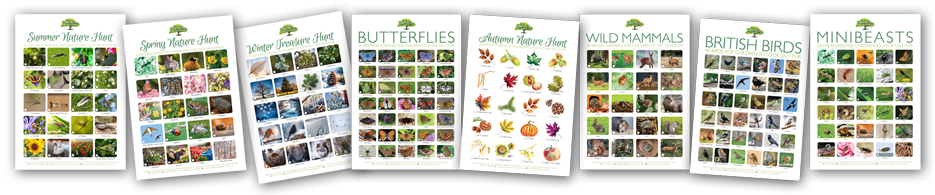
Today’s Summer Nature Hunt activity is just one in a series of nature-inspired activities for children available here on this website. Each comes with its own free reference poster for children and families to print out. So, if exploring nature and learning about the natural world is something you want to encourage your child to do, visit our other nature-inspired activity suggestions today and download your free poster for each. Examples include an autumn nature hunt, winter treasure hunt, and spring nature hunt as well as activities for spotting British birds, minibeasts, mammals, and butterflies. Follow the bold links to learn more and access the free posters — or bookmark them today so you can come back later.
Forest School Sessions Near Wigan
from Little Acorns Nursery, Hindley Green
 At Little Acorns Nursery in Hindley Green, we know how important nature and spending time close to it are for children and under-fives. That’s why we’re lucky to have such extensive outdoor grounds where the children can play, explore, discover, and learn under the watchful eye of our early years professionals. It’s also why we’ll provide Forest School sessions for our nursery children. Learn more about Forest School sessions coming to Little Acorns Nursery in Hindley Green, Wigan, here.
Little Acorns Nursery provides almost year-round nursery and preschool places for babies, toddlers, and children under five in and around Hindley Green, Wigan. We support funded childcare hours and places for eligible children and welcome enquiries from families looking for childcare provision in the area. Please get in touch using an option below to get started. We’ll be delighted to tell you more, show you and your child around, and begin your child’s enrolment.
If you are a family living in Wigan, Bolton, Atherton, Platt Bridge, Westhoughton, Bickershaw, Leigh, Ince-in-Makerfield, Tyldesley, or near Greater Manchester, Little Acorns Nursery in Hindley Green could make a very convenient choice for your weekday childcare. Contact us using one of the above options if you’d like to explore this further — we’d love to hear from you.
* Safety notice: Always ensure that children, especially the youngest, are supervised by a responsible and vigilant adult when they’re playing and exploring outdoors. There are many hazards out there!



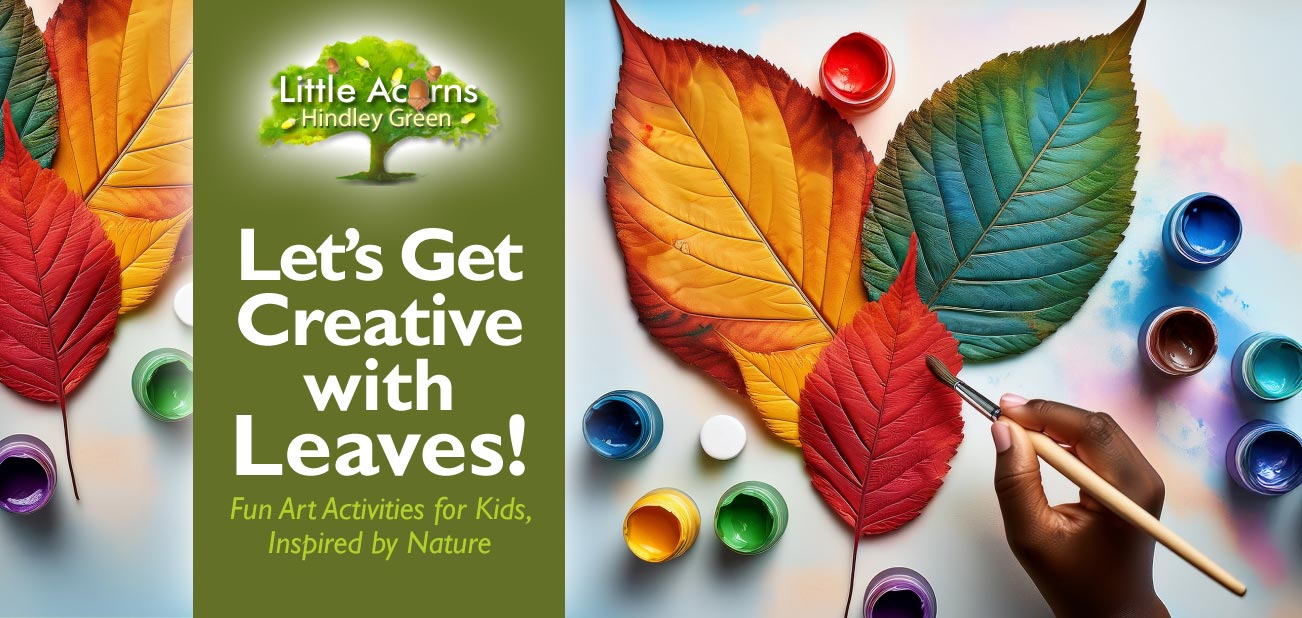
 Following May’s
  Children will need some leaves for these ‘leaf art’ activities. We suggest they collect a wide selection of shapes, sizes, and varieties, so they have the flexibility to undertake any of the leaf art activities below. Our
 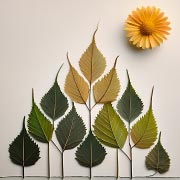 Whether fresh, dried, or pressed (see below), leaf collages can be used to make wonderful pictures and designs. With a little imagination, leaves can suddenly resemble little trees and landscapes, or be combined into formations that depict a flower head or a graphical design. The accompanying images show a couple of examples to get children’s creative juices flowing.
 One of the most straightforward creative activities with leaves is simply to paint and decorate them with coloured paints. Doing so can create highly attractive groups of leaves that are fun and cheerful to look at. Experiment with flat colours or more intricate decorations such as polka dots, stripes, stars, or zigzags. Glue the finished leaves to paper or card once dry to use them as part of a leaf collage (see above).
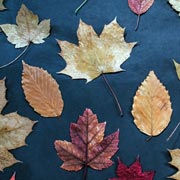 Leaves and small flowers can be dried, flattened, and kept longer by pressing them. Once pressed and dried, they’re like little works of art in themselves and are quite delightful. They can be kept as bookmarks or keepsakes, or used as art and collage components for some of the other leaf activities outlined today.
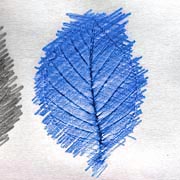 Leaf rubbing is a simple yet effective art activity involving leaves. First, simply place a leaf under a sheet of fairly thin paper. Holding the paper still with one hand, children should use their writing hand to rub a crayon, pastel, charcoal stick, or soft pencil lead over the area where the leaf sits, scribbling from left to right in closely aligned lines. A ‘picture’ of the underlying leaf will gradually appear!
 Leaf printing is super-easy and fun for little ones. Find a suitable leaf and, using a broad brush or — better still — paint roller, paint the most textured side of a leaf with a thin layer of paint, ensuring it covers the whole side of the leaf. Then, while the paint is still wet, place the painted side carefully over a sheet of blank paper. Without moving its position, press all parts of the leaf down so the paint makes contact with the underlying paper. Another way to accomplish this is to use a clean roller to ‘roll’ over the leaf so it connects the paint with the paper. Carefully remove the leaf and — hey presto — you should have an image of the leaf structure and texture right there on the paper. Try different leaves, various colours, and overlapping experiments to accomplish different outcomes.
 Instead of painting or using leaves directly, children can also try to depict them with their own paintings and drawings. These are a good way to encourage children to focus on getting the shape and details correct, fine-tune hand-eye coordination, and bolster technical mark-making skills. And, because children are free to paint or draw however they like, they can let their imaginations run riot and perhaps invent their own leaf shapes, leaf patterns, and natural worlds on paper.
 Children can use some of the creative skills they’ve learnt in the activities above to make greeting cards that feature their leaf art. For example, they can forage for heart-shaped leaves and paint them cerise pink to use as part of a simple Valentine’s Day or Mother’s Day greeting card. More general greeting cards for other special occasions can also be accomplished using leaves and dried flowers — for example, arranged to depict a leaf or dried ‘bouquet’ on a card sent for a birthday.

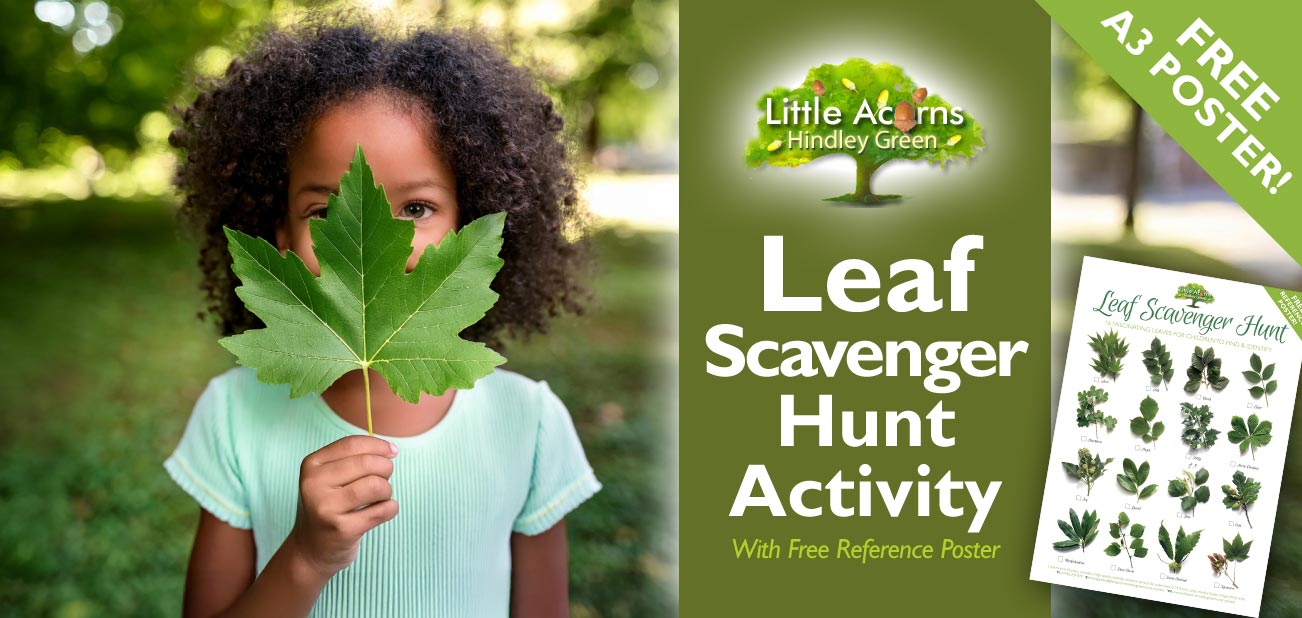
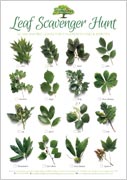
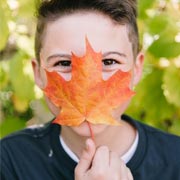 Wherever you look, nature’s flowers and trees are bursting with life during spring and summer. This got us thinking about the many nature-based activities that are possible for children and under-5s to enjoy at this time of year — under appropriate supervision, of course. One of them is a simple leaf-hunting activity that’ll get little ones exploring the outdoors, enjoying the fresh air, having some fun, and learning about the natural world. With this in mind, we’ve put together a Leaf Scavenger Hunt reference poster for children and families. It can serve as inspiration for some common leaves to look out for during the warmer months of the year. The poster is free to download, right here today, and highlights 16 different types of leaves. Included are oak, sycamore, beech, lime and many more. Children will probably be familiar with some — especially oak leaves with their wonderful little acorns — while others may be unfamiliar. However, all of our examples were sourced on a single morning’s outing, so it’s feasible to find all 16 kinds with a bit of eagle-eyed persistence! So, download the poster for your children, print it out, and explore the outdoors to see how many of the 16 leaf types your little one can find. See if they can identify the differences which make each species of leaf/tree/plant unique — and learn their names if they can. The free identification poster and some help from an adult should help. Have fun out there!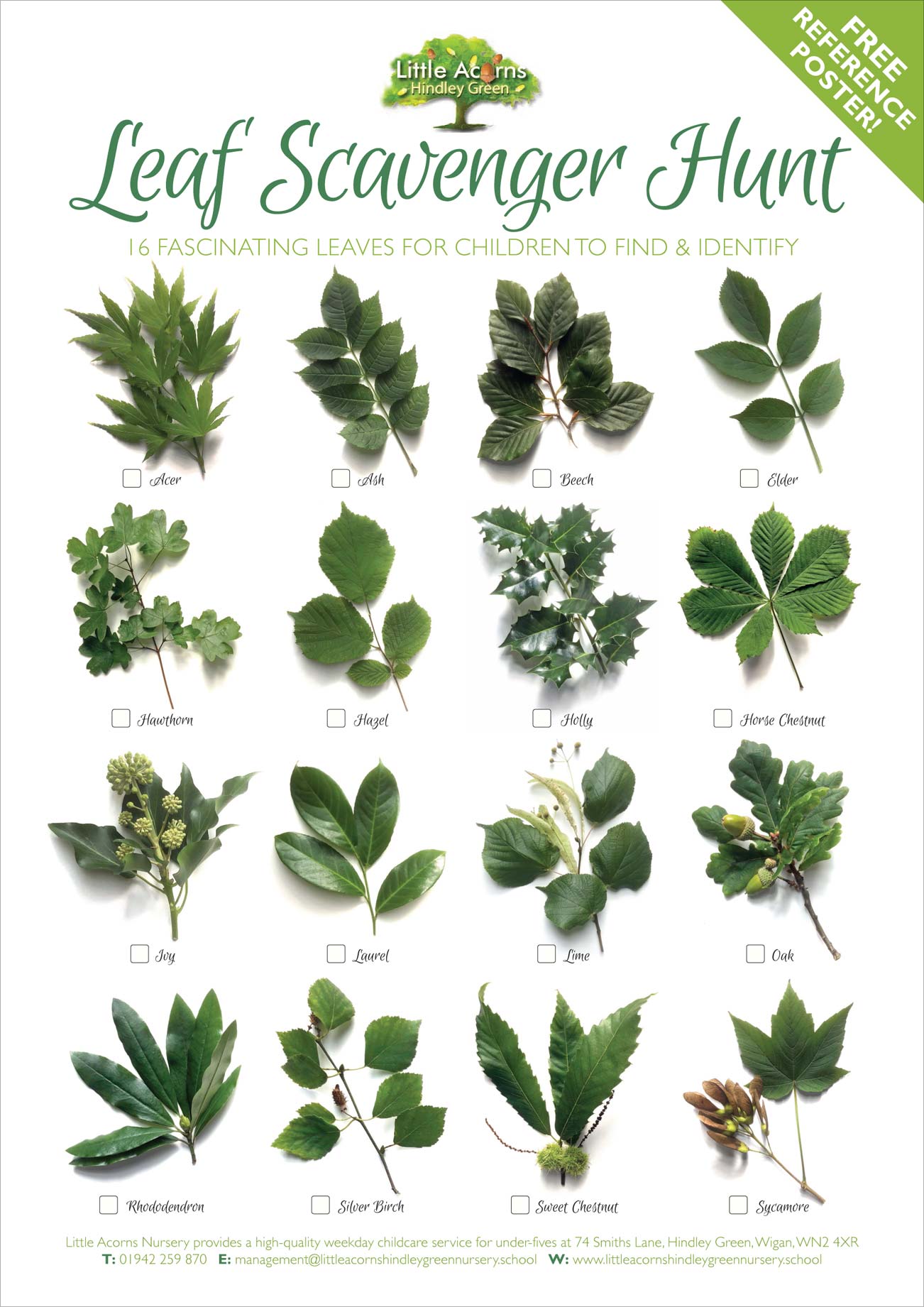
 Some of the leaves will be easier to identify than others. For example, Horse Chestnut (a.k.a. ‘conker tree’) leaves are quite distinctive with their fan of multiple sections (see the 2nd row, last image on the right on the poster for our example). In contrast, hazel and lime leaves are quite similar to one another. One easy clue to tell them apart is that lime leaves are slightly shiny, whereas hazel leaves are extremely matt. And, of course, they have very different seeds once those appear (the lime seed clusters are quite beautiful as you can see on the poster in the 3rd row, 2nd image from the right).
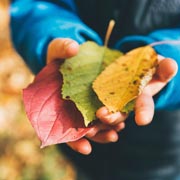 Another interesting factor to point out to children is that some of the leaves come in different colours. Beech leaves, for instance, can be green or deep burgundy, brown or dark purple depending on which variety of beech a child locates. It’s similar for acers, which can be green, yellow, red or a deep purple/maroon. Acers however, are more likely to be found in gardens and parks than in the countryside. Some are a little like miniature sycamores, only rather more delicate and fancy! And, come
 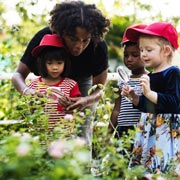 This activity is a great opportunity for children to open their eyes to the natural world. By looking at nature more deeply, they’ll see the finer details that may have been overlooked. Nature is incredibly varied and interesting when you take the time to look closely and discover it properly. It’ll teach children about the natural world, the seasons, the changes in plants and trees at different times of the year, the circle of life, and so much more. Getting out, close to nature, is also incredibly beneficial to children. From busting stress, improving well-being, supporting the EYFS and boosting exercise, to improving concentration and even academic grades,
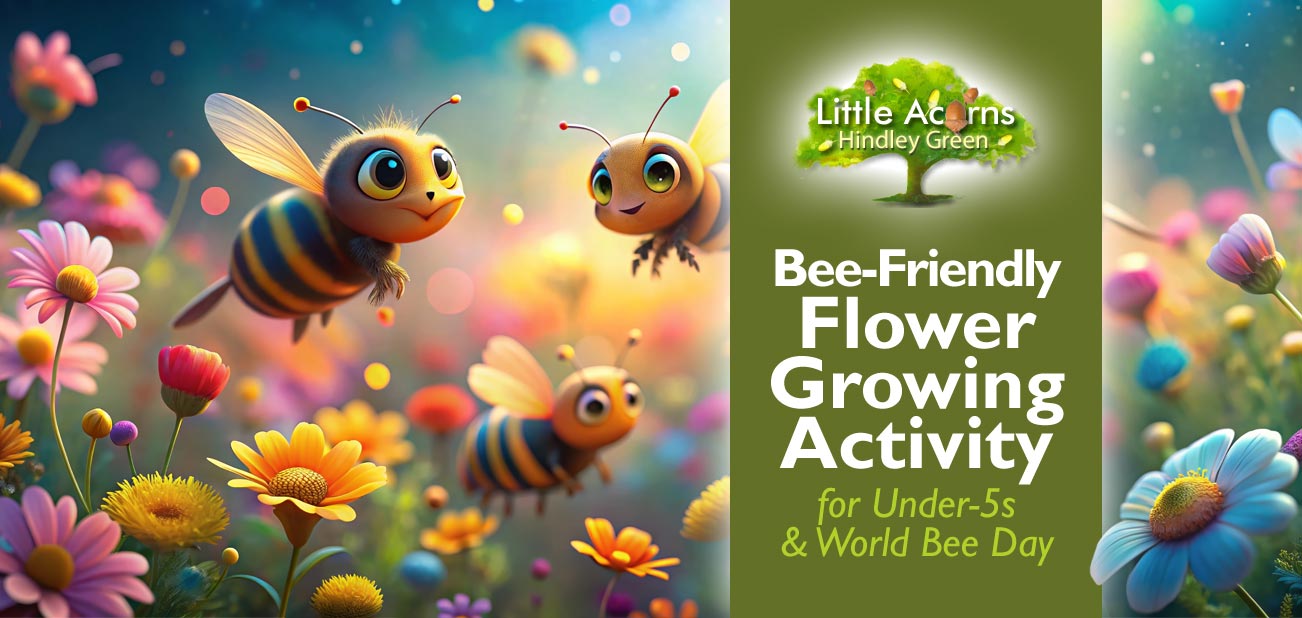
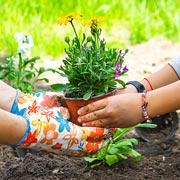 With World Bee Day arriving on the 20th of May and National Children’s Gardening Week arriving on the 24th, it’s an excellent time for a flower-growing activity for children — including under-fives. More specifically, the growing of bee-friendly flowers — from seeds — will be an excellent way to celebrate World Bee Day and support these adorable little creatures. Bees, butterflies, and other pollinators are incredibly important for the world, being largely responsible for pollinating the crops, including nuts, seeds, fruits and vegetables, that we rely on for food. Yet they are under threat with numbers dwindling severely in recent years. Without bees and other pollinators, the world’s animals, plants, trees, and flowers would be in real danger. Today’s bee-friendly flower-growing activity is therefore an incredibly worthwhile one for children to get involved in. It’s fun, highly educational for little ones, and will help to make the world a better place! Little ones, let’s get growing!
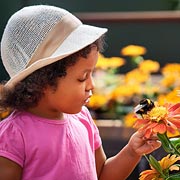 Unless seeds are available from friends and family or harvests from previous years, parents of under-fives will need to source them. However, that’s easy and can be incredibly inexpensive. Most supermarkets sell seed packets and, if not, there is a whole range of online stores to choose from (
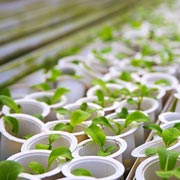 If children are going with our recommended second option, they will first need to read packets to ensure their timing is right. For seed trays, they can use inexpensive, commercially available seed trays or use smaller options like flower pots. Another free alternative is to use repurposed margarine tubs, yoghurt pots, or similar. Whichever option they choose will need drainage holes added underneath by supervising parents plus a drip tray of some kind. Whether that’s a commercial one or something as simple as a saucer is up to families.
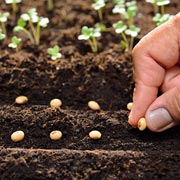 Once the soil is layered into the seed trays or pots, to a level an inch or so below the top, children can indent the soil/compost for the seeds to go into. Seeds can be manually spaced out into these indents so that, once they grow, the individual plants will be easily separated. We suggest scattering a shallow layer of sieved soil or compost over the seeds once placed into the indents and given a sprinkling of water.
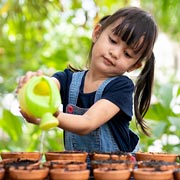 Children should continue to water the seedlings regularly, when needed, and may also have to thin out any ‘clumps’ or plants that are too close together, otherwise, several plants may get tangled and have to compete with one another unnecessarily.
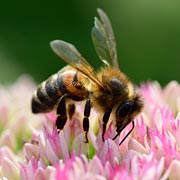 Once flowers appear, children can expect pollinators like honey bees, bumblebees, butterflies, and hoverflies to appear. It’s going to be magical for children when that day first arrives! Bees and the other pollinators truly are delightful and adorable. Children should look but not touch*, after all, bees have important work to do!
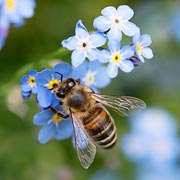 This activity will raise awareness of bees and pollinators in children of all ages. It’s not only a wonderful way to introduce children to these adorable creatures, but also a great opportunity to raise awareness of the plight bees and pollinators are facing. They are under severe pressure from habitat loss, global warming, the use of harmful pesticides/weedkillers, pollution, invasive predators, and many other threats that have made their populations plummet in recent years.

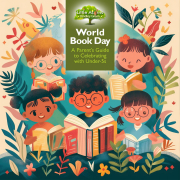

 World Book Day is a special charitable event, celebrated globally, that encourages children of all ages to discover the joy of reading. Why? Because reading has the power to substantially improve children’s lives. Schools, nurseries, and libraries across the nation make the day extra special for children through storytelling sessions, fancy dress, and book-related activities.
 Find time for your little one to read.
 Dress up as a favourite character! There’s no need for elaborate costumes; a simple hat, crown, or themed outfit inspired by a beloved book character can bring your child’s favourite stories to life.








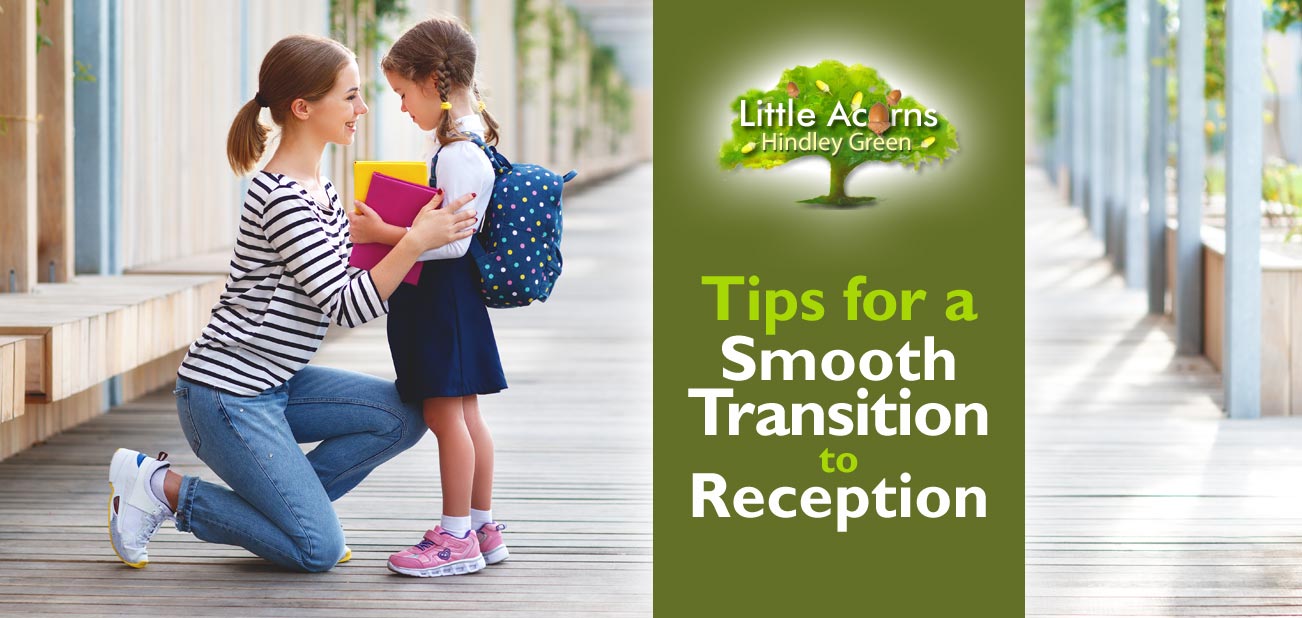
 The transition from preschool to Reception marks a significant milestone in any child’s life. It can be emotional for parents and, for children, it can be a period filled with excitement, curiosity, and perhaps a bit of apprehension. Ensuring a smooth transition involves a combination of careful planning, practical strategies and emotional support. With that in mind, today’s guide outlines more than twenty simple, actionable ways to ensure your child has a seamless transition and a positive start to school life.
 Use positive reinforcement to create a positive association with the idea of school. For example, highlight the exciting aspects of learning, making friends, playing new games, and discovering new things.
 Organise play dates with future classmates to build social connections before the first day. Encourage interactions with other children to develop essential social skills. Attending a nursery, preschool, or playgroup will provide excellent opportunities for this.
 Foster self-reliance by allowing your child to perform simple tasks like dressing themselves, tidying up, using the toilet, and organising themselves. Also, assign small responsibilities to them at home to instil a sense of accountability and responsibility. Such skills will serve them well once at school.
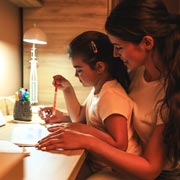 Read age-appropriate books together, particularly those that introduce topics they’ll be introduced to in Reception class. This not only sparks excitement and teaches them new things but also helps children understand what to expect. Instil a love for reading through interactive reading sessions. Visit the library too and explore a variety of books.
 Ensure that your child understands basic time concepts, such as morning, afternoon, and evening. This, in tandem with our next tip below, will help your child better understand the structure of the school day.
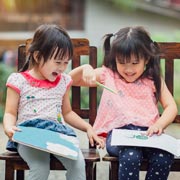 Ensure your child can manage basic self-care tasks independently. Such skills will be invaluable to them once they have started school.
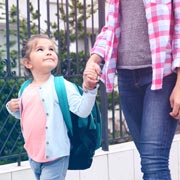 Ensure sufficient sleep by establishing a calming bedtime routine. This not only gets them used to a pattern but will also help them to maintain focus and energy levels once at school.
 The journey from preschool to the first day of school is a significant milestone for both parent and child. Preparing children for school involves a holistic approach that addresses emotional, social, and practical aspects. By incorporating these strategies into your family’s daily routine, you can contribute to a positive and confident transition for your child and set the stage for the most successful start to their school journey.
