
Let’s Get Composting!
 Autumn brings a variety of new, nature-based activity opportunities for children to enjoy outdoors. Along with an autumn scavenger hunt, there is another activity that is perfect for the season given the abundance of fallen leaves — composting. Composting is a simple activity that not only teaches children new skills and knowledge, but also benefits the natural world. Showing children and under-fives how easy it is to make compost will educate them about the circle of life, teach them the value of recycling, give a home to creatures like minibeasts, and give households a free resource that will nourish plants come springtime. It’s a win-win for children, families, and nature! With that in mind, welcome to today’s introductory guide to composting for kids — let’s get composting! And rest assured that, because this is for children and under-fives, we’ll keep things simple.
Activity Overview
Through this activity, children will learn how to make a compost heap, the simple measures needed to maintain it, the types of things that can be composted, and what the compost can be used for once ready. They’ll discover that things usually discarded can be repurposed, recycled, and given a second life that will benefit nature and the household.
What Will Children Need
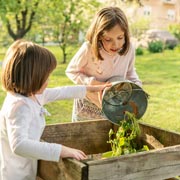 Children will essentially need material to compost and somewhere to compost it. Also, depending on the scale of the compost heap, a spade or gardening trowel will be useful, along with access to water. During the compost preparation, gloves can be worn for protection if preferred, and/or supervising adults will need to ensure that children wash hands with soap and water after working on the task.
What Can Children Compost?
Children and their families can compost an array of things that would otherwise have gone to waste. Key ingredients can include:
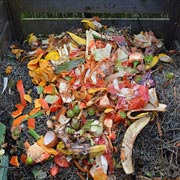 Fresh grass cuttings;
- Fallen/dead leaves and small twigs foraged from the garden or local open space;
- Crushed eggshells;
- Vegetable scraps and fruit peelings;
- Loose coffee grounds and loose tea leaves (empty the contents of any tea bags as the bags themselves often contain microplastics, which do not break down);
- It’s also possible to incorporate small pieces of unlaminated cardboard and shredded paper scattered into the overall organic mix, although see the next section for details to avoid.
Avoid…Avoid including scrap meat, fish, dairy products including cheese, oily foods, pet food, laminated or glossy paper/cardboard, string, tags containing metal rivets, anything containing plastic, and pet litter or waste. After all, you don’t want to attract pests and bad smells, and you only want to use ingredients that are biodegradable. |
How Children Can Get Started
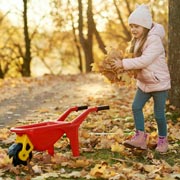 The first task is to choose somewhere for your child’s compost heap. An unused corner of the garden would be perfect for a simple heap, although it’s also possible to make a child’s compost heap in a container like a large pot, a timber packing crate, or even a robust cardboard box if garden space and resources are limited. A parent may need to guide children in this regard.
At the other end of the scale, it’s also possible, of course, to build a larger compost area that has sturdier sides. With the help of an adult, such a construction can be made out of repurposed pallet wood, logs, wire mesh, a crate, or timber sleepers. However, as this particular composting task is a children’s activity, we’ll assume you’ll keep the scale fairly modest and the approach fairly simple. Even at a small scale, high-quality compost is possible with the right approach and ingredients.
What to Do
Whatever the location and style of the compost heap, the approach for making compost is the same.
 Ideally, the compost heap should contain a layer of garden earth at the base to get things started.
- Children should regularly collect the ‘ingredients’ for the compost heap that we outlined earlier. For example, crushed eggshells, vegetable scraps, fruit peelings, banana skins, foraged autumn leaves, grass cuttings, twigs, and so on. Including a wide mix is important. Once collected, these can be scattered in a layer onto the compost heap, which will build up over time.
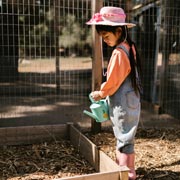
- The child should keep it moist by regularly sprinkling water on the pile. This can be done with either a watering can or a wet sponge that can be wrung out over the compost pile.
- The pile should be stirred and mixed once a week, using a spade, gardening trowel, or stick, depending on the size and depth of the heap.
- Take care to avoid hurting any minibeasts that will inevitably move in once the compost heap is established.
First Steps to a Greener Life
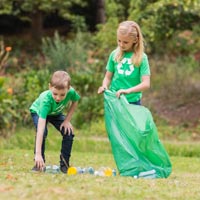 One of the first lessons that children will learn during their composting journey is that what might have been considered rubbish can, in fact, be converted into a valuable resource. All those scraps hold nutrients and minerals that need not be wasted. Instead, they can be recycled and put to new use rather than being discarded and going into landfill.
Recycling is a concept that is becoming more and more important over the years, and composting is an easy and worthwhile way to introduce green values to little ones. Indeed, it may be the first step that sets them on a path towards a more ecologically friendly lifestyle.
What to Expect
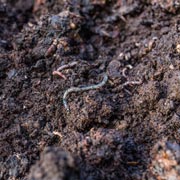 As the compost heap builds up and is mixed over time, the ingredients will gradually biodegrade. Whilst doing so, the pile may appear to shrink and will also darken in colour. Biodegrading is a natural process that is helped by the bacteria, worms, and little bugs that inhabit the mixture.
Indeed, as the composting process unfolds, children will discover some of the little minibeasts that have made the compost heap their home. These are fascinating little creatures that help the compost heap break down. From worms and centipedes to woodlice and beetles, they come in a wide variety of different forms. Another important lesson for children to learn is that the creatures should be treated delicately, with empathy, so they are not unduly disturbed or harmed. Learn more about minibeasts and download a free minibeasts reference poster for your child here.
Eventually, the composting process will result in a rich, crumbly, earth-like compost that’s dark brown in colour. This is packed full of natural goodness that plants will love.
What to Do With the Compost
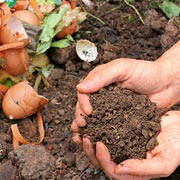 The resulting compost can be used as the soil for potted plants, for growing vegetables and fruits, or mixed around those already in the garden to give them a boost. Compost is rich in nutrients that will greatly enhance the health of growing plants and shrubs, to help them grow and reach their full potential. Plants and flowers will be stronger and will thrive. Fruit and vegetables grown at home will be more bountiful too. All in all, growing plants will become healthier.
Lessons From This Activity
 This activity is not only fun, but will also feed children’s minds. It will teach children new skills, the value of preparation, the importance of patience, and the need to look after nature’s flora and fauna. It teaches children about the natural world, the circle of life, the seasons, how to care for other living things, and the importance of green values. Above all, the exercise demonstrates that if you look after nature, it will look after you. These are all wonderful concepts for children to understand, so it’s crucial to explain them as part of children’s learning journeys during the activity.
So, we encourage families to gather autumn leaves and save those kitchen scraps — they’re a valuable commodity and setting children on their composting path will open children’s eyes to new concepts while combining outdoor exploration, science, recycling, horticulture, and so much more.
Happy Composting, from Little Acorns Nursery
Weekday Childcare Services in Hindley Green, Near Wigan
 At Little Acorns Nursery in Hindley Green, we know how important spending time outdoors, close to nature, is for children. Nature benefits children in so many ways, including physically, mentally, emotionally, spiritually — and even academically (click the bold link to learn more). It’s one of the many reasons we recommend outdoor play and nature-based activities so often on our blog.
Children who attend Little Acorns Nursery in Hindley Green are fortunate to have access to the nursery’s unusually large garden and outdoor area. Various zones allow them to get involved in nature watching, gardening tasks, sensory play, construction, counting activities, creative play, and a wide variety of outdoor play activities. It’s easy to understand why it’s therefore so popular with the nursery children!
Get in touch to find out more about nursery places at Little Acorns or to arrange a visit. Choose a button below to get started — we’ll be delighted to hear from you:
Little Acorns Nursery provides childcare services in Hindley Green, Wigan. As such, we’re also a great match for families in nearby areas like Bolton, Ince-in-Makerfield, Platt Bridge, Westhoughton, Atherton, Leigh, Bickershaw, and Tyldesley.
Safety Note
Supervision from a responsible parent or adult will always be needed for little ones, especially when children are playing and exploring outdoors. Children will need guidance when it comes to outdoor safety, hazards, and hygiene and, indeed, all such guidance will help educate them about potential dangers and the assessment of risks.
 Most children in England start school in Reception Class, usually in the September term, when they’re still only 4. That’s up to a year before they have officially reached Compulsory School Age. This allows them to start their school education earlier than the law requires so that, by the time they begin Year One at school, they can confidently hit the ground running. Starting in Reception at the age of four sets them up for success in so many ways, including academically, socially, emotionally and more. Beginning earlier also empowers them with a wider skill set, with a greater level of confidence and independence, an existing cohort of friends, a better grasp of what Year One will have in store for them, and so on. And, of course, by enrolling at school from Reception Year, they will complete the final EYFS modules that will be so important to their success from Year One onwards.
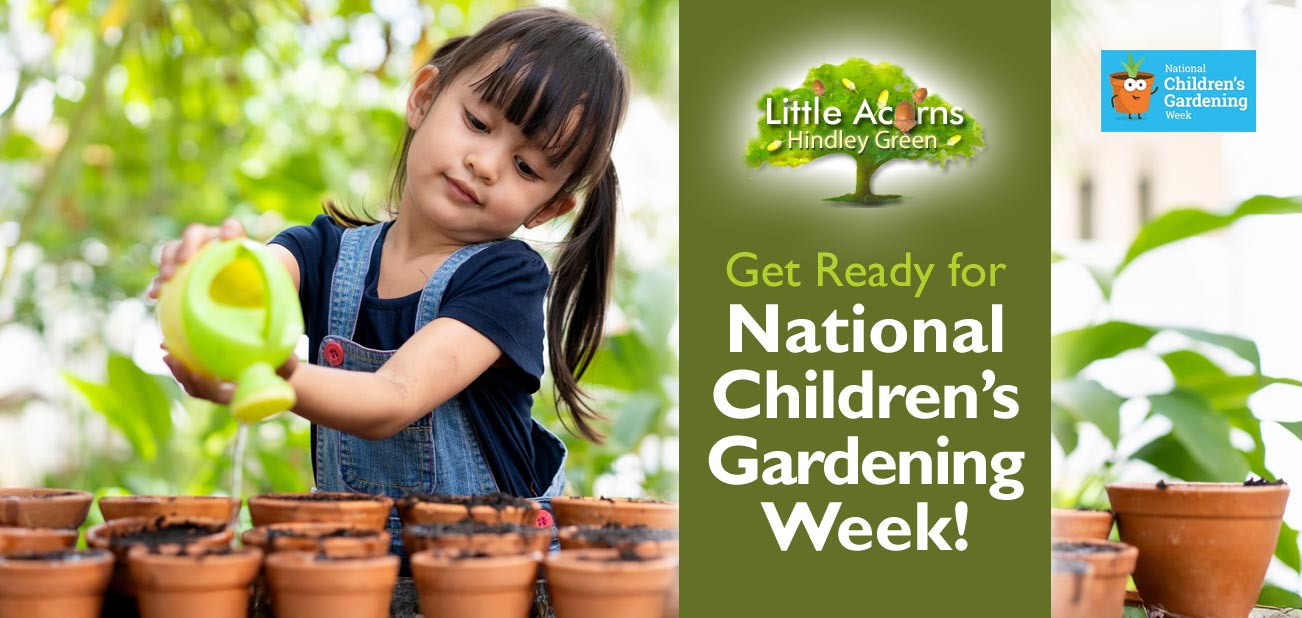
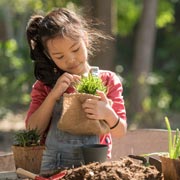 National Children’s Gardening Week arrives in May and is the perfect opportunity for children to get outdoors and enjoy some wholesome, nature-based activities. Starting towards late May, it’s a time when spring is in full swing, the weather is usually fine, and seeds and plants grow fast in the nourishing sunshine. Embraced by children at homes, in childcare settings, schools and community groups across the Nation, this special week is fun, educational, and hugely worthwhile for children. What’s more, it benefits Greenfingers, the chosen charity supported by the initiative.
 Many children have an instinctive connection to nature. National Children’s Gardening Week nurtures such instincts by encouraging children to get hands-on in the garden or local green space. As well as helping children discover many new facets about the natural world, activities in this special spring week will also teach them about the circle of life, ecosystems, and a sense of responsibility towards nature. It will also open their eyes to the beauty and wonder of the world as a whole, as well as giving them a greater sense of their place within it. Let’s also not forget that
 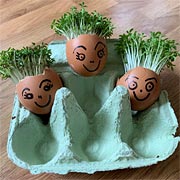 Growing mustard, cress, or microgreens is even more simple and can be accomplished entirely indoors if families have no outdoor access. What’s more, the results are very tasty to eat!
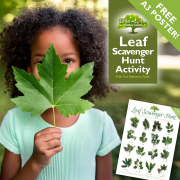

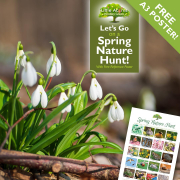
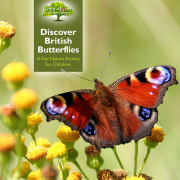 Discovery hunts are also fun and entertaining this spring. If children have completed the spring nature hunt above, they can graduate to
 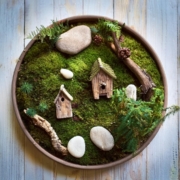 Make a mini garden, also similar to a fairy garden. These are always a huge hit with children, and look magical!
  In our introduction, we mentioned that this fabulous children’s gardening week raises money for Greenfingers. They are a wonderful charity that supports children in hospices. This is achieved by creating beautiful gardens and open spaces where children and their families and friends can spend quality time together. Without the support of Greenfingers, such magical spaces simply wouldn’t exist. Check out
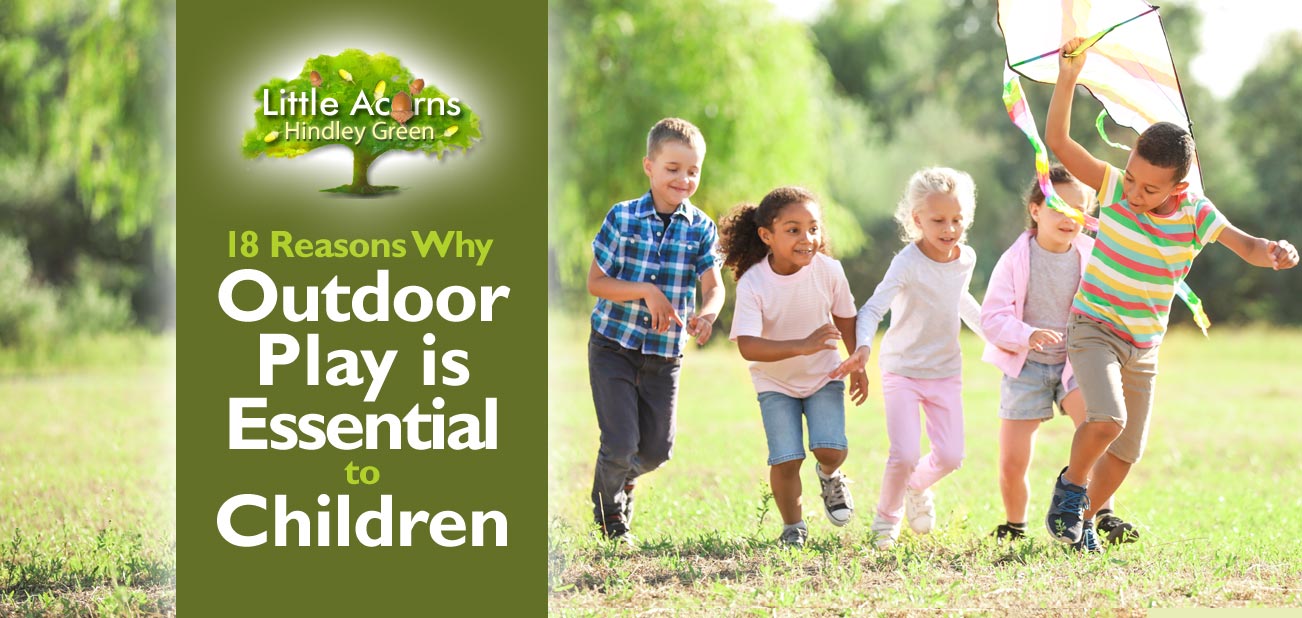
 Outdoor play is one of the truly magical elements of any healthy, fun-filled childhood. At the very least, it gives children the chance for some freedom, fresh air, and adventures that simply aren’t possible indoors. In today’s technological age of electronic screens, however, it’s also something that children have been doing less and less of over the generations. That’s a shame, when you think about it, not least because outdoor play is immense fun and incredibly beneficial to children. In light of this, today’s post explores 18 Reasons Why Outdoor Play is Essential to Children — of all ages. Take a look and see why outdoor play is so good for little ones.
 We mentioned it in our introduction — playing outdoors provides children with wonderful opportunities for real adventures! Whether it’s exploring The Great Outdoors on a family ramble, climbing on playground equipment with friends, embarking on a make-believe quest with the family dog, or making a den with siblings, there are no limits to what’s possible with outdoor play. Indeed, the adventures that are possible through outdoor play are only limited by a child’s imagination! Speaking of which…
 Let’s not forget, too, that playing outdoors is huge fun — and that’s important. Simply put, playing outdoors and giving children space to run around will make them happy. And there’s not much in life that’s more important than a child’s happiness — it’s an essential part of any magical childhood.
 Outdoor play lends itself to the learning of new skills. With such a varied array of activities possible, children will naturally attempt new things, and each of these can be an opportunity to extend their skills. Physical skills might include tying knots, building dens with branches, playing ball games, climbing, racing, and so on. In addition, children will learn softer skills like teamwork, cooperation, strategy, critical thinking, leadership, and role play. What’s more, all of this will happen instinctively — such is the power of outdoor play.
 Children who regularly play outdoors will inevitably meet other children and encounter new dynamics. These will help them make new social connections, and immersive activities will deepen existing friendships. Playing outdoors is a great way, therefore, to strengthen and extend a child’s social circle, and boost social skills like teamwork, leadership, cooperation, brain storming, and so on.
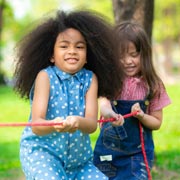 The often high-octane activities associated with outdoor play will also help children boost strength, fitness, motor, and coordination skills. By exposing themselves to different terrains, environments, tasks, games, and equipment outdoors, they will increase the variety of motor skills they need to accomplish activities. Running, jumping, hopping, constructing, chasing, and climbing will all help improve them physically, in so many ways that may not be possible indoors. What’s more, such things will help children protect themselves from harm, as well as empower them physically.
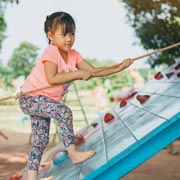 Playing outdoors, with adult oversight, is the perfect opportunity for children to begin learning how to assess risk. Whether it’s safely navigating outdoor play equipment, stepping over undulating ground, climbing a tree, or playing fast-paced ball games, children will soon learn when and how they need to assess possible risks. It’s a skill that, once learned, will keep them safer from harm, so is incredibly important.
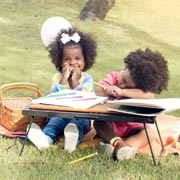 All these new skills and enhancements make under-5s well-equipped when the time comes to leave preschool and begin school. Through outdoor play, they’ll have greater independence, confidence, communication and social skills, and physical skills, to name just a few. What a great way to help them hit the ground running from the moment they begin school!
 All in all, outdoor play prepares children for life. Through greater independence, better confidence, raised self-esteem, and new tools, skills and knowledge at their disposal, children can go forward with new vigour and thrive. Such is the power of outdoor play.

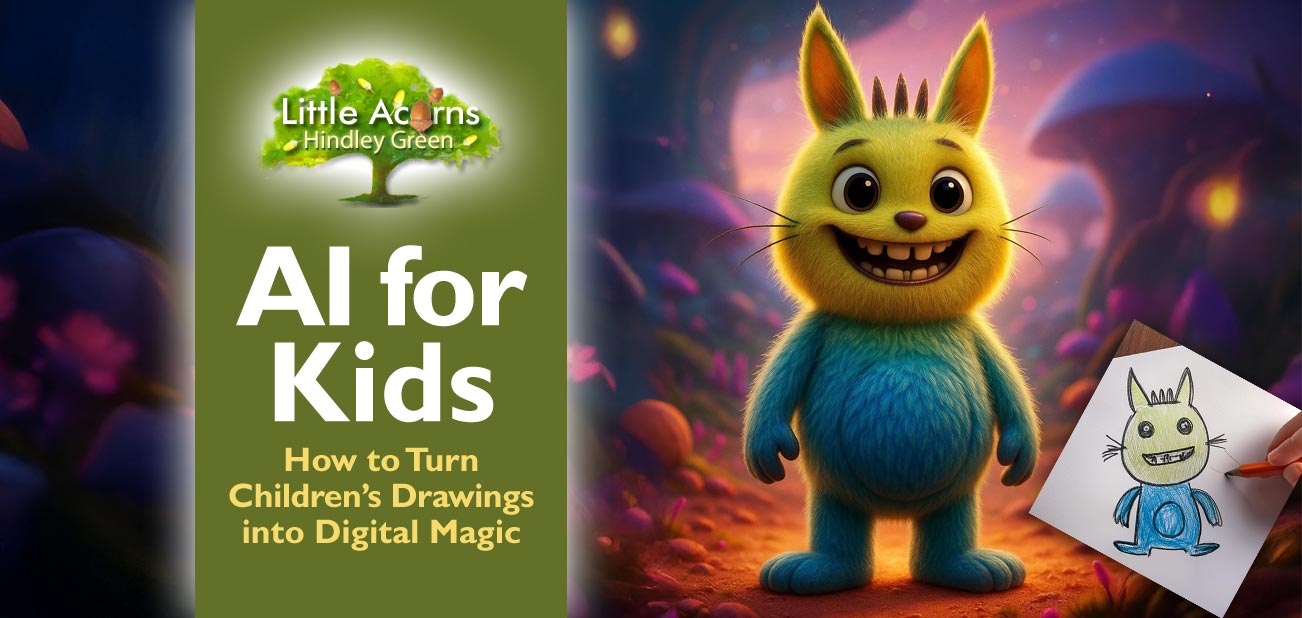
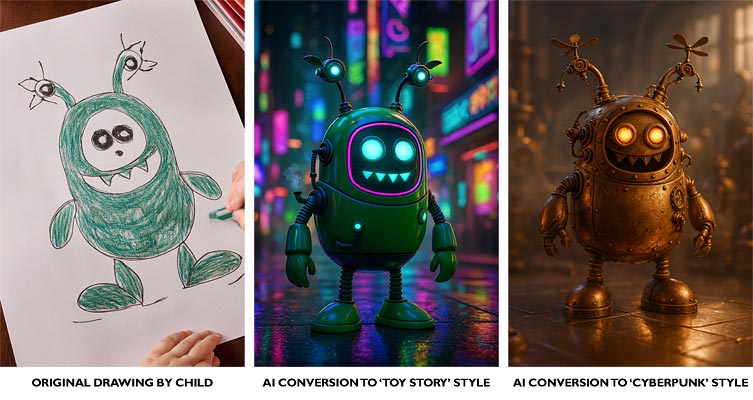
 Even the youngest children have an incredible gift for imagination. Give them a handful of crayons and a sheet of paper, and, in no time at all, they’ll have created charming drawings that will delight. You’ll be introduced to colourful monsters, kindly robots, prancing unicorns, and pets reimagined. They may also depict family members, perhaps holding hands outside a home surrounded by flowers and love hearts. Each drawing tells a story and gives insights into how they see the world. Now, thanks to Artificial Intelligence (AI), families can bring those stories to life in a simple yet magical way. What’s more, it’s incredibly good fun and the results can be astounding!
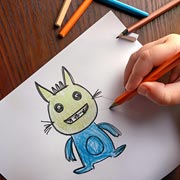 This activity works best as a family project. Begin by letting your child create a drawing — anything they like, from a friendly monster to a robot, a pet dragon, or a family picnic on the moon. Encourage them to use lots of colour and detail, then take a clear photo of the finished drawing — a smartphone’s camera is usually perfect for the task.
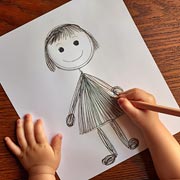 Some children know exactly what they want to draw, while others may need a starting point. You might suggest a dancing robot covered in buttons, a dragon who lives under the nursery slide, or a family of aliens enjoying tea on the moon.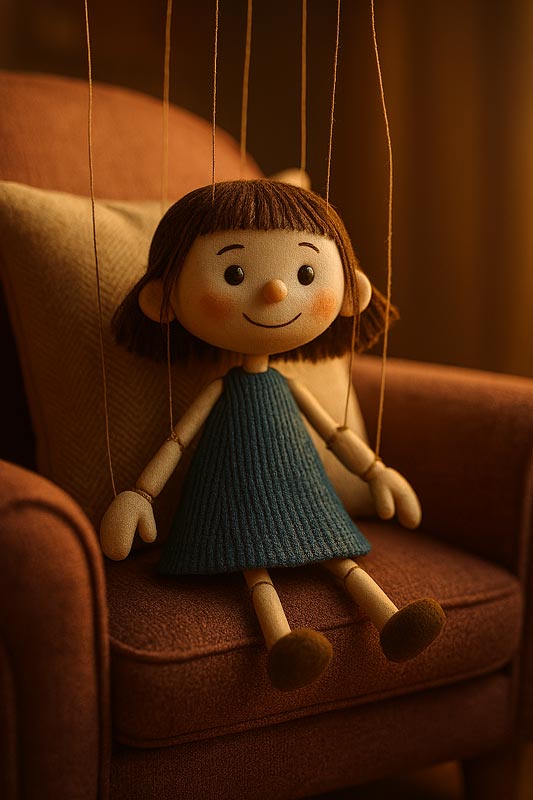
 Once you’ve created your child’s AI-enhanced image, there are plenty of ways to keep the creativity flowing. You might print both versions and frame them together, start a digital scrapbook of your child’s art, or create a picture book where each page features one of their AI-inspired characters.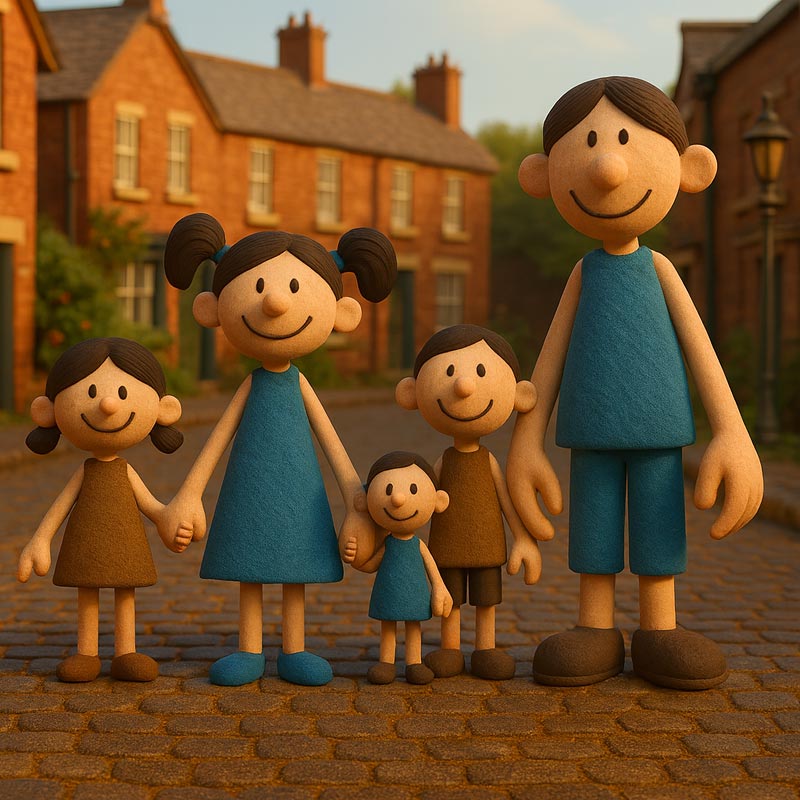

 Following May’s
  Children will need some leaves for these ‘leaf art’ activities. We suggest they collect a wide selection of shapes, sizes, and varieties, so they have the flexibility to undertake any of the leaf art activities below. Our
 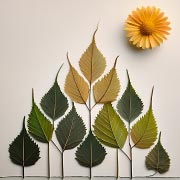 Whether fresh, dried, or pressed (see below), leaf collages can be used to make wonderful pictures and designs. With a little imagination, leaves can suddenly resemble little trees and landscapes, or be combined into formations that depict a flower head or a graphical design. The accompanying images show a couple of examples to get children’s creative juices flowing.
 One of the most straightforward creative activities with leaves is simply to paint and decorate them with coloured paints. Doing so can create highly attractive groups of leaves that are fun and cheerful to look at. Experiment with flat colours or more intricate decorations such as polka dots, stripes, stars, or zigzags. Glue the finished leaves to paper or card once dry to use them as part of a leaf collage (see above).
 Leaves and small flowers can be dried, flattened, and kept longer by pressing them. Once pressed and dried, they’re like little works of art in themselves and are quite delightful. They can be kept as bookmarks or keepsakes, or used as art and collage components for some of the other leaf activities outlined today.
 Leaf rubbing is a simple yet effective art activity involving leaves. First, simply place a leaf under a sheet of fairly thin paper. Holding the paper still with one hand, children should use their writing hand to rub a crayon, pastel, charcoal stick, or soft pencil lead over the area where the leaf sits, scribbling from left to right in closely aligned lines. A ‘picture’ of the underlying leaf will gradually appear!
 Leaf printing is super-easy and fun for little ones. Find a suitable leaf and, using a broad brush or — better still — paint roller, paint the most textured side of a leaf with a thin layer of paint, ensuring it covers the whole side of the leaf. Then, while the paint is still wet, place the painted side carefully over a sheet of blank paper. Without moving its position, press all parts of the leaf down so the paint makes contact with the underlying paper. Another way to accomplish this is to use a clean roller to ‘roll’ over the leaf so it connects the paint with the paper. Carefully remove the leaf and — hey presto — you should have an image of the leaf structure and texture right there on the paper. Try different leaves, various colours, and overlapping experiments to accomplish different outcomes.
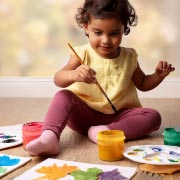 Instead of painting or using leaves directly, children can also try to depict them with their own paintings and drawings. These are a good way to encourage children to focus on getting the shape and details correct, fine-tune hand-eye coordination, and bolster technical mark-making skills. And, because children are free to paint or draw however they like, they can let their imaginations run riot and perhaps invent their own leaf shapes, leaf patterns, and natural worlds on paper.
 Children can use some of the creative skills they’ve learnt in the activities above to make greeting cards that feature their leaf art. For example, they can forage for heart-shaped leaves and paint them cerise pink to use as part of a simple Valentine’s Day or Mother’s Day greeting card. More general greeting cards for other special occasions can also be accomplished using leaves and dried flowers — for example, arranged to depict a leaf or dried ‘bouquet’ on a card sent for a birthday.

 Calling all children and their families — people of all ages are needed this July and August for the world’s biggest wildlife survey — the Big Butterfly Count! So, whether you’re a child or an adult, you can play your part. This is a great activity for under-fives too as it’ll be fun, educational, and incredibly worthwhile. What’s more, they’ll become little citizen scientists by taking part. The nature-based activity takes as little as just 15 minutes and costs nothing at all. Children don’t need any special abilities other than a little patience and good observation — both great skills for them to practise. Let’s take a look and see what the Big Butterfly Count is all about and how children can take part this year.
 The Big Butterfly Count is a nature survey that anyone can take part in during July and August each year. For 2025, it takes place from Friday the 18th of July to Sunday the 10th of August, a period in which temperatures are usually warm and butterfly populations are likely to peak. In essence, all that is required is for butterflies to be counted during a 15-minute period (more detail follows later in this guide). The survey event is open to everyone and, indeed, the more people who take part, the better. So, if you, your child, your family, or your friends want to play a part in protecting butterflies and nature as a whole, please get involved.
 The populations of butterflies can be used as a barometer for the health of pollinator numbers and nature as a whole. With some butterfly species already disappearing from our gardens and countryside and others nearing extinction, there is no time to lose. Only by identifying the issues can we, as a nation, begin to reverse some of the decline. By reversing it, it will be good for butterflies, good for other pollinators like bees, good for nature as a whole — and good for humans too! After all, without pollinators, the supply of foods like cereals, fruit, vegetables and legumes would start to run out. So, taking part in the Big Butterfly Count is extremely worthwhile and we urge little ones and their families to take part.
 First, ensure you have downloaded and printed out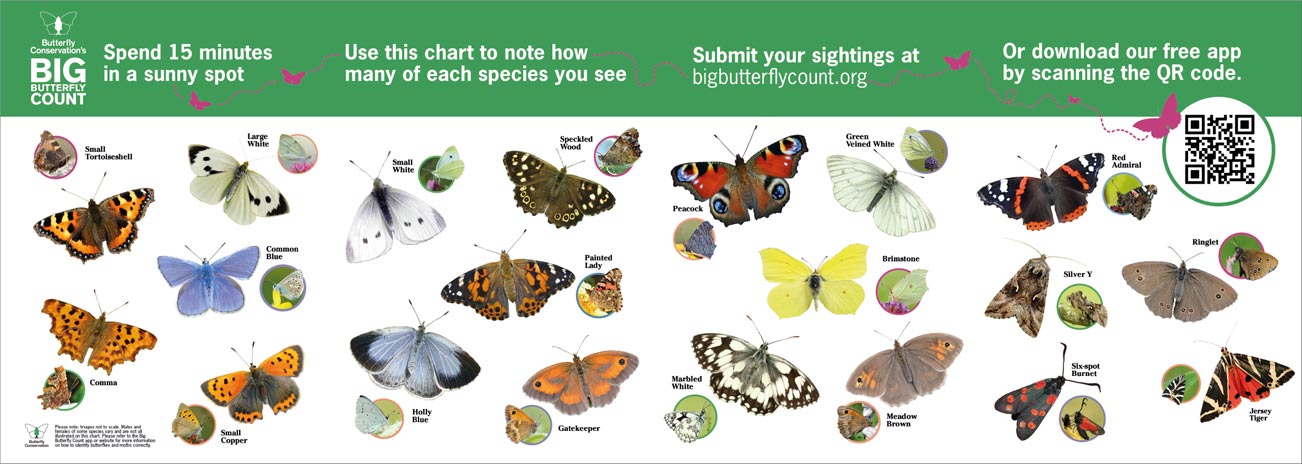
 Choose a spot for your butterfly survey. It should be somewhere outside where butterflies are most likely to be seen. Sunny, sheltered spots are good, particularly where a variety of different sizes and types of flowers or blossoms are in bloom.
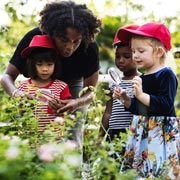 Sometime in the period from Friday the 18th of July to Sunday the 10th of August, you/your child should spend 15 minutes making a note of how many of each type of butterfly you can see. Concentrate only on the species included in the event organiser’s reference from Step 1. You must count how many of each single species you see at the same time. So, if you see three Painted Ladies at the same time, then record that as 3. However, if you see one Painted Lady on three separate occasions during the 15 minutes, that would only count as 1 — otherwise, it could simply be the same butterfly revisiting.
 Did You Know?
 Nature and outdoor play feature significantly in children’s time at
