Forest School: Coming Soon to Hindley Green, Wigan
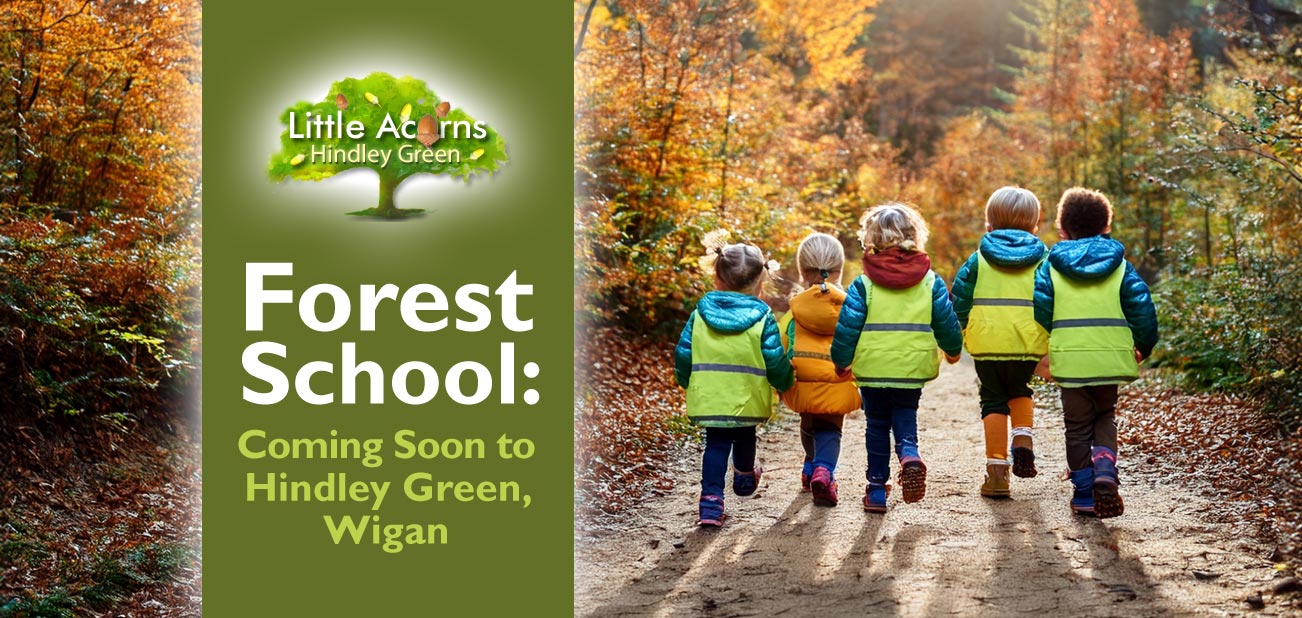
 The team at Little Acorns Nursery is delighted to announce that we’ll soon be running regular Forest School sessions for children under five in the Hindley Green/Wigan area. Little ones absolutely adore Forest School — they seem instinctively drawn to nature and natural outdoor spaces. Like them, we simply can’t wait to begin! Preparations and training are underway, and we hope to begin our first Forest School sessions for children from September 2026. It’ll be a really exciting addition for the new term and for families living nearby. With all that in mind, today’s post explains what Forest School is all about, how it came to be, and how it benefits children, especially those under five.
By way of introduction, take a look at this excellent introductory video from The Forest School Association. It explains the fundamentals of Forest School and is about 6 minutes long. That said, we suggest skipping the last minute — everything after the 5-minute mark — to avoid the more commercial content in the final section.
What Forest School Is … & What It Is Not
 Forest School is not so much a place, destination, or static centre of learning as it is a child-centred philosophy and learning process. Through a Forest School programme, little learners can safely play, explore, and discover outdoors, close to nature, under the supervision of specially trained adult leaders. There, in the natural environment, they will learn new skills and grow holistically in a vast number of new ways.
“Qualified practitioners carefully facilitate programmes which are uniquely tailored to the needs of the individuals within the group and have the fundamental aim of building participants’ self-esteem, confidence, independence and creativity.” — Forest School Association (FSA).
The Forest School approach is backed by research that concludes that attending regular outdoor sessions helps children develop in truly profound ways, including spiritually, emotionally, intellectually, socially, and physically. That’s a lot of benefits! What’s more, it helps open young children’s eyes to the wonder and scope of the wider natural world — and helps them better understand how they fit into it.
Forest School’s Roots
 As well as being inspired by several incredibly influential proponents* of outdoor play, learning, and discovery, Forest School has its strongest roots in Scandinavia. It was there that people first took notice of their outdoor ‘Friluftsliv’ (free air life) culture. Soon becoming virtually a way of life, the philosophy began to spread around the world. It eventually arrived as ‘Forest School’, in the UK, back in the early 1990s. Its UK beginnings were initially led by staff from Bridgewater College, Somerset, who had visited Scandinavia to see Friluftsliv for themselves. Since then, Forest School’s popularity has grown and grown, with children and adults loving everything about it and enjoying the many benefits it brings.
What Do Children Do During Forest School Sessions?
During Forest School sessions, children are escorted under the supervision of trained Forest School leaders to a natural open space which, ideally, includes woodland or a wooded section. There, they will play, explore, discover, and learn in a myriad of exciting and stimulating ways. They will develop holistically, learning new skills whilst doing so, as well as developing their own unique relationship to the natural world.
“Forest School programmes aim to develop, where appropriate, the physical, social, cognitive, linguistic, emotional and spiritual aspects of the learner.” — FSA.
 Forest School sessions are held regularly over an extended period of time and, weather conditions permitting, cover several seasons of the calendar year. They’re usually likely to include a variety of activities in tandem with general exploration and discovery. Examples might include climbing, balancing, problem-solving, activities connecting children to nature, working in teams to complete creative or building tasks, and so on.
Importantly, Forest School sessions are designed to be low-impact in their effect on the natural world. This is part of the philosophy of Forest School, with one of the key aims being to foster a sense of responsibility towards the natural world in each child.
“Forest School aims to foster a relationship with nature through regular personal experiences in order to develop long-term, environmentally sustainable attitudes and practices in staff, learners and the wider community.” — FSA.
Forest School principles can also be applied in the nursery setting as well as at home, when appropriate. There, under adult supervision, children can continue on their Forest School programme using resources found in nature as inspiration for ideas, creativity, and further learning.
What About Health & Safety?
All Forest School sessions are undertaken with trained leaders and, of course, appropriate adult supervision and adult-to-learner ratios at all times. In line with the Health & Safety policy of the nursery, practitioners hold appropriate paediatric first aid qualifications. Additionally, a variety of risk assessments are also taken in relation to children exploring the natural environment. Interestingly, though, Forest School sessions are also a perfect way to introduce children themselves to the concept of assessing risk — something they too need to learn to manage as they grow older.
Children Get So Much from Forest School
 The impact of Forest School on children can be truly profound. It’s not only immense fun but also incredibly beneficial to little ones. Even those who previously might have been reserved, or who displayed challenging behaviour, often absolutely flourish when embarking on a Forest School programme. Indeed, many discover skills they didn’t know they had and often relate deeply to the natural world. Forest School is also a great leveller, with children from all kinds of backgrounds finding a new niche where any of them can thrive on an equal playing field. Nature is a place where social bonds adapt and grow in unexpected but often brilliant new ways. New connections are made on so many different levels too. And, with all its profound effects on children, Forest School often helps children develop a long-term appreciation for the natural world, the Great Outdoors, and the need to look after the planet responsibly. It really is a wonderful thing — and we can’t wait to introduce Hindley Green and Wigan children to Forest School.
“Forest School aims to promote the holistic development of all involved, fostering resilient, confident, independent and creative learners.” — FSA.
Forest School at Little Acorns Nursery
A Wonderful Start for Children Under 5 in Hindley Green, Wigan

Little Acorns Nursery in Hindley Green provides high-quality childcare every weekday, almost all year round. We open early at 7:30 am and close late at 6:00 pm, offering wraparound convenience for working families. We support free childcare places for eligible children too, and look forward to welcoming children to our Forest School programme later in 2026. We’ll announce when it opens officially here on the blog and on social media. We can’t wait to start!
If you’d like to learn more about a nursery place and a Forest School programme for your child at Little Acorns Nursery in Hindley Green, please get in touch using one of the options below:
Our nursery and Forest School in Hindley Green is also perfectly located for those living nearby in Wigan, Bolton, Bickershaw, Leigh, Atherton, Platt Bridge, Westhoughton, Ince-in-Makerfield, Tyldesley, and Greater Manchester.