


 As adults, it’s lovely to reflect back on the type of childhood memories that give us a warm, fuzzy feeling. These are memories that still bring joy when we think about them, even years later. They’re often memories of events and special moments shared with parents and siblings, in times of wonder and togetherness. Sometimes, they might be of a family adventure of some kind — a holiday somewhere wild, an unforgettable activity, or a magical moment that’s simply so wonderful we’ll never forget it. We can think of such memories as almost foundational parts of our childhoods, very much akin to milestones in the progression of our growth as children. These moments are irreplaceable. With that in mind, we’ll explore some ideas today for how to gift your own children such wonderful memories — moments they’ll remember fondly — perhaps for the rest of their lives. What a gift that would be!
Going on An Adventure
 Children’s ears will always prick up when you tell them they’re going on an adventure! These can take many forms, so they are limited only by your imagination, time, and resources as a parent. Need an example? Try taking them on a ramble or hike. Take a picnic! Take rucksacks, suitable footwear, wet weather gear (just in case), something to drink, and a smartphone with a camera for any photos. Maybe first show them a map of where you plan to walk with them. Aim for some interesting places. Viewpoints, interesting landmarks, beautiful countryside, woodlands, and riverside walks are good examples, and will give children something to look forward to on the journey. Ensure there is somewhere to stop for food, drinks, and/or snacks along the way. Maybe build in some activities or games en route too. All such things will make for a really memorable day. Even if they find it hard at first, they will end up with lots of fresh air and exercise, a feeling of accomplishment, and some great memories.
Cloud Magic
 Next time it’s sunny, and you and your child are out and about in the garden or open space, look out for the big fluffy, white ‘cumulus’ clouds. If there are some gently gliding across the sky, encourage your child to lie on their back, look up, and study them (avoiding looking directly at the sun, of course). Many of these enormous clouds are quite beautiful. Even better, there’s a game you can play together — looking for cloud animal shapes, faces, or even dragons and monsters in the clouds. Such shapes sometimes form naturally as the clouds shift and change formation on the winds high above us. There is even a name for this type of illusion; pareidolia, although it applies to seeing faces and shapes anywhere, not just in clouds. Searching for and finding an animal or face, whether in the clouds, the bark of a tree, or on a rocky formation, is sure to delight any child. It will be something they’re likely to remember and repeat throughout childhood and even into adulthood. Indeed, it’s another magical aspect of childhood and the world around us.
A Magical Sunset
 Setting aside 30 to 60 minutes specifically to witness a sunset with your child is also something that can be magical. It’s also an incredibly simple but powerful activity to do with children. Some sunsets are truly awe-inspiring, with incredible colours, cloud patterns, and shapes that look like they’re something from a fantasy movie or book. If the timing is right, children can even see the distant sun slowly disappear over the horizon as dusk and then nighttime arrive. It is a beautiful thing to witness, and it also teaches children more about the world and our place within the universe. It will be a lovely memory of shared, high-quality family time too, and will also demonstrate to little ones that some of the most magical activities cost no money at all, and do not involve toys or electronic screens.
Safety note: teach children never to look directly at the sun and always accompany and supervise them when outdoors.
A Last-Minute Getaway
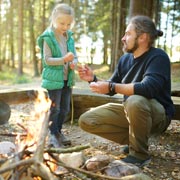 Surprise your little ones with a last-minute getaway. Editor’s note: My father did this for us a few times each year when my sister and I were children. He’d come home from work on a Friday evening and excitedly ask the family, “Who wants to go away for the weekend?” and my sister and I would shout, “We do!” with great gusto. We’d quickly pack, and off we’d go. By Friday night, we’d arrive at a campsite, or sometimes a random spot en route, and sleep like babies. After spending the weekend visiting our favourite places, we’d arrive back on Sunday night feeling like we’d been away for a week. Those are still some of my fondest childhood memories. And, it’s the kind of exciting last-minute break that doesn’t cost the Earth and is huge fun — something we could all do for our children occasionally, perhaps.
Garden Camping
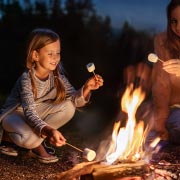
If going away for a last-minute short break is not feasible, camping in the garden may be the next best thing! Children’s imaginations are incredible; even if they’re camped in the garden, it’s every bit an adventure for them. You should sleep out there with little ones, of course, and supervise their safety and wellbeing. That can help it become more exciting for them, though, as you can supervise a small bonfire, perhaps, where you can all toast some marshmallows or bread, away from the tent (it could be flammable) and ensure it’s damped down afterwards for safety. Some torches, sleeping bags, packed sandwiches, and hot chocolate or similar in a flask will make the camp more realistic, but the house is always there if they get spooked and ask to go back indoors. Garden camping is also the perfect opportunity for our next activity idea…
Stargazing
 On a clear, cloudless night, stargazing somewhere away from neighbourhood lights will open children’s eyes to the magic of the nighttime sky. Even if you spend just 5 or 10 minutes together watching the night sky, you’re bound to bring out the wonder of space in your child’s mind. The Moon, twinkling stars, the little star tinged red (Mars), the pan-shaped form of the Plough (a.k.a. ‘Big Dipper’), and helping your child find the North Star are all things they’ll find fascinating and remember longer-term. Stay watching long enough for them to see little satellites marching their way across the darkness as they loop around the world, nowadays often in the company of others in a satellite ‘constellation’. Even better: help your child spot their first shooting star — and make a wish. Magical!
Discovering Their First Fossil
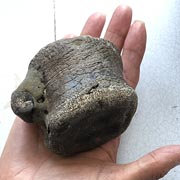 There are many places around England and the UK where fossils can be found if you/your children take the time to look for them. Children love it when they find them (as do many adults), and it’s always incredible to see their reactions when you tell them that this fossilised creature or plant they just found lived literally millions of years ago. It puts things into perspective and opens their eyes and minds to the wonders of Planet Earth and even life itself. Not only that, they have a magical keepsake to remind them of their fossil hunt(s). Try Googling good fossil-hunting locations near you, or visit this site and click a local region on the coloured map to get started. Parental supervision over children is, of course, essential at all times with all activities, especially for the youngest children and outdoors.
Nature Watching
 Children are naturally fascinated by the world around them — and especially the natural world. The UK is lucky to be a lush environment with lots of flourishing flora and fauna. So, for little ones, there is so much to see and discover. That’s one of the many reasons we will soon be providing Forest School sessions at Little Acorns Nursery in Hindley Green, in fact. It’s also why we’ve published various nature-based scavenger hunt activity ideas here on this website. So, another interesting, informative, educational, and memorable activity that will enrich your child’s childhood is a nature-based scavenger hunt. Check out our leaf hunt, spring nature hunt, winter treasure hunt, autumn nature hunt, or take them mammal-spotting, minibeast-spotting, bird-spotting, or butterfly-spotting. These activities are all designed for families, and each comes with a free reference poster to get children started. Perhaps spend a few hours with your child doing some of these next time the weather is suitable. They’re sure to remember them and think fondly of their time spent looking for all these magical things. Spending time in and around nature is also hugely beneficial to children, and it’s a great way for them to slow down, take in the beauty of nature away from electronic screens, and create high-quality family memories.
Bedtime Storytime
 Let’s not forget that magical memories can be made indoors, too! Reading books to children before they go to bed can build lasting memories. Editor’s note: My own children, now in their late twenties, still recall me reading to them every night, as we gradually worked through all the Harry Potter books. This was before they had started making the movies, and I made sure to put on different voices for different characters, whisper when there was a tense moment, or speak more urgently when Harry Potter was in mortal danger. They loved it! And now they’re parents themselves, they’re paying it forwards and reading books in a similar way for their own children. And, not only were those book-reading sessions “an integral part of their childhood” (they tell me), but they’re also incredibly good memories for me, as a parent. It really was magical on so many levels, so it is thoroughly recommended.
Music & Song
 Editor’s note: Another thing my own children remember fondly was singing songs each evening with me when they were very young. These were home-spun songs that we made up as we went along, sung together near bedtime most evenings, along with some basic guitar playing. It was both entertaining and amusing as we took it in turns to make up new, often silly, verses. What’s more, my children described it recently as a ‘free concert every night’, and it’s lovely that they remember it so clearly and fondly over two decades later. So, regularly playing musical instruments and singing together is highly recommended and highly creative for all parties. And, who knows where it could lead — a possible career in music, perhaps!
Magical Memories Are Like Gold Dust
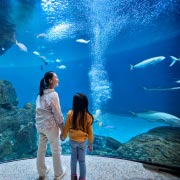 We hope you’ve enjoyed our ideas today for creating magical memories for your child. They’re just a starting point, though, to inspire new ideas for families. When high-quality memories are made, they can last a lifetime. Children may well look back on them as integral parts of their childhood, and instantly be transported back in time as they recall them. Such memories can bring togetherness, as well as a warm, fuzzy glow. What’s most important, though, is that the proactive creation of such memorable times lets children know that their happiness is important, they matter, are loved, and, all in all, it really is a wonderful world.
Welcome to Little Acorns Nursery, Hindley Green
High-Quality Childcare Provision Near Wigan

Little Acorns is a fabulous Nursery in Hindley Green, near Wigan. Providing high-quality weekday childcare, from 7:30 am to 6:00 pm over 51 weeks of the year, we represent a great choice for working families. What’s more, we support free childcare for eligible children. We’re also pleased to announce that we’ll soon also be providing Forest School sessions to children at the setting. These are hugely popular and allow children to get the most from close proximity to nature and woodland settings. We’ll soon publish more about Forest School at Hindley Green, here on the blog, so come back soon for our imminent announcement and more detail about this wonderful initiative.
Interested? Apply for a nursery place, ask any questions, or come for a guided visit using an option below:
Little Acorns Nursery is located in Hindley Green. And, if you live in Wigan, Bolton, Bickershaw, Leigh, Atherton, Westhoughton, Ince-in-Makerfield, Platt Bridge, Tyldesley, or Greater Manchester, Little Acorns may also be a very convenient choice for your childcare.
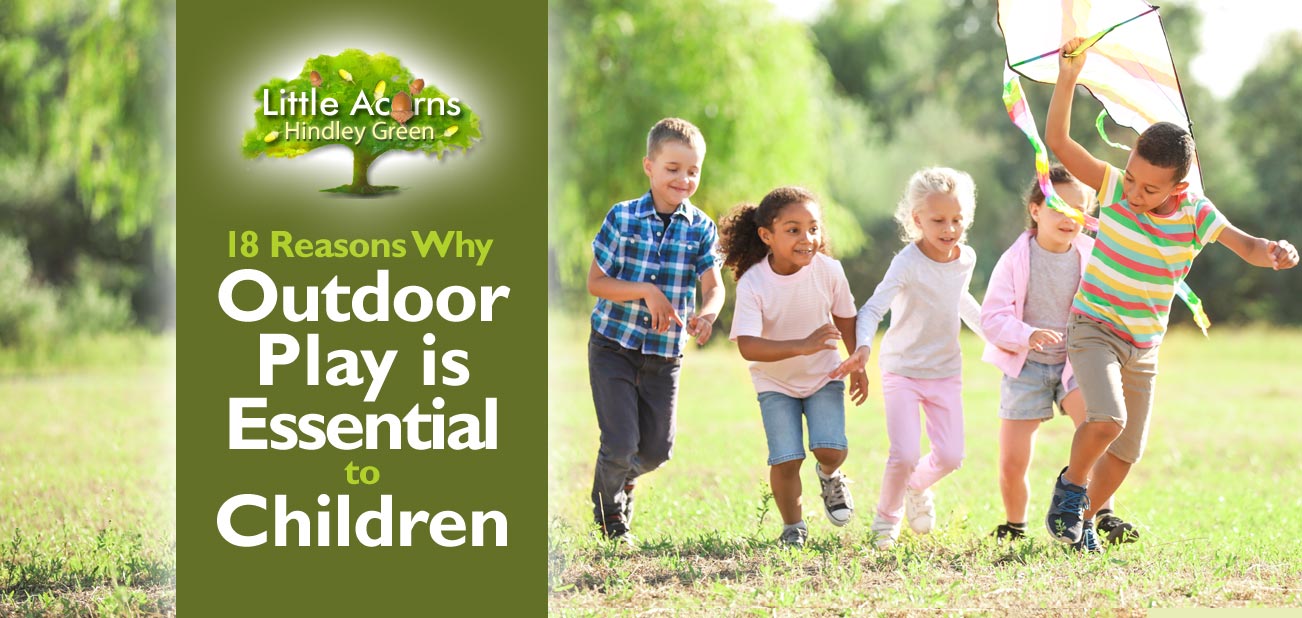
 Outdoor play is one of the truly magical elements of any healthy, fun-filled childhood. At the very least, it gives children the chance for some freedom, fresh air, and adventures that simply aren’t possible indoors. In today’s technological age of electronic screens, however, it’s also something that children have been doing less and less of over the generations. That’s a shame, when you think about it, not least because outdoor play is immense fun and incredibly beneficial to children. In light of this, today’s post explores 18 Reasons Why Outdoor Play is Essential to Children — of all ages. Take a look and see why outdoor play is so good for little ones.
 We mentioned it in our introduction — playing outdoors provides children with wonderful opportunities for real adventures! Whether it’s exploring The Great Outdoors on a family ramble, climbing on playground equipment with friends, embarking on a make-believe quest with the family dog, or making a den with siblings, there are no limits to what’s possible with outdoor play. Indeed, the adventures that are possible through outdoor play are only limited by a child’s imagination! Speaking of which…
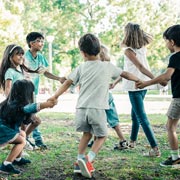 Let’s not forget, too, that playing outdoors is huge fun — and that’s important. Simply put, playing outdoors and giving children space to run around will make them happy. And there’s not much in life that’s more important than a child’s happiness — it’s an essential part of any magical childhood.
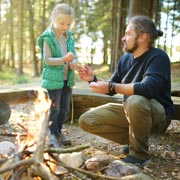 Outdoor play lends itself to the learning of new skills. With such a varied array of activities possible, children will naturally attempt new things, and each of these can be an opportunity to extend their skills. Physical skills might include tying knots, building dens with branches, playing ball games, climbing, racing, and so on. In addition, children will learn softer skills like teamwork, cooperation, strategy, critical thinking, leadership, and role play. What’s more, all of this will happen instinctively — such is the power of outdoor play.
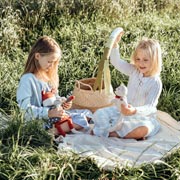 Children who regularly play outdoors will inevitably meet other children and encounter new dynamics. These will help them make new social connections, and immersive activities will deepen existing friendships. Playing outdoors is a great way, therefore, to strengthen and extend a child’s social circle, and boost social skills like teamwork, leadership, cooperation, brain storming, and so on.
 The often high-octane activities associated with outdoor play will also help children boost strength, fitness, motor, and coordination skills. By exposing themselves to different terrains, environments, tasks, games, and equipment outdoors, they will increase the variety of motor skills they need to accomplish activities. Running, jumping, hopping, constructing, chasing, and climbing will all help improve them physically, in so many ways that may not be possible indoors. What’s more, such things will help children protect themselves from harm, as well as empower them physically.
 Playing outdoors, with adult oversight, is the perfect opportunity for children to begin learning how to assess risk. Whether it’s safely navigating outdoor play equipment, stepping over undulating ground, climbing a tree, or playing fast-paced ball games, children will soon learn when and how they need to assess possible risks. It’s a skill that, once learned, will keep them safer from harm, so is incredibly important.
 All these new skills and enhancements make under-5s well-equipped when the time comes to leave preschool and begin school. Through outdoor play, they’ll have greater independence, confidence, communication and social skills, and physical skills, to name just a few. What a great way to help them hit the ground running from the moment they begin school!
 All in all, outdoor play prepares children for life. Through greater independence, better confidence, raised self-esteem, and new tools, skills and knowledge at their disposal, children can go forward with new vigour and thrive. Such is the power of outdoor play.
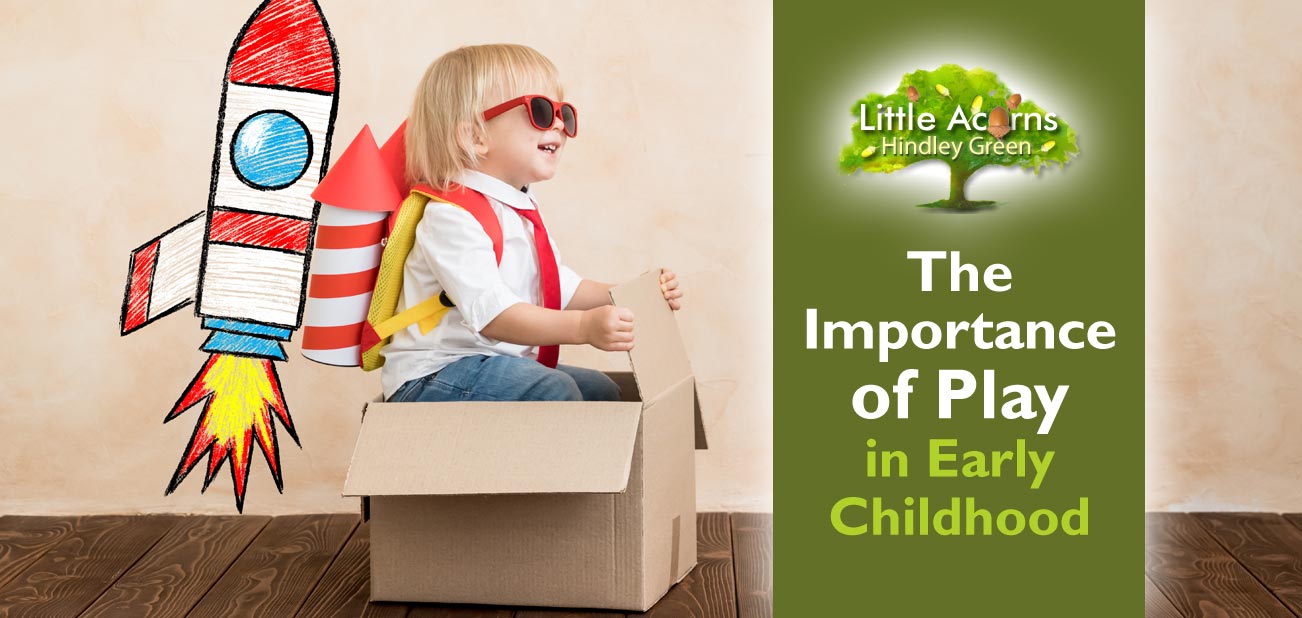
 One of the most widely accepted truths among professionals involved in ‘early years’ education is that play is incredibly important to children. That’s not just because it comes naturally to them and is fun; play is the key tool through which children learn about themselves, each other, and the world around them. Indeed, the act of playing benefits children in a wide array of profoundly beneficial ways, including socially, mentally, physically, and emotionally. With that in mind, today’s post highlights some of the many benefits of play to children, particularly in their early years. So, if you have a child under five, take a look and you’ll soon see why encouraging your little one to play in a variety of ways will bring out the very best in them and help set them up for life.
 One of the most obvious things about children’s play is that often it gets them exerting themselves physically, as they run, climb, jump, make, create, and construct. Such activities help them to master gross and fine motor skills, balance, movement, and coordination. All such skills are enhanced significantly through play and are a fundamental building block of children’s development.
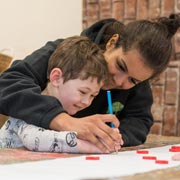 Right from an early age, the act of playing helps in the development of young minds and even contributes to the rapid growth of new connections in the brain. This is true even for babies, whose key tool to learn about the world is through play, as they explore with their senses as well as by reaching out to grasp toys and objects around them.
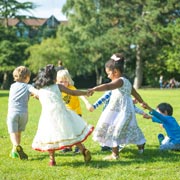 Whether playing with peers or with parents, the need to gradually master communication and language is imperative. Play helps that to happen in the most natural of ways. All the time they’re playing, children are naturally communicating, picking up new vocabulary, learning new phrases, getting to grips with grammar, and so on. Play is indeed a wonderful facilitator of communication and language.
 Playing is an integral part of every happy childhood. It’s fun and, put simply, makes children happy. That’s wonderful for children’s emotional and spiritual well-being and the importance of that cannot be overstated.
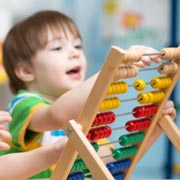 As we have seen in this article, play benefits children in a completely holistic way. Play enhances their lives through a multitude of benefits that include improved skills and abilities, a deeper understanding of the world and society, solid friendships and the myriad of opportunities that all of that will bring. Play also fosters a deeper love of learning, because play makes learning enjoyable. Indeed, through play, children explore, discover, and learn instinctively — with zero ‘friction’. As such, play should be at the very core of every child’s learning and development journey.
 Settings like