
Parents: How to Boost Your Child’s Success
Did you know that children are significantly more successful if their parents* are actively involved in their education? It’s proven too; study after study concludes that parental involvement in a child’s education boosts their achievements and outcomes enormously.  What’s more, the boost in the child’s success is clear to see at all stages — in the short term, medium term and long term — right into adulthood. When parents are actively involved in a child’s education, that child will do better at nursery and pre-school, achieve better grades at school and go on to have more success in higher education and, ultimately, in their careers. It’s incredible, therefore, just how powerful proactive parental involvement in a child’s education can be. Let’s take a closer look at the findings.
What Did the Studies Say About Parental Involvement in Education?
There have been many studies into the role of parents in children’s education and they reach the same kinds of conclusions. We highlight some of the key findings to illustrate the point …
 There are lots of free or assisted funding schemes for childcare and these are especially useful to parents looking to keep childcare costs down. With increased inflation and the cost of living crisis in Britain, such schemes have probably never been more welcome. Today we’ll take a condensed look at the main childcare funding options available to parents, particularly those of children under five, although many schemes also help children substantially older.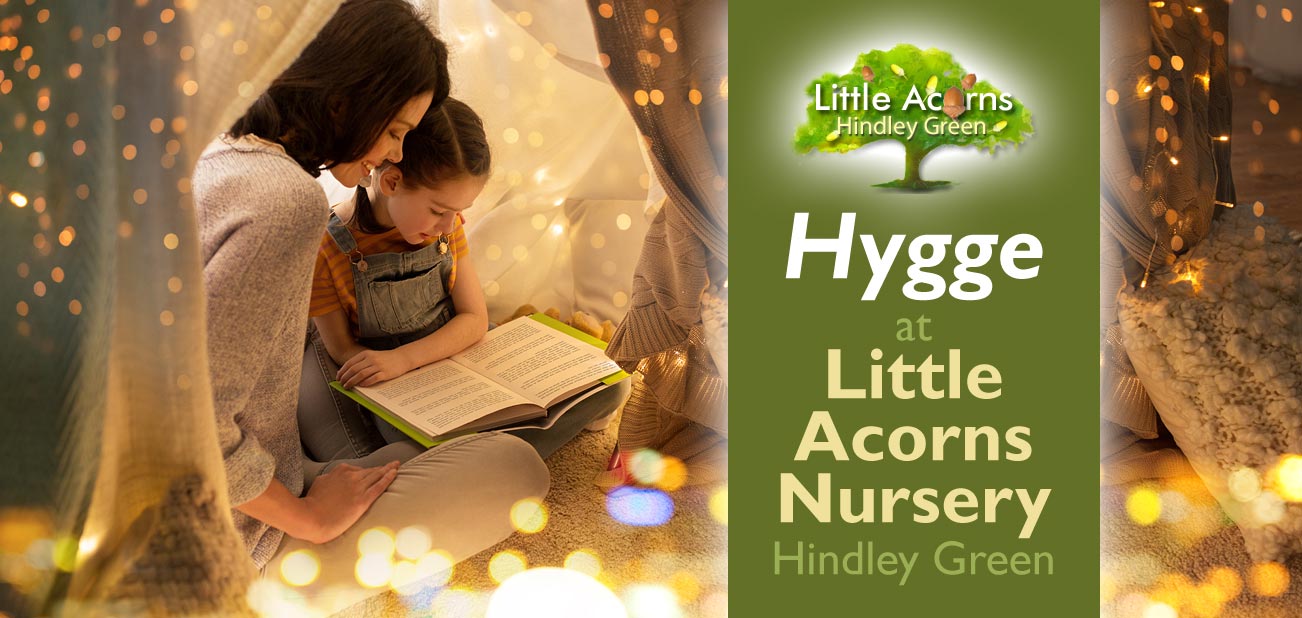
 At Little Acorns Nursery in Hindley Green, we’re embracing Hygge (pronounced “Hue-gah”), which is becoming very popular around the globe. But what is Hygge and why are we embracing it? This article explains everything and you’ll soon see why Hygge is a very good thing for everyone at the nursery, including both children and staff. Take a look …
 Hygge has been described as resulting in “comfortable conviviality” i.e. friendliness and warmth that makes everyone feel welcome and happy. It’s also been described as “the pursuit of everyday happiness … basically like a hug, just without the physical touch.”
 There will be twinkly ‘mood’ lighting instead of harsh fluorescent lighting. Rooms will have real plants that bring nature indoors, natural materials and objects like wood, wicker, pine cones and pebbles. There will be calming music and perhaps even scent in the air. There will be cosy corners, dens and even teepees where children can ‘nest’ while they read, play or converse. Hygge gives a room a lovely atmosphere, often with flickering candles (or, at the nursery, the warm-coloured LED equivalents, for safety purposes).

