 With free tutorials available on YouTube and inexpensive instruments available in charity shops, phone apps and online marketplaces, there has never been a better time for children to start learning a musical instrument. It’s something for every parent to consider because such a pastime will benefit their child in an incredible variety of ways. Not only will they learn a new skill that will stay with them for life, but their lives will be enriched in many additional ways too. So, today, we take a look at the often profound benefits of learning a musical instrument, especially for young children. We’ll start with the three most obvious benefits before coming to many others that may surprise you.
Playing Music is Great Fun
Firstly, let’s not forget the obvious: learning to play a musical instrument can be great fun. It’ll give children hours of entertainment and sensory enrichment. That’s a good enough reason to learn to play music all on its own!
More Opportunities
The ability to play music is also a skill that often stays with children for life. So, once they grow older, the skill may well lead to participation in bands, orchestras, theatrical performances or even a career in entertainment. Composers, stars of the screen, pop stars and theatrical entertainers all started somewhere. Indeed, many such careers will have roots in having learnt to play a musical instrument as a child.
Boosted Coordination & Fine Motor Skills
 Playing all these notes in a certain order, sometimes in isolation and at other times as chords and progressions, will do wonders for a child’s coordination and fine motor skills. Although perhaps tricky at first, with practice and ‘muscle memory’, children’s ability to master the playing of musical sequences, chords, melodies and rhythms will gradually become easier and easier. Before long, it’ll become second nature to them.
As well as those very obvious benefits to learning to play a musical instrument, children will benefit in other, perhaps less obvious, ways. We’ll take a look at those next.
Enhanced Maths Skills
Music, the structure of songs and rhythm are all rooted in mathematics. So, when learning to play music, children will give their brains a maths workout, ensuring that note length, tempo and rhythm all sound correct and combine correctly. It’s also a great way for children to learn real-world applications of things like fractions (for example, half notes, quarter notes, double note length and so on). At the same time, each musical bar usually remains the same length overall. There’s real-world addition in practice for you!
Enhanced Reading Skills
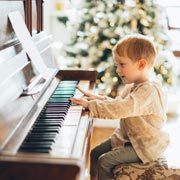 In a similar way, children who learn a musical instrument will usually, of course, also be learning to read printed music. While this comes in different forms, it all encourages children to concentrate on the reading process. Specifically, they’re learning to read from left to right, to analyse the printed music detail and to make sense of it. It’s another great workout for the brain, and we’ll say more about that next.
“…there is little doubt that regular exposure to music, and especially active participation in music, may stimulate development of many different areas of the brain. Takako Fujioka and her colleagues, for example, looking at children with a single year of violin training (compared to children with no training), recorded striking changes in activity in the brain’s left hemisphere. In terms of brain development, musical performance is every bit as important educationally as reading or writing.” (Oliver Sacks, Neurologist & Writer)
Boosted Cognitive Function
All this attention to detail, concentrated effort and intricate movement will also have a profound effect on the child’s developing brain. Reading and playing music is a complete, cognitive workout that’ll deeply exercise the brain, in particular boosting the development of the left side. This will spark the generation of millions of new neural connections, or ‘brain synapses’, which will permanently empower the child going forwards. With the left part of the brain also influencing skills like language and reasoning, these are also going to be boosted.
“Research shows that at least some musical education has a positive impact on [the] social and cognitive development of children. And these effects are long-lasting – better hearing, better motor skills, improved memory, better verbal and literacy skills.” (Alan Harvey, Musician and Neuroscientist)
A Boost for Social Skills
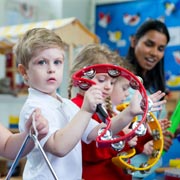 Playing a musical instrument often goes hand-in-hand with collaboration. Whether it’s forming a band, taking part in a school orchestra, writing songs with friends or simply jamming out together, children of all ages will naturally play together given the opportunity. As such, it’s a natural socialiser and one that brings children of different ages together, with new friendships being formed through a common interest. That is a very healthy thing. It also teaches children a wide variety of social skills including communication (e.g. speaking and listening at appropriate times), collaboration, being mindful of the needs of others, waiting your turn and so on.
Creative Self-Expression
Playing a musical instrument is a wonderful outlet for children’s creativity. Give them just about any instrument and they’re sure to express themselves in some way. Their musical or rhythmic expression is also likely to vary depending upon the instrument being played, showing just how powerful a tool it is. Playing an instrument opens up all kinds of creative possibilities to children and they can experiment however they choose. It can also lift their mood or give them the means to express it. Creating music is hugely empowering.
Greater Self-Confidence
With abundant new skills and even new friendships forming because of their musical endeavours, children will naturally get a healthy boost of confidence. Praise and encouragement from adults and peers around them will naturally help boost their self-esteem too. That’s important, especially when they’re very young and unsure of themselves and their place in the world.
Improved Listening Skills
When children learn to play music on a musical instrument, they learn quickly the importance of listening intently at the right time. Through attentive listening, children will learn to compute and formulate the appropriate response to important information, instructions and requests. This is an essential skill and one that will benefit them at home, in nursery, preschool, at school and ultimately in the workplace. Indeed, knowing when to be quiet and listen is one of the key skills of any good consultant!
Enhanced Well-Being
 Music itself is also a great antidote to stress and other emotions. Giving children the tools to appreciate music — and even involve themselves in it — will help with their mental well-being as it can calm them when they’re stressed, relax them when they’re tired or even give them an energy boost when they need to get active. Ask any runner! All they need is the right piece of music and half the mental battle is already complete.
Insights into Different Cultures
Music is the common language of the whole world and, as such, is a great bridge between different cultures. Hearing and playing different types of music, from different cultures, countries and even eras will give children an insight into those other people, places and beliefs. Different music genres (rock, blues, pop, etc.) will also be something they’ll find interesting as they grow older, teaching them even more about their own country. For example, the music history of Britain has been hugely influential over the fashion and culture of the nation and this influence is integral to our identity in the world — amazing when you think about it.
The Teaching of Life Lessons
Through learning to play a musical instrument, children learn so many important life lessons; the importance of persistence, for example, and the value of trial and error. Children learn about teamwork, leadership, critical thinking, collaboration and so much more. The following quotation brings the value of this into perspective:
“The things I learned from my experience in music in school are discipline, perseverance, dependability, composure, courage and pride in results… Not a bad preparation for the workforce!” (Gregory Anrig, President, Educational Testing Service)
It Supports Children’s Education
With all of the above benefits, learning to play a musical instrument is clearly going to help many areas of children’s education. For the youngest, all 7 key areas of the Early Years Foundation Stage (EYFS) curriculum will be supported through musical endeavours. For example, it’ll help boost creativity, communication, language, reading, maths, social development, personal development, physical coordination and so much more. This can only stand them in good stead as they progress from nursery, through preschool, into school and beyond. It’s amazing when you take a closer look like we have done today.
Starting Children Young
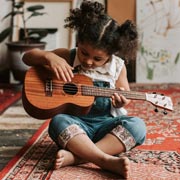
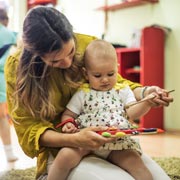 With all these benefits, it’s highly worthwhile for children to start learning a musical instrument as young as possible. It’s easy to start them, for example with simple instruments like drums, triangles, and tambourines initially. With these simple instruments, very young children can learn to keep time to music or a beat a rhythm demonstrated by adults. They can then progress to more advanced instruments such as recorders, keyboards, and stringed instruments. They have to start somewhere, though, but it’s never too early to start! Mozart was just 3 when he began to learn piano playing. By 5 he had composed a whole concerto! Who knows; perhaps your child could be a star in the making!
Your Nursery & Preschool in Hindley Green, near Wigan
 If you have a child under five and require weekday childcare in the Hindley Green area near Wigan, do consider Little Acorns Nursery. We give babies and under-fives the very best start in life. At Little Acorns, they’ll receive a wonderful early years education and a personalised learning and development programme that includes sensory and creative activities through music and rhythm. It’s a wonderful, safe, loving, home-from-home environment for little ones too. We also support a wide range of childcare funding options for those that are eligible. Get in touch to register your child for a place, arrange a guided tour or simply ask a question. We’ll be happy to assist.
Little Acorns is a wonderful nursery & preschool in Hindley Green near Wigan. We’re also suitably close to those in Bickershaw, Leigh, Atherton, Westhoughton, Ince-in-Makerfield, Platt Bridge, Tyldesley, Bolton and Greater Manchester.
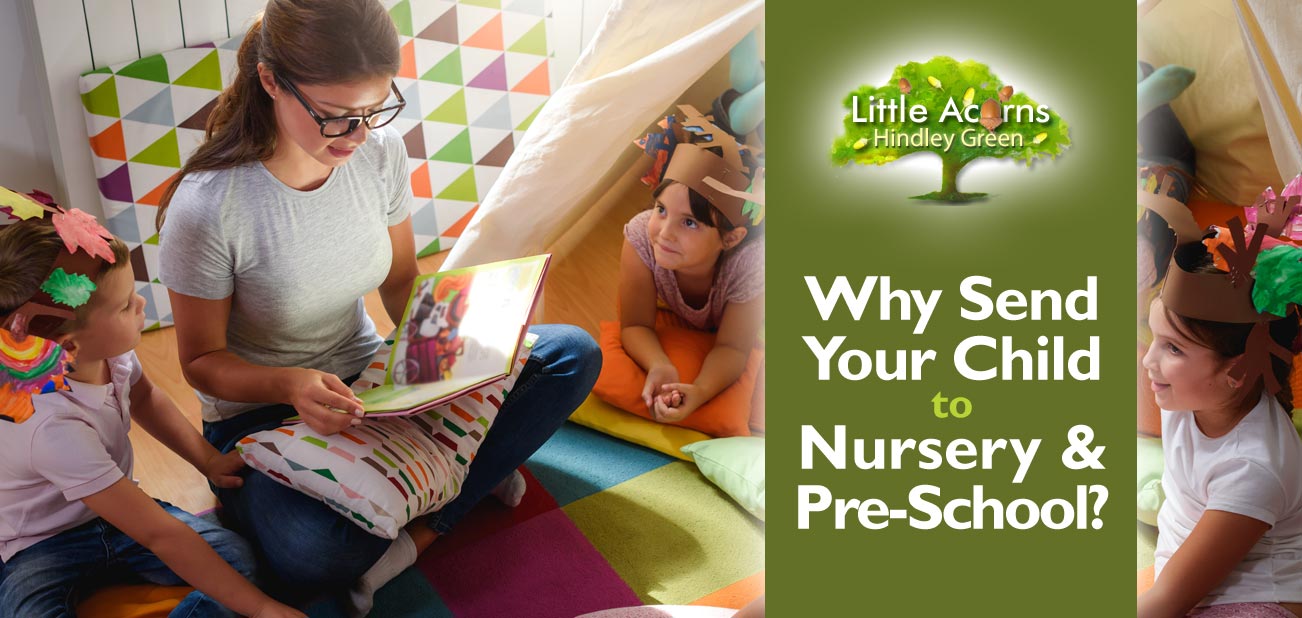
 Some may be surprised to learn that nurseries/pre-schools like Little Acorns are not simply “childcare services”. We’re way more than just a crèche, playgroup or a group of nannies or childminders. In reality, our services extend way beyond simply looking after children while parents go to work, although of course we do that too. The truth is that we benefit little ones and their families in a whole range of additional, often profound, ways and that’s what we look at today.
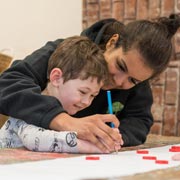 First of all, a Key Person will be allocated to your child on Day 1 when they start at the nursery. The Key Person is a childcare professional that will look out for the child’s wellbeing in all manner of different ways. One of the most important is in the monitoring of the little one’s progress in terms of learning and development. From the day they help to settle the child into the nursery to the day they leave for school, the child’s Key Person will be there to ensure that all the child’s individual needs are being met and that they are fulfilling their fullest potential in every area. Part of that will be the oversight of the bespoke early years education programme, which we’ll come to next.
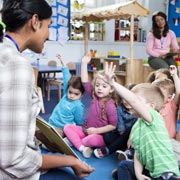 At Little Acorns Nursery, a bespoke early years learning and development programme will be designed and implemented to suit the strengths and any challenges for each individual child. This is orchestrated by the child’s Key Person and nursery staff and, where needed, through cooperation with any external professionals, e.g. for children that have any special educational or developmental needs. The learning and development programme is tailored to them and them only. Using this approach bolsters the child’s stronger areas, so they can be further strengthened, and addresses any weaker areas that may require extra focus. It is also adapted as time goes by, as progress is made by the child. In this way, every child gets to achieve personal bests and optimal outcomes in every area of their learning and development.
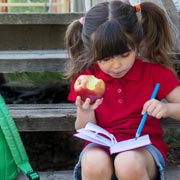 All of this nurturing, education and facilitation of their personal development does one other crucial thing too; it sets them up well for when they leave us around the age of five to start at primary school. By giving them the skills and tools they will need in every area, they are in a better position to absolutely thrive once they start school, right from day one. Indeed, many studies have shown that children who receive a good early years education go on to be higher achievers both at school and in their working lives. That’s gold dust, right there. Let’s take a closer look …
 ‘Hygge’, pronounced ‘Hue-gah’, is another exciting initiative happening at Little Acorns Nursery in Hindley Green. If you’ve not heard of it, rest assured that it’s something that children will absolutely love and will benefit them in many ways. It’s also something that we’ll be pioneering in the area, so you may not find it in other nurseries and pre-schools around Wigan right now.
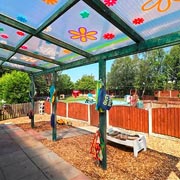 Everything at Little Acorns Nursery is there for a reason. It’s all been carefully brainstormed, pre-planned and implemented with utmost care. Whether it’s the introduction of Hygge, the addition of a new piece of equipment, or the purchasing of a specific toy or learning device, everything at Little Acorns has a purpose and is there to benefit the children.
 Parents of children at Little Acorns Nursery also give us great feedback about the wonderful childcare provision at the setting. Browse the site for full examples of parent feedback received (it’s scattered around the site) but, to give you a taster, comments include, “My girls absolutely adore this nursery but most of all they adore the staff”, “thank-you for the bottom of my heart for what you have done for my girls”, “I couldn’t recommend this nursery enough, they care and love the children like their own and I couldn’t of ever felt more comfortable leaving my children with a nicer set of girls.”, “I would not hesitate to recommend this nursery to anyone!”, “You should all be very proud of the work you do. It really means so much to us every time we see those small steps forward and we appreciate it.”, and “If I ever had any more children, without a doubt they will be coming to this nursery even if I moved 500 miles away!”.
 Parents* of under-fives may have heard nurseries, pre-schools, childcare professionals and other parents referring to “the EYFS”. However, what is it, and how does it affect your children? Well,
  For early years practitioners in England, following the EYFS framework is not optional. It is actually enshrined in law in England, via Section 39 of the Childcare Act 2006, so is an important and binding entity. (Other parts of the UK have similar equivalents).
 Ensuring high levels of safeguarding, welfare and happiness for every child at an early years setting;
 Communication and Language;
 As they work towards their individual goals, assessments will be made, for each child, on a continuous basis. By assessing the children, the learning and development programme and the goals themselves can be tailored and fine-tuned along the way, as required. This will optimise each child’s progress and achievements.
 Ensure those who have access to children are suitable, safe, pre-vetted people;

