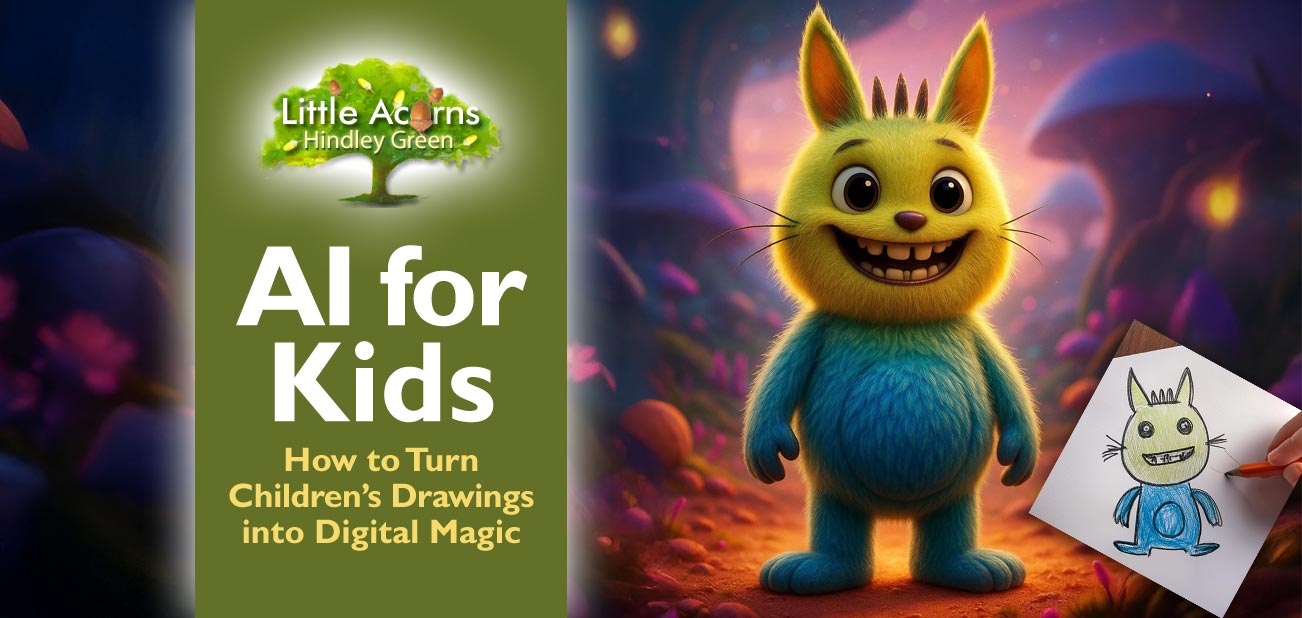
 Even the youngest children have an incredible gift for imagination. Give them a handful of crayons and a sheet of paper, and, in no time at all, they’ll have created charming drawings that will delight. You’ll be introduced to colourful monsters, kindly robots, prancing unicorns, and pets reimagined. They may also depict family members, perhaps holding hands outside a home surrounded by flowers and love hearts. Each drawing tells a story and gives insights into how they see the world. Now, thanks to Artificial Intelligence (AI), families can bring those stories to life in a simple yet magical way. What’s more, it’s incredibly good fun and the results can be astounding!
Of course, not everyone feels instantly comfortable with the idea of AI, particularly when it comes to young children. Some parents may be uncertain about whether it’s appropriate or necessary for their little ones to use such technology at all. But AI is already part of daily life — and it’s a simple fact that our children will grow up surrounded by it. That’s why it’s far better for parents to be the ones to introduce it, in a safe, creative, and responsible way. Used thoughtfully, AI can become a wonderful way to explore ideas together, igniting children’s imaginations rather than limiting them.
With that in mind, today’s simple home activity helps children see how creativity and technology can work together, showing them that AI can be a tool for art, discovery, and fun — guided, of course, by their parents.
How to Try the Activity at Home
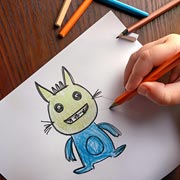 This activity works best as a family project. Begin by letting your child create a drawing — anything they like, from a friendly monster to a robot, a pet dragon, or a family picnic on the moon. Encourage them to use lots of colour and detail, then take a clear photo of the finished drawing — a smartphone’s camera is usually perfect for the task.
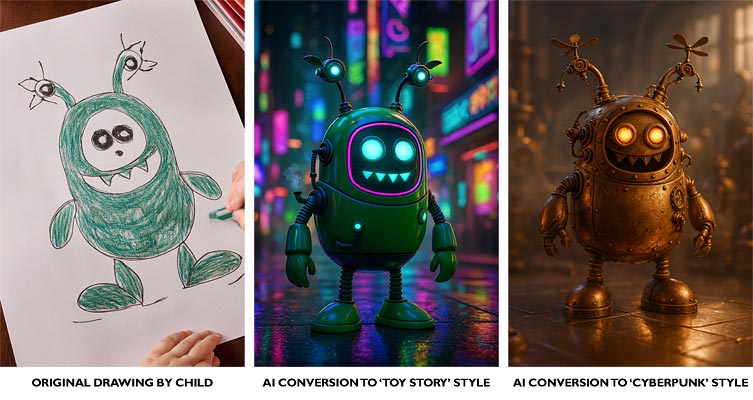
Parents can then upload the image to an AI tool*, for example, ChatGPT, CoPilot, Gemini, or DALL-E, then type a simple instruction. For example: “Please turn this child’s drawing of an alien monster into a Pixar-style character with bright colours, soft fur, and a background that depicts a fantasy alien landscape which complements the design.” 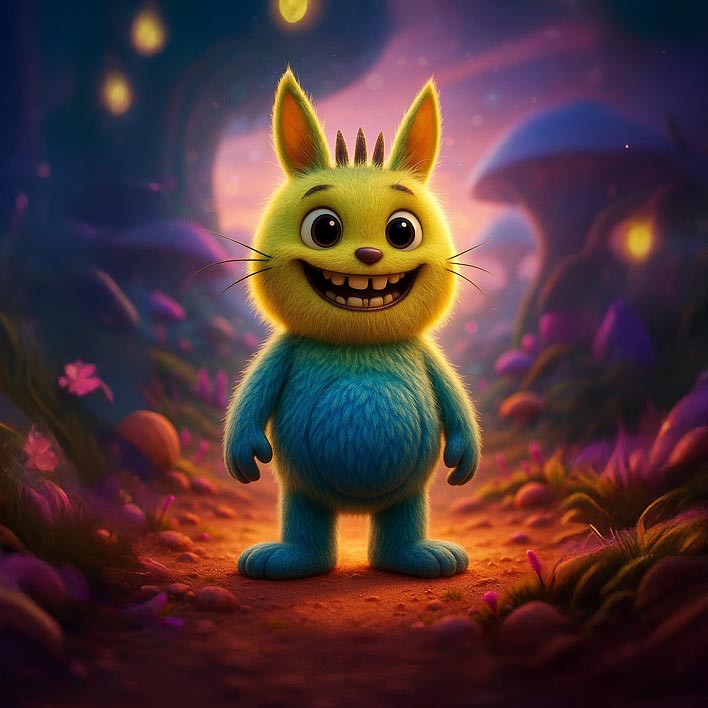 Within a few moments, the AI tool will generate a new image that’s 100% inspired by the child’s original artwork. Given the right instructions — highly-detailed specifics work best — the result will be an incredibly professional-looking version that keeps the child’s original creation at its heart.
The best part comes next: viewing the result together. Children love comparing the two versions, pointing out the similarities and differences, and describing what they see. It’s a wonderful opportunity to talk about shapes, colours, textures, and even emotions, encouraging rich language and communication. It’s also a fabulous way to encourage children to think about the small details when they draw or create. AI will usually pick up on these, often resulting in outcomes that will delight and often amuse. Click the fluffy alien image (above/right) for a larger view, or see this post’s top image.
Ideas to Inspire Children’s Imagination
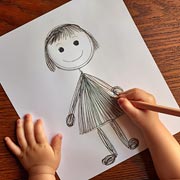 Some children know exactly what they want to draw, while others may need a starting point. You might suggest a dancing robot covered in buttons, a dragon who lives under the nursery slide, or a family of aliens enjoying tea on the moon.
 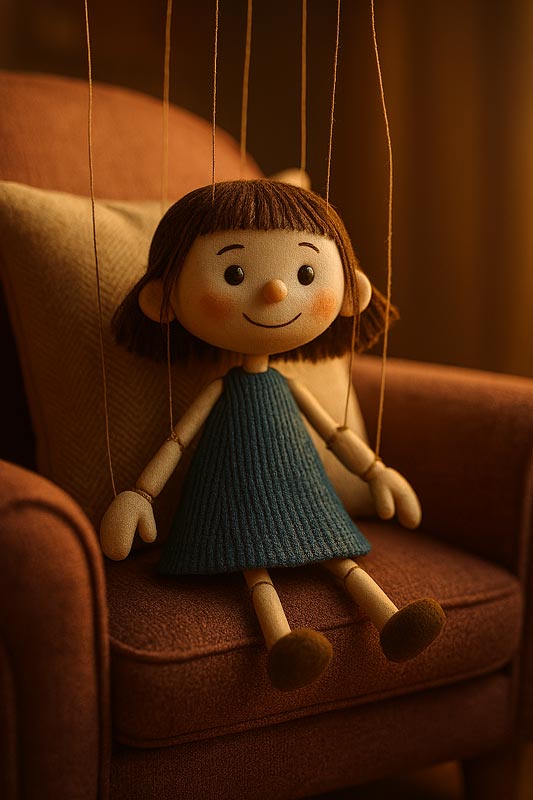 Perhaps they’d like to reimagine your family pet as a superhero, or picture your home as a castle or rocket ship.
Once the AI version appears, you can build on it by giving the new character a name or inventing a story about their adventures. This turns a single drawing into a wider learning experience that blends art, storytelling, and technology in one. Our accompanying example depicts the child’s simple drawing of a girl reimagined as a puppet.
Why Introduce AI at an Early Age?
Today’s children are growing up in a world shaped by technology. From a tablet used for songs and stories to the smart speaker that answers questions, AI is already quietly present all around our little ones. Introducing it proactively through a playful, artistic activity will help children see technology not as something mysterious or purely functional, but as a creative companion that can bring their own ideas to life.
AI can be a creative companion that can bring children’s own ideas to life.
When a child draws something from their imagination and then watches that drawing transformed into a detailed, lifelike image, it helps them understand that their ideas have power and influence. It’s also a gentle way to begin exploring important early skills such as curiosity, problem-solving, and communication.
This kind of creative exploration connects beautifully with the Early Years Foundation Stage (EYFS), especially within the areas of Expressive Arts and Design, Understanding the World, and Communication and Language. It’s learning through play at its best — imaginative, exciting, and entirely child-led.
What Children Learn Along the Way
Although it may feel like simple fun, this activity quietly nurtures a range of valuable early learning skills. Children’s creativity and imagination flourish as they see their original drawings reinterpreted in vivid new ways. Talking about the process helps develop language and vocabulary — for example, they might describe shiny metal, soft fur, sparkly eyes, or colourful rainbow wings.
“AI becomes something that helps them explore and represent their ideas, not something that replaces them.”
Through this kind of activity, they will also begin to understand the role of digital tools in creative expression. AI becomes something that helps them explore and represent their ideas, not something that replaces them. For many children, seeing their work ‘come to life’ also boosts confidence and nurtures a sense of pride. And for parents, it’s a wonderful opportunity to connect, collaborate, and share in the excitement of discovery. For them, too, it may represent a simple, yet powerful, way to begin using AI — and one that’ll delight and surprise them as much as it will a child. Have a go — honestly, it’s huge fun!
Keeping It Safe and Supportive
Because AI tools involve uploading images, this should always be an adult-led activity. Parents should handle the photographing and uploading, and guide children through the results. It’s best to avoid sharing personal details or identifiable features — the focus should stay firmly on the drawing itself.
It’s also helpful to remind children that AI doesn’t always get things right. Sometimes it adds unexpected details or interprets shapes differently. Rather than seeing this as a mistake, treat it as a chance to laugh, guess, and imagine what might have happened. After all, creative surprises are part of what makes learning enjoyable.
Extending the Experience
 Once you’ve created your child’s AI-enhanced image, there are plenty of ways to keep the creativity flowing. You might print both versions and frame them together, start a digital scrapbook of your child’s art, or create a picture book where each page features one of their AI-inspired characters.
 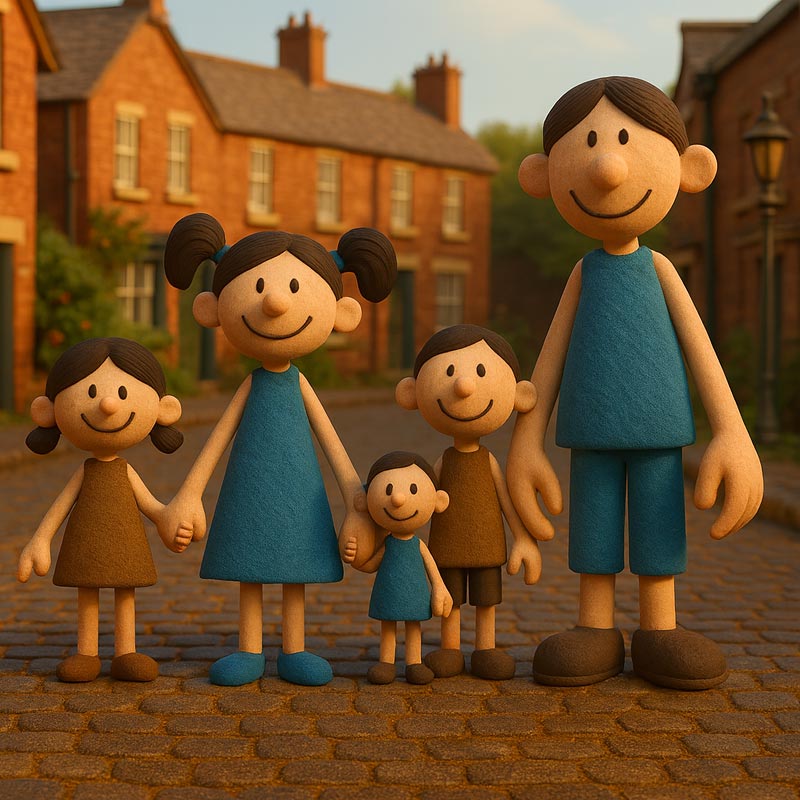 The whole family will love these! And, if your nursery welcomes family projects, you could even share some of the images to show how home learning links with classroom creativity.
Encouraging children to describe their pictures, retell stories about their characters, or dream up sequels helps deepen the learning experience while keeping it playful and imaginative.
Looking Ahead
Today’s toddlers will grow up in a world where AI is as normal as the internet or mobile phones are for adults today. By introducing it early in a positive, creative way, parents can help children see it as something friendly and inspiring rather than soulless or intimidating. Learning about technology doesn’t have to mean staring at screens — in this case, the technology simply amplifies a child’s original drawing, using imagination as the true starting point.
“The technology simply amplifies a child’s original drawing, using imagination as the true starting point.”
AI will no doubt play a big role in the world our children inherit. Helping them approach it with curiosity, creativity, and confidence is one of the best gifts we can offer.
So, next time your little one proudly brings you a drawing of a monster, a robot, or a rainbow house, why not explore what happens when you let a touch of AI join the fun? You might both be surprised — and delighted — by what imagination and technology can create together.
“Today’s little artists and inventors will grow up in a world where imagination and technology work hand in hand — and that’s a future worth celebrating.”
Nursery Places at Little Acorns, Hindley Green, Wigan

At Little Acorns Nursery in Hindley Green, we love to see how imagination flourishes in our little ones. Whether children are exploring paint, building blocks, stories, or digital tools, their creativity is always a key element of their learning — and we celebrate it.
Little Acorns invites families to consider a nursery place at this Hindley Green setting near Wigan. We provide high-quality childcare for babies and children up to the age of five, and support funded childcare places for eligible families. Get in touch today to arrange a guided visit, ask a question, or enrol your child for a place — we look forward to meeting you!
We are a nursery in Hindley Green, Wigan, near Bolton, Ince-in-Makerfield, Platt Bridge, Westhoughton, Atherton, Leigh, Bickershaw, and Tyldesley.
* We have used ChatGPT and CoPilot for our image examples. Free yet powerful versions of these and other AI applications are available on the Internet as well as via its smartphone app. Note that some AI tools and packages may limit the number of uploads and renders to a specific number per hour or day. A paid upgrade is an option if you reach your limit and want to upload more images to transform.
 Following May’s
  Children will need some leaves for these ‘leaf art’ activities. We suggest they collect a wide selection of shapes, sizes, and varieties, so they have the flexibility to undertake any of the leaf art activities below. Our
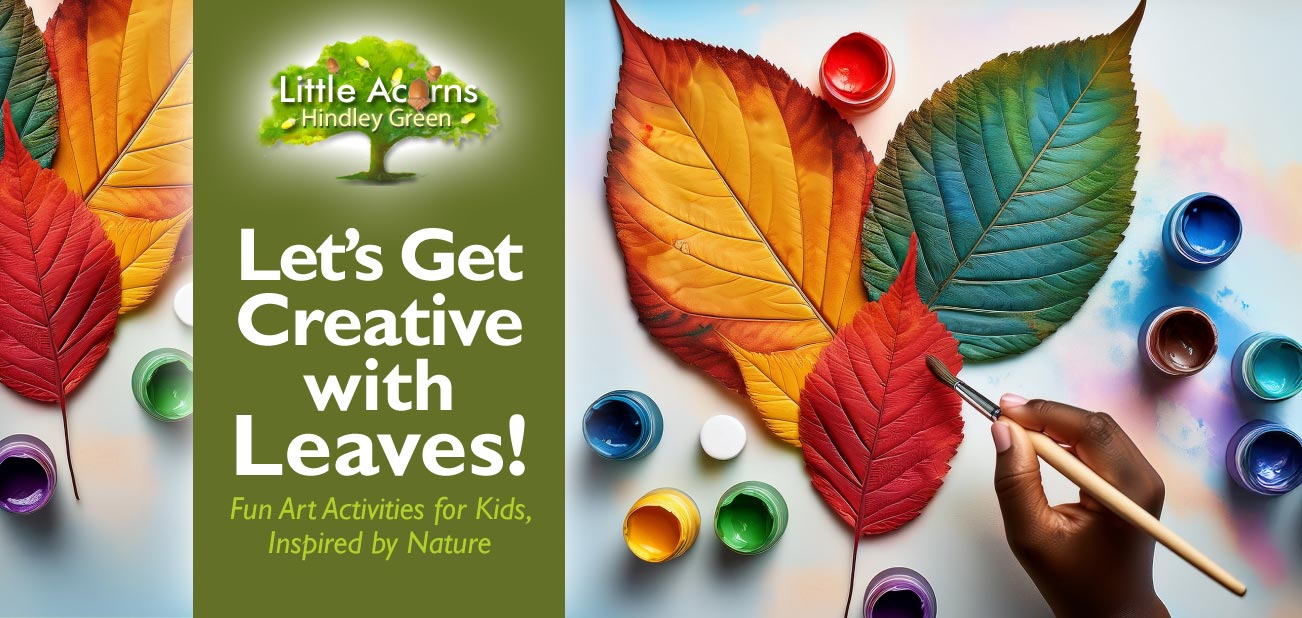
  Whether fresh, dried, or pressed (see below), leaf collages can be used to make wonderful pictures and designs. With a little imagination, leaves can suddenly resemble little trees and landscapes, or be combined into formations that depict a flower head or a graphical design. The accompanying images show a couple of examples to get children’s creative juices flowing.
 One of the most straightforward creative activities with leaves is simply to paint and decorate them with coloured paints. Doing so can create highly attractive groups of leaves that are fun and cheerful to look at. Experiment with flat colours or more intricate decorations such as polka dots, stripes, stars, or zigzags. Glue the finished leaves to paper or card once dry to use them as part of a leaf collage (see above).
 Leaves and small flowers can be dried, flattened, and kept longer by pressing them. Once pressed and dried, they’re like little works of art in themselves and are quite delightful. They can be kept as bookmarks or keepsakes, or used as art and collage components for some of the other leaf activities outlined today.
 Leaf rubbing is a simple yet effective art activity involving leaves. First, simply place a leaf under a sheet of fairly thin paper. Holding the paper still with one hand, children should use their writing hand to rub a crayon, pastel, charcoal stick, or soft pencil lead over the area where the leaf sits, scribbling from left to right in closely aligned lines. A ‘picture’ of the underlying leaf will gradually appear!
 Leaf printing is super-easy and fun for little ones. Find a suitable leaf and, using a broad brush or — better still — paint roller, paint the most textured side of a leaf with a thin layer of paint, ensuring it covers the whole side of the leaf. Then, while the paint is still wet, place the painted side carefully over a sheet of blank paper. Without moving its position, press all parts of the leaf down so the paint makes contact with the underlying paper. Another way to accomplish this is to use a clean roller to ‘roll’ over the leaf so it connects the paint with the paper. Carefully remove the leaf and — hey presto — you should have an image of the leaf structure and texture right there on the paper. Try different leaves, various colours, and overlapping experiments to accomplish different outcomes.
 Instead of painting or using leaves directly, children can also try to depict them with their own paintings and drawings. These are a good way to encourage children to focus on getting the shape and details correct, fine-tune hand-eye coordination, and bolster technical mark-making skills. And, because children are free to paint or draw however they like, they can let their imaginations run riot and perhaps invent their own leaf shapes, leaf patterns, and natural worlds on paper.
 Children can use some of the creative skills they’ve learnt in the activities above to make greeting cards that feature their leaf art. For example, they can forage for heart-shaped leaves and paint them cerise pink to use as part of a simple Valentine’s Day or Mother’s Day greeting card. More general greeting cards for other special occasions can also be accomplished using leaves and dried flowers — for example, arranged to depict a leaf or dried ‘bouquet’ on a card sent for a birthday.
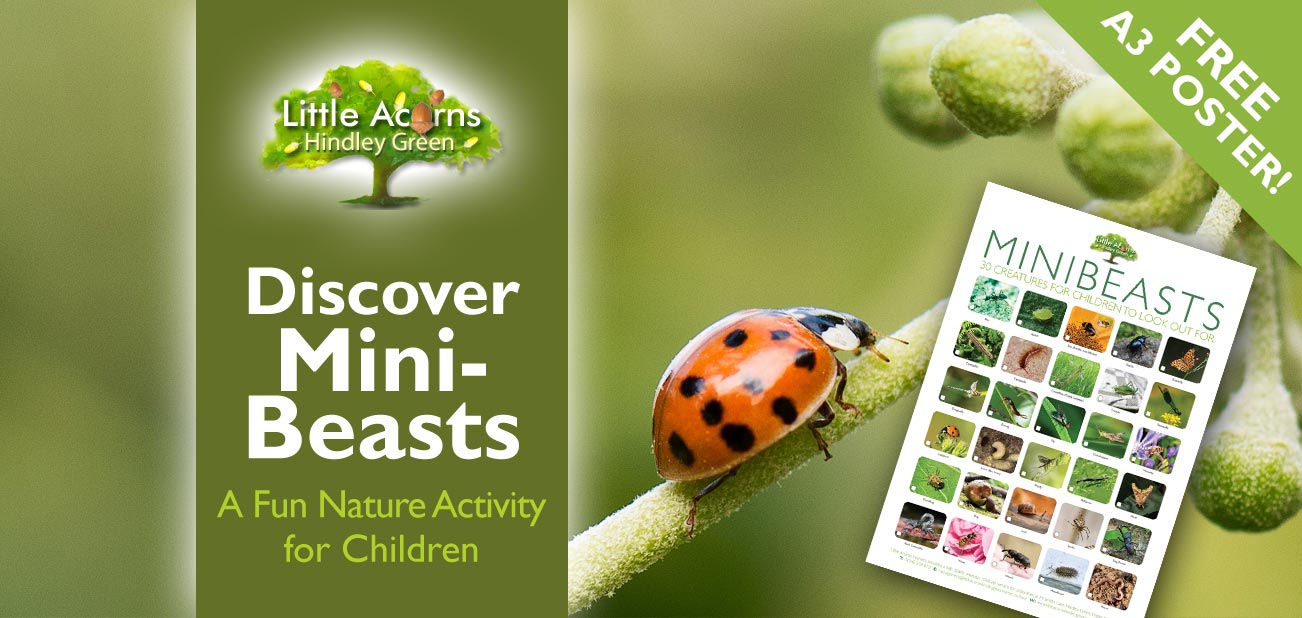
 Today’s ‘Discover Minibeasts’ post is the third in our series of nature-based activities for children. And, as with the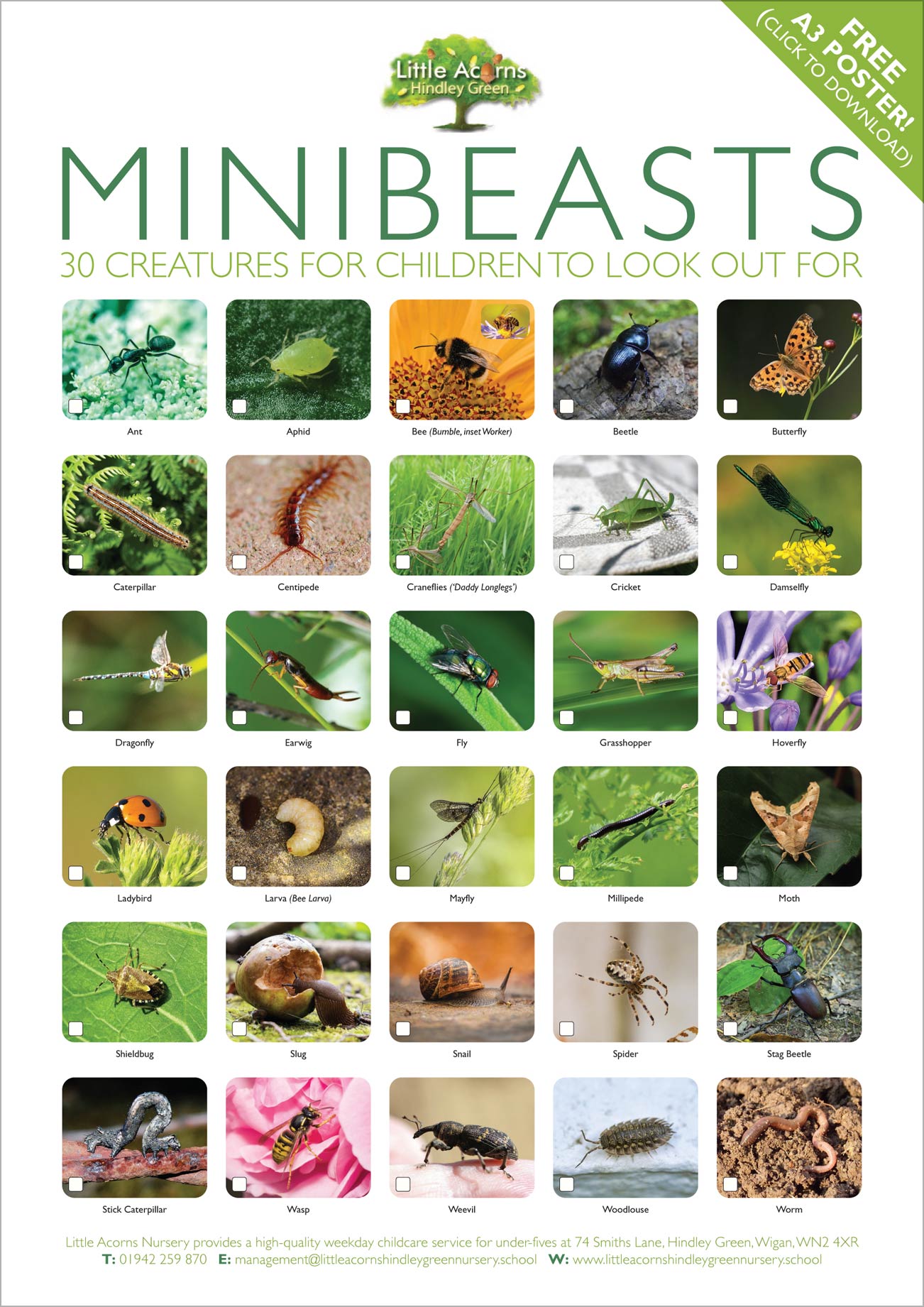
 The childcare professionals at
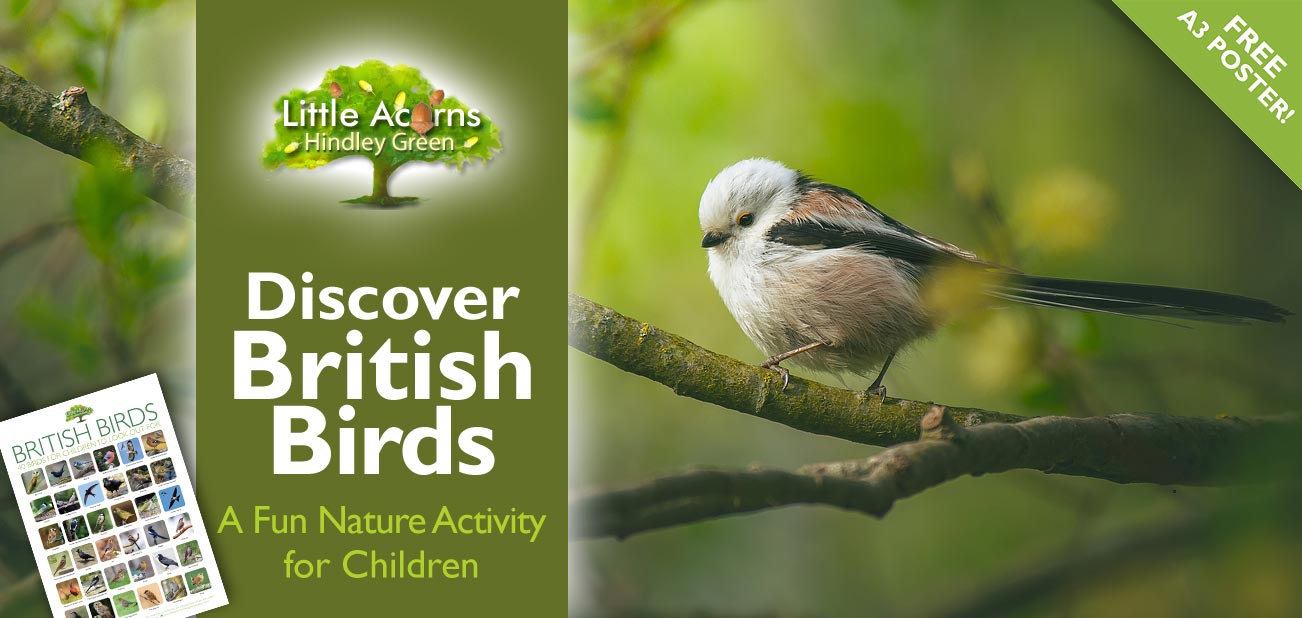
 Today, in a follow-up to the
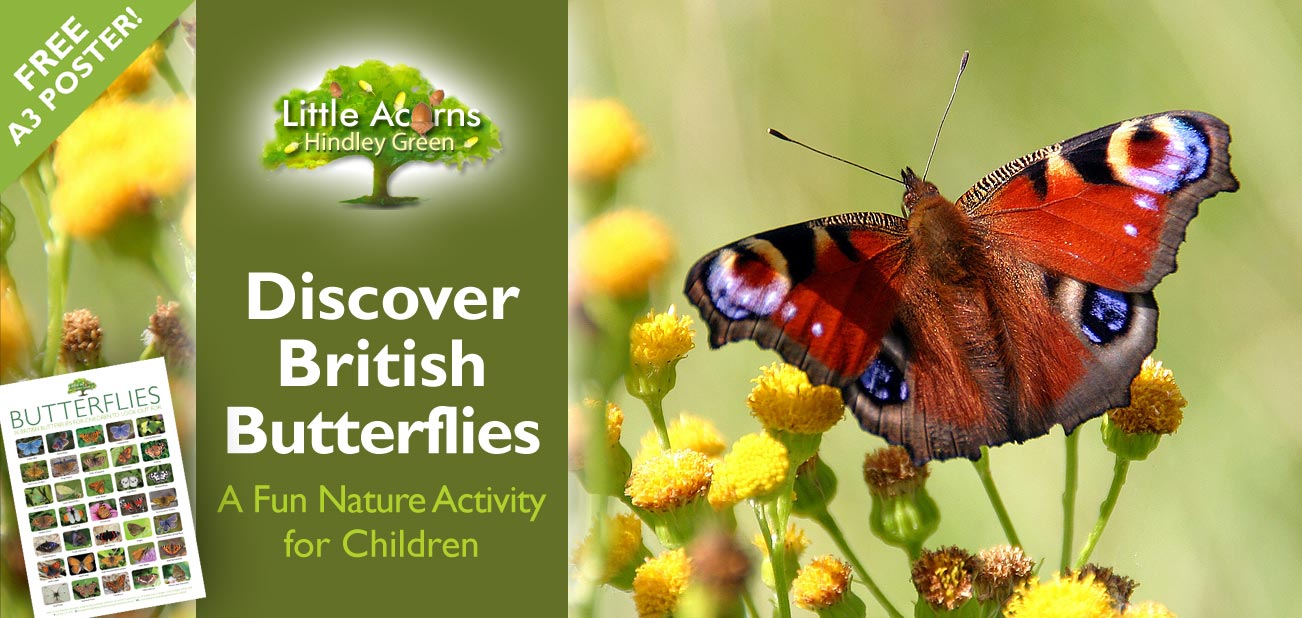
 Today’s exciting blog post encourages families to explore the wonders of nature and embark on a delightful butterfly-spotting adventure! Butterflies are simply beautiful creatures and their amazing colours and patterns are sure to appeal to little ones. With that in mind, we have prepared a visually appealing and informative A3 poster featuring 36 British butterflies, which you can download for free and print out. So, why not get the family ready to step outside, immerse yourselves in nature, and create cherished memories as you observe these enchanting creatures in their natural habitat? The poster gives visual reference and also ensures you have a lasting memento of this unique experience. Over time, this poster and nature-based activity will help you and your little one learn to identify these diverse and important little pollinators. As we reported before,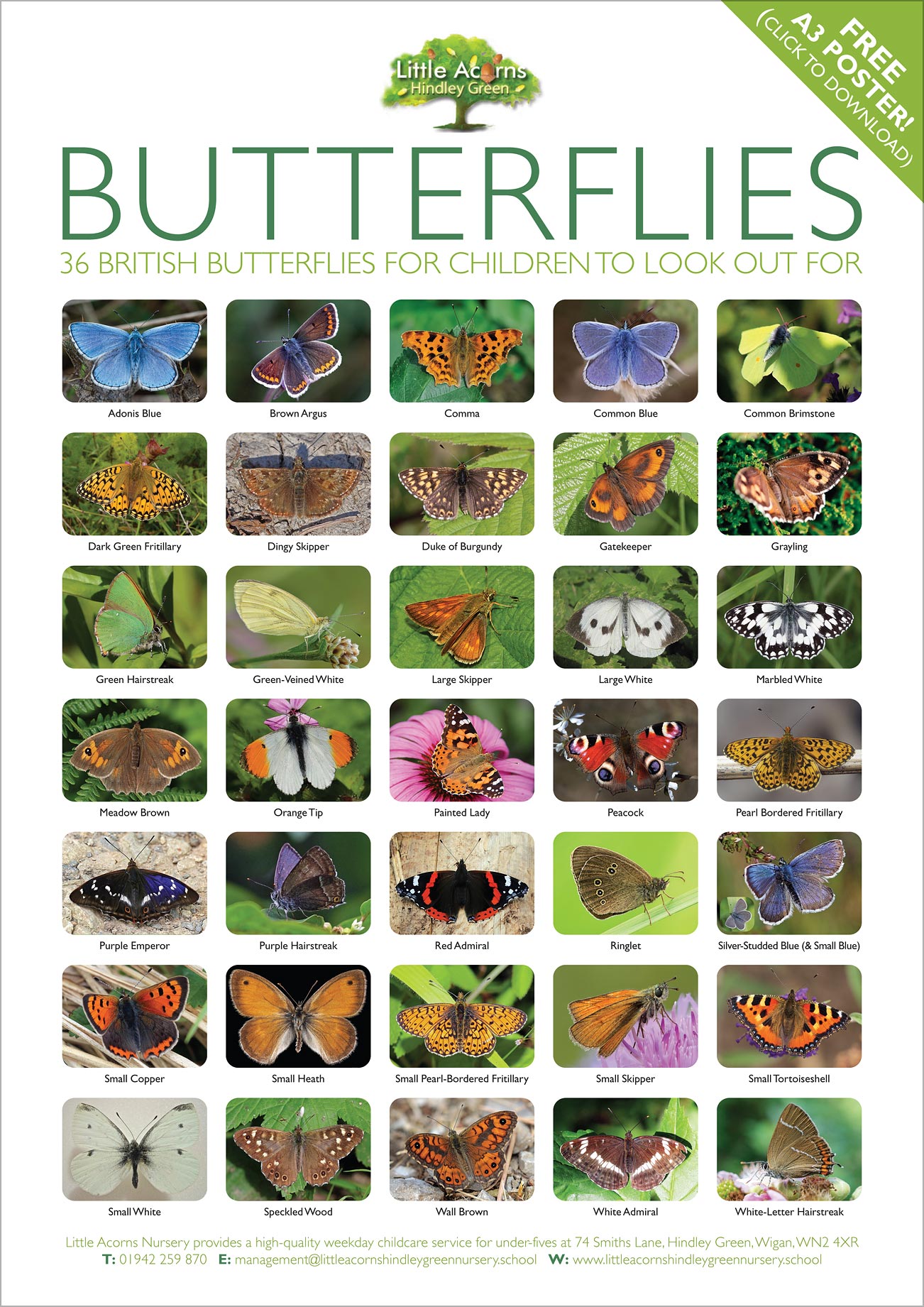
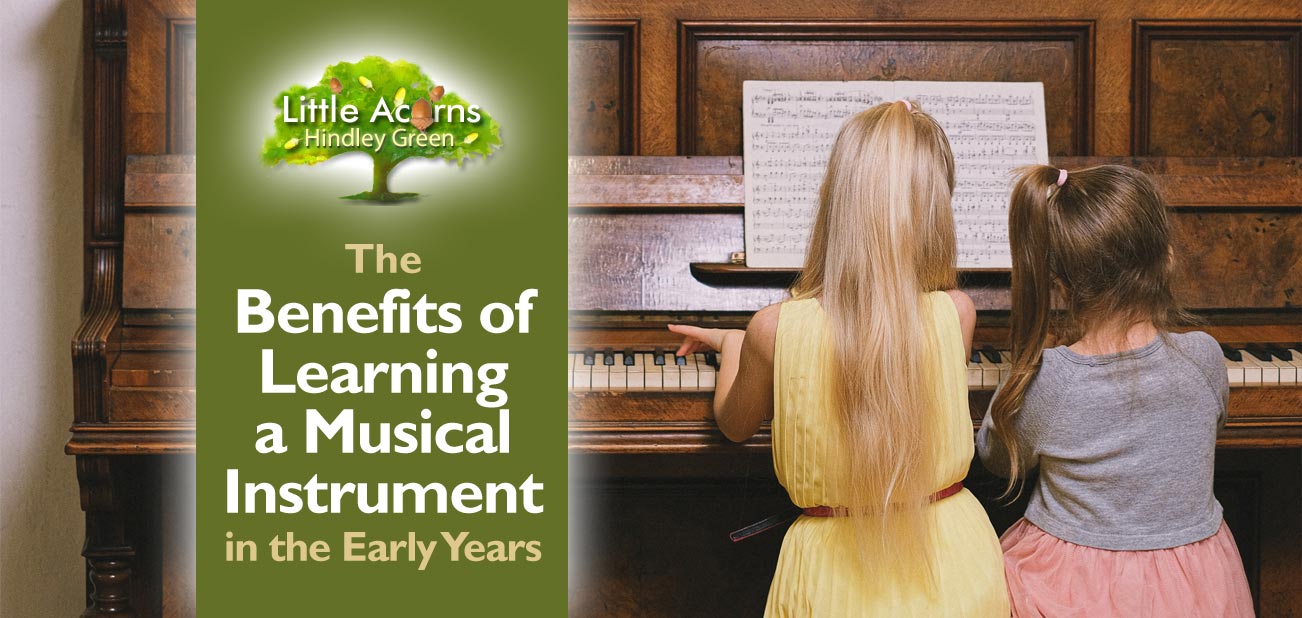
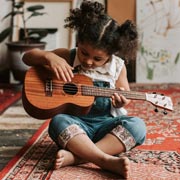 With free tutorials available on YouTube and inexpensive instruments available in charity shops, phone apps and online marketplaces, there has never been a better time for children to start learning a musical instrument. It’s something for every parent to consider because such a pastime will benefit their child in an incredible variety of ways. Not only will they learn a new skill that will stay with them for life, but their lives will be enriched in many additional ways too. So, today, we take a look at the often profound benefits of learning a musical instrument, especially for young children. We’ll start with the three most obvious benefits before coming to many others that may surprise you.
 Playing all these notes in a certain order, sometimes in isolation and at other times as chords and progressions, will do wonders for a child’s coordination and fine motor skills. Although perhaps tricky at first, with practice and ‘muscle memory’, children’s ability to master the playing of musical sequences, chords, melodies and rhythms will gradually become easier and easier. Before long, it’ll become second nature to them.
 In a similar way, children who learn a musical instrument will usually, of course, also be learning to read printed music. While this comes in different forms, it all encourages children to concentrate on the reading process. Specifically, they’re learning to read from left to right, to analyse the printed music detail and to make sense of it. It’s another great workout for the brain, and we’ll say more about that next.
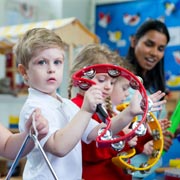 Playing a musical instrument often goes hand-in-hand with collaboration. Whether it’s forming a band, taking part in a school orchestra, writing songs with friends or simply jamming out together, children of all ages will naturally play together given the opportunity. As such, it’s a natural socialiser and one that brings children of different ages together, with new friendships being formed through a common interest. That is a very healthy thing. It also teaches children a wide variety of social skills including communication (e.g. speaking and listening at appropriate times), collaboration, being mindful of the needs of others, waiting your turn and so on.
 Music itself is also a great antidote to stress and other emotions. Giving children the tools to appreciate music — and even involve themselves in it — will help with their mental well-being as it can calm them when they’re stressed, relax them when they’re tired or even give them an energy boost when they need to get active. Ask any runner! All they need is the right piece of music and half the mental battle is already complete.
 With all these benefits, it’s highly worthwhile for children to start learning a musical instrument as young as possible. It’s easy to start them, for example with simple instruments like drums, triangles, and tambourines initially. With these simple instruments, very young children can learn to keep time to music or a beat a rhythm demonstrated by adults. They can then progress to more advanced instruments such as recorders, keyboards, and stringed instruments. They have to start somewhere, though, but it’s never too early to start! Mozart was just 3 when he began to learn piano playing. By 5 he had composed a whole concerto! Who knows; perhaps your child could be a star in the making!
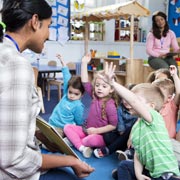 Parents* of under-fives may have heard nurseries, pre-schools, childcare professionals and other parents referring to “the EYFS”. However, what is it, and how does it affect your children? Well,
  For early years practitioners in England, following the EYFS framework is not optional. It is actually enshrined in law in England, via Section 39 of the Childcare Act 2006, so is an important and binding entity. (Other parts of the UK have similar equivalents).
 Ensuring high levels of safeguarding, welfare and happiness for every child at an early years setting;
 Communication and Language;
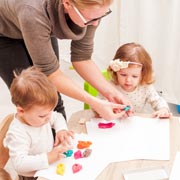 As they work towards their individual goals, assessments will be made, for each child, on a continuous basis. By assessing the children, the learning and development programme and the goals themselves can be tailored and fine-tuned along the way, as required. This will optimise each child’s progress and achievements.
 Ensure those who have access to children are suitable, safe, pre-vetted people;

