

People often use the phrase ‘the miracle of life’ and, indeed, there seems to be a lot of truth in it when it comes to babies. Hidden within the evolution of these little beings are some facts and figures that many will find surprising. Some sound incredible until one delves deeper, and that’s exactly what we’re going to do in today’s Crazy Baby Facts exploration. So, perhaps grab a warm drink, take a seat for a few minutes, and get ready to be surprised…
Early Signs of Right-Handedness
 Did you know that the position newborn babies prefer to face when lying on their backs may be an indicator of whether they’ll be left- or right-handed? The thumb they suck is, of course, a similar indicator. The 85% of them who prefer to face right in the first few months and the 90% who suck their right thumb generally turn out to be right-handers — the same kinds of percentage of adults who are right-handers.
The Age From Which Infants Have Memories
How old are you in your earliest memory? The memory of infants is interesting in that their ability to remember long-term, ‘autobiographical’ memories of events — including what will later become their earliest memories — doesn’t occur until they’re around 3 to 4 years of age. Although they may be able to form memories of events, particularly emotional ones, a little earlier between the ages of 2 and 3, those memories tend to fade. We should mention, of course, that shorter-term memories, such as recognising caregivers and remembering where toys are, come much earlier.
Newborn Babies’ Hearts Race
While it’s common knowledge that adults have a typical resting heartbeat rate of about 60 to 100 beats per minute (bpm), for newborn babies in their first month, it’s much higher at 100 to 160 bpm. That said, it can be higher or lower — 70 to 190 bpm while awake — without necessarily meaning there is a problem. The range is usually lower while asleep, typically ranging between 90 and 160 bpm. As the child grows older, the range decreases further, with a typical rate being between 70 and 110 bpm by the time they’re around 7 to 9 years of age. [Source]
Should there be any concerns, it’s important, of course, to seek professional medical advice.
How Many Babies Are Born Every Hour?
Here’s another crazy baby fact: 15,981 babies are born every hour across the world. That equates to >266 new babies every minute, and 4.44 every second! It’s no wonder that the world’s population is growing (at +0.9% annually). [Source]
Where 53% of All Births Occur
 The locations where babies are born around the world are also very interesting. 5% of the world’s babies are born in Europe. What about the other 95%? Well, a staggering 52.9% of all babies are born in the continent of Asia, 30.7% across Africa, 10.7% in the Americas, and just 0.7% across Oceania.
Do Foetuses Really Have Gills?
There is some debate as to whether foetuses have gills at some point while they’re growing. The answer is sort of because they do grow pharyngeal arches, which look rather like gill folds, while in the womb. They’re not true gills, as such, however; it’s thought they may be a throwback to our very distant evolution from fish. What we do know is that what appear to be gill slits during the foetus’s early stages eventually evolve into parts of the baby’s mouth and jaw. [Source]
Foetuses Do Have Tails
We’re all born with a coccyx, the tailbone at the end of our spine. However, did you know that foetuses have tails with vertebrae during the early stages of development in the womb? These fuse together around the 7th to 8th week of gestation, the tail disappears, and only the coccyx is left by the time babies are born.
Foetuses Really Have Fur
While many parents are familiar with Vellus hair, the soft “peach fuzz” that newborn babies often have, many will not be aware that they were even more furry in the womb. Lanugo hair is a soft, fine, and usually colourless ‘fur’ that covers babies while in the womb, alongside vernix caseosa, the creamy covering that babies have when they’re born. Both protect the foetus and help to regulate its temperature while in the womb. However, the Lanugo hairs are usually shed before birth, around week 35, although a few babies are born with some, particularly if they’re born prematurely. [Source]
Taste Bud Superpowers
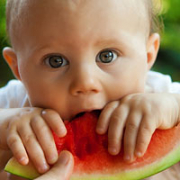 Babies are born with many more taste buds than adults. They’re not only on the tongue either. Spread on the roof and sides of the mouth, tonsils, and throat, as well as on the tongue, it’s thought they’re super-abundant in babies to help them experience tastes in a highly sensitive way. This could be an evolutionary mechanism to help them identify safe and unsafe food sources. Some estimates put the number of babies’ taste buds as high as three times more than adults, although we have found conflicting reports about the exact numbers. Whatever the number, it decreases by the time a child reaches adulthood. Interestingly too, babies can’t taste salt until the age of about 4 months.
Bone Bonuses for Babies
Adults have 206 bones in their bodies. What you may not know, however, is that babies are born with somewhere between 275 and 300! As they grow older, some of these fuse together to become stronger and more solid, hence the number of bones reducing to 206 by adulthood. The bones in the skull are a great example.
No Tears for Newborns
The moment a newborn first cries is one that a parent never forgets. However, did you know that they don’t cry actual tears until they’re between one and three months old? Until then, it’s rather more like ‘dry crying’ than crying liquid tears, simply because their tear ducts take that long to mature.
Rapidly Expanding Brains
 Did you know that babies’ brains double in size in the first year alone, and triple in size by the time children are 5? Some experts believe that boys’ brains grow faster than girls’ brains in the first three months, but it’s inconclusive. Either way, brains don’t finish developing fully until the age of 21 and, even then, there is some scientific debate as to whether they continue developing even longer.
The Most & Least Popular Date for Births
More babies in England and Wales are born in September than in any other month, with 28 September being the most popular birth date of the year. In fact, it has appeared in the top ten dates for births for several years.
Boxing Day, on the other hand, is the year’s least popular day for births, with fewer babies being born on that date than on any other in the year. According to the Office for National Statistics (ONS)*, this has been the case for well over ten years.
How Many Children Mothers Have on Average
According to ONS data* for 2024 (the latest available at the time of writing), women in England and Wales have, on average, 1.41 children in their lifetimes. This is slightly lower than the preceding year and, indeed, there has been a downward trend for several years. That said, there are regional variations, with the West Midlands seeing the average number of children higher at 1.59 children, while the equivalent for London mothers is lower at just 1.35.
The Average Age of New Parents
Interestingly, the standardised mean age (SMA) of parents has gradually increased over the last two decades — parents are getting older, in other words. This increase in the age of parents has grown by just under 2 years for fathers, and just over 2 years for mothers, during those two decades. Latest ONS data*, at the time of writing, is for 2024, and shows the SMA for fathers in England and Wales at 33.9 years of age, and 31 for mothers. For just the first born child specifically, mothers gave birth at the age of 29.4 on average, although in London, it was higher at 31.1 years — the only region higher than the average age for England and Wales as a whole (31).
Incredible Breastfeeding Fact
 As well as many other benefits associated with breastfeeding, statistics show that babies who are breastfed for at least two months are half as likely to be at risk of Sudden Infant Death Syndrome (SIDS). As well as that, breastmilk passes on important antibodies to the infant, helps protect it from certain diseases and allergies, and even adapts to supply the exact calorific content the baby requires over time. Incredible!
Little Acorns Nursery
Are You Looking for High-Quality Childcare Services in Hindley Green, Wigan?

Today’s amazing baby facts were brought to you by the team at Little Acorns, a nursery in Hindley Green, near Wigan. As well as providing childcare services in Hindley Green and Wigan, we may suit families living nearby in places like Bolton, Ince-in-Makerfield, Platt Bridge, Westhoughton, Atherton, Leigh, Bickershaw, and Tyldesley. Free childcare hours are available here for eligible families aged from 9 months to 4 years.
Get in touch to start your child’s early years education at Little Acorns Nursery — ask a question, come for a guided visit, or start your child’s application today — we can’t wait to meet you and your little one!
* ONS data referenced in this article is available here.
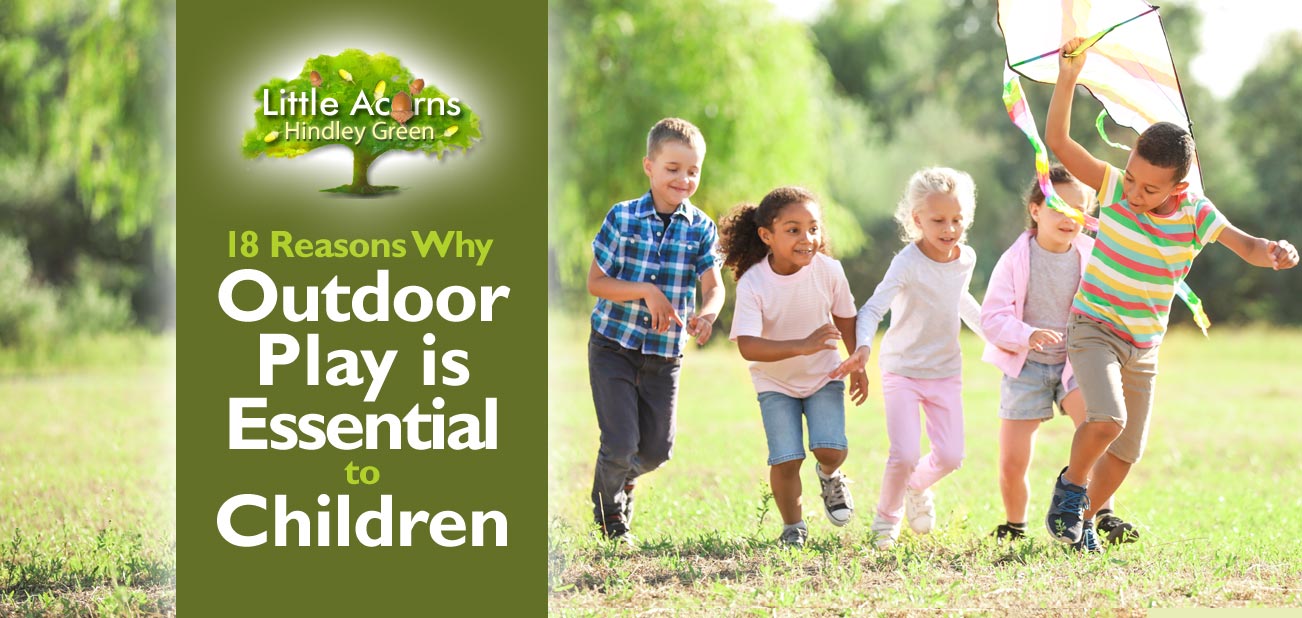
 Outdoor play is one of the truly magical elements of any healthy, fun-filled childhood. At the very least, it gives children the chance for some freedom, fresh air, and adventures that simply aren’t possible indoors. In today’s technological age of electronic screens, however, it’s also something that children have been doing less and less of over the generations. That’s a shame, when you think about it, not least because outdoor play is immense fun and incredibly beneficial to children. In light of this, today’s post explores 18 Reasons Why Outdoor Play is Essential to Children — of all ages. Take a look and see why outdoor play is so good for little ones.
 We mentioned it in our introduction — playing outdoors provides children with wonderful opportunities for real adventures! Whether it’s exploring The Great Outdoors on a family ramble, climbing on playground equipment with friends, embarking on a make-believe quest with the family dog, or making a den with siblings, there are no limits to what’s possible with outdoor play. Indeed, the adventures that are possible through outdoor play are only limited by a child’s imagination! Speaking of which…
 Let’s not forget, too, that playing outdoors is huge fun — and that’s important. Simply put, playing outdoors and giving children space to run around will make them happy. And there’s not much in life that’s more important than a child’s happiness — it’s an essential part of any magical childhood.
 Outdoor play lends itself to the learning of new skills. With such a varied array of activities possible, children will naturally attempt new things, and each of these can be an opportunity to extend their skills. Physical skills might include tying knots, building dens with branches, playing ball games, climbing, racing, and so on. In addition, children will learn softer skills like teamwork, cooperation, strategy, critical thinking, leadership, and role play. What’s more, all of this will happen instinctively — such is the power of outdoor play.
 Children who regularly play outdoors will inevitably meet other children and encounter new dynamics. These will help them make new social connections, and immersive activities will deepen existing friendships. Playing outdoors is a great way, therefore, to strengthen and extend a child’s social circle, and boost social skills like teamwork, leadership, cooperation, brain storming, and so on.
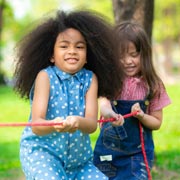 The often high-octane activities associated with outdoor play will also help children boost strength, fitness, motor, and coordination skills. By exposing themselves to different terrains, environments, tasks, games, and equipment outdoors, they will increase the variety of motor skills they need to accomplish activities. Running, jumping, hopping, constructing, chasing, and climbing will all help improve them physically, in so many ways that may not be possible indoors. What’s more, such things will help children protect themselves from harm, as well as empower them physically.
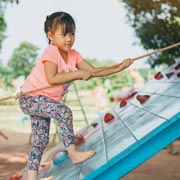 Playing outdoors, with adult oversight, is the perfect opportunity for children to begin learning how to assess risk. Whether it’s safely navigating outdoor play equipment, stepping over undulating ground, climbing a tree, or playing fast-paced ball games, children will soon learn when and how they need to assess possible risks. It’s a skill that, once learned, will keep them safer from harm, so is incredibly important.
 All these new skills and enhancements make under-5s well-equipped when the time comes to leave preschool and begin school. Through outdoor play, they’ll have greater independence, confidence, communication and social skills, and physical skills, to name just a few. What a great way to help them hit the ground running from the moment they begin school!
 All in all, outdoor play prepares children for life. Through greater independence, better confidence, raised self-esteem, and new tools, skills and knowledge at their disposal, children can go forward with new vigour and thrive. Such is the power of outdoor play.




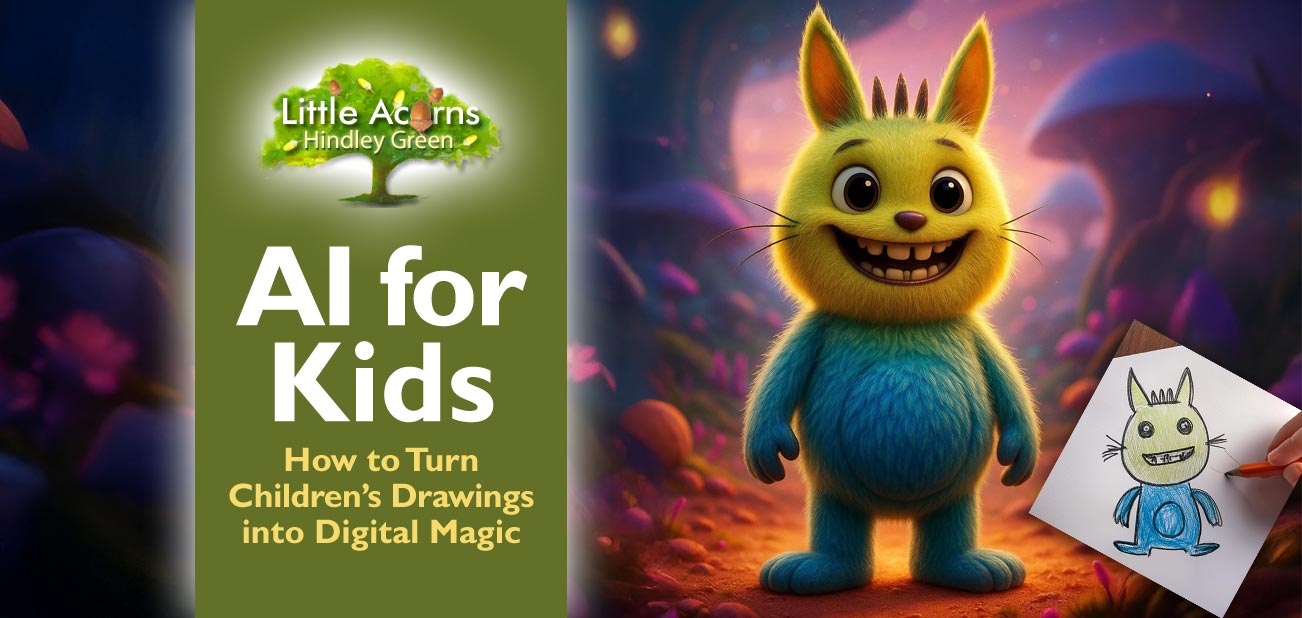
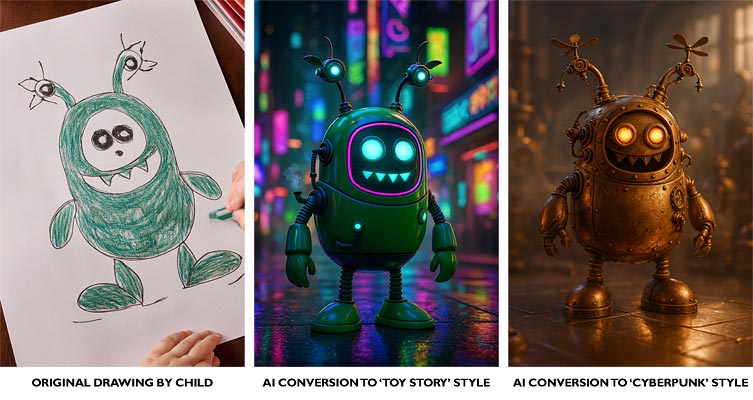
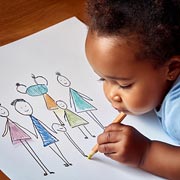 Even the youngest children have an incredible gift for imagination. Give them a handful of crayons and a sheet of paper, and, in no time at all, they’ll have created charming drawings that will delight. You’ll be introduced to colourful monsters, kindly robots, prancing unicorns, and pets reimagined. They may also depict family members, perhaps holding hands outside a home surrounded by flowers and love hearts. Each drawing tells a story and gives insights into how they see the world. Now, thanks to Artificial Intelligence (AI), families can bring those stories to life in a simple yet magical way. What’s more, it’s incredibly good fun and the results can be astounding!
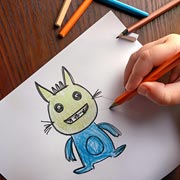 This activity works best as a family project. Begin by letting your child create a drawing — anything they like, from a friendly monster to a robot, a pet dragon, or a family picnic on the moon. Encourage them to use lots of colour and detail, then take a clear photo of the finished drawing — a smartphone’s camera is usually perfect for the task.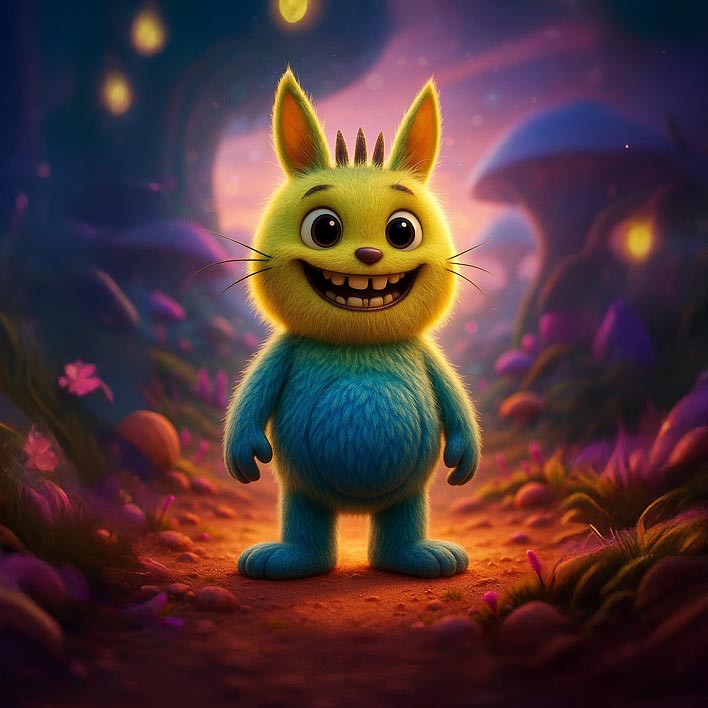
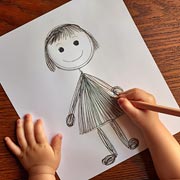 Some children know exactly what they want to draw, while others may need a starting point. You might suggest a dancing robot covered in buttons, a dragon who lives under the nursery slide, or a family of aliens enjoying tea on the moon.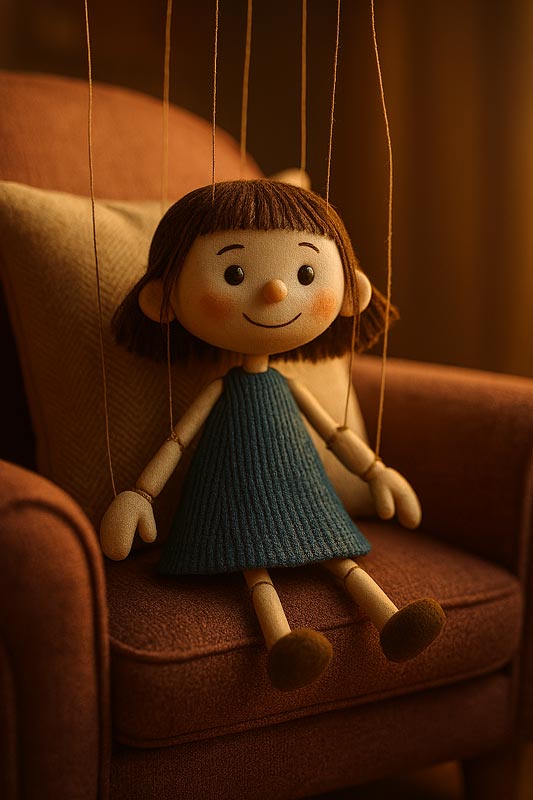
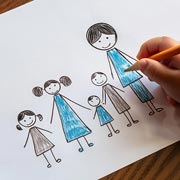 Once you’ve created your child’s AI-enhanced image, there are plenty of ways to keep the creativity flowing. You might print both versions and frame them together, start a digital scrapbook of your child’s art, or create a picture book where each page features one of their AI-inspired characters.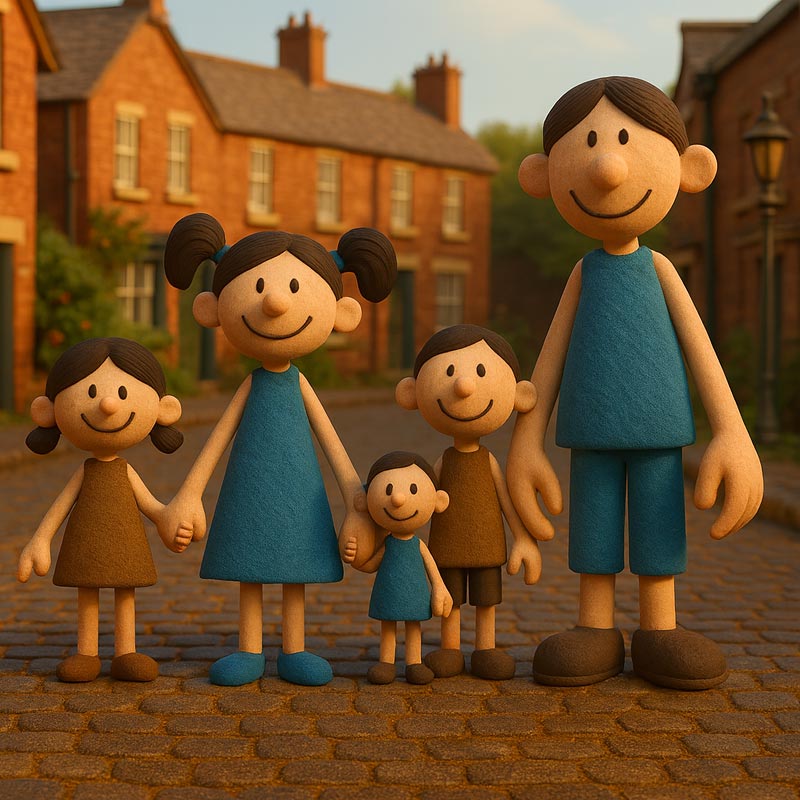
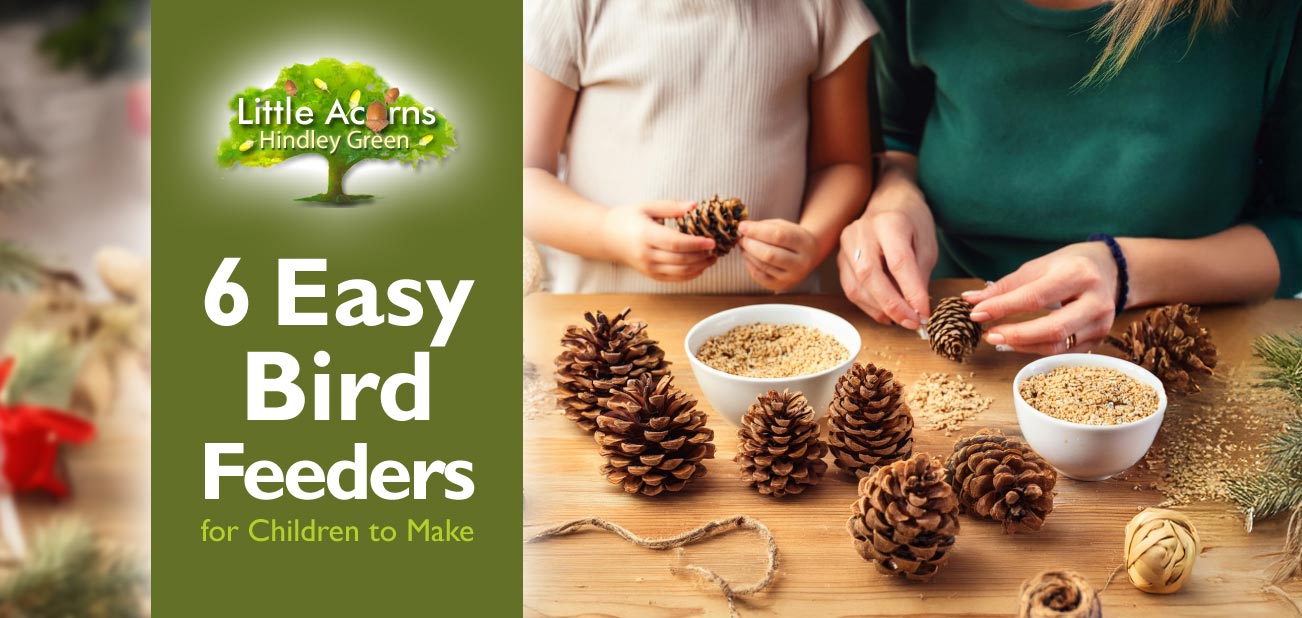
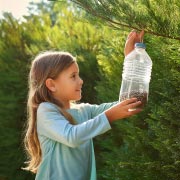 Once summer has gone, observant children will begin to notice a change in the behaviour of wild birds. Many of our feathered friends will begin migrating to warmer locations, evidenced by often noisy flocks heading south overhead. Those that stay in the UK, like robins and blackbirds, will soon find that all the wild berries, seeds, and grubs have been eaten — food becomes scarce as remaining supplies disappear in the run-up to winter. In view of this, wild birds will become more reliant on good-natured humans to ensure they still have enough food to eat over the colder months.
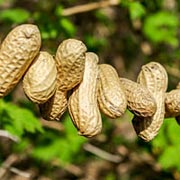 This simple type of bird feeder is quick and easy to make. Simply thread string or gardening twine through the outer husks of unroasted monkey nuts to form a garland. Holes can be made in the monkey nut husks using a small matchstick. Alternatively, if using something sharp like a darning needle, an adult should make the holes so that little ones don’t hurt themselves. Once a whole chain of monkey nuts is in line along the string, the ends can be tied between twigs, branches, or bushes, so the nuts dangle in a stretched arc. Blue tits will love pecking at the husks to get to the nuts inside!
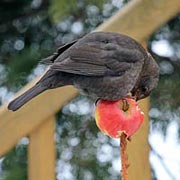 Apple bird feeders are by far the most simple to accomplish. In essence, they are simply an apple either dangling from a tree, bush, or fence, or are held high in the air from underneath by a vertical bamboo cane pushed into the ground. Whether the apple is dangled by string or held aloft by a cane, it’s best to expose some of the apple by removing some of the outer skin, so birds have a weak spot to begin feeding on. Check the apple daily to ensure it does not go mouldy; discard if so – mould can be dangerous to birds. (Adults should also supervise* children to keep them safe around hazards and other possible dangers, of course).
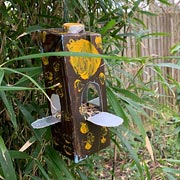 These bird feeders are extra fun because little ones can decorate them! You’ll first need an empty juice or milk carton. With help from an adult, rectangular or arc-shaped flaps should be cut on 3 or 4 sides of the carton, ensuring the bottom of the rectangle or arc is not cut. Crease and fold the flaps out at that lowest point, as shown in our example. The flaps provide a landing platform for birds, as well as access to the inside. That’s where the birdseed will go when the feeder is complete. After painting the exterior with a nice design and leaving it to dry, the carton bird feeder can be suspended by a string. This can be attached at the top, for example, by trapping it with the carton’s lid. Fill with birdseed to the level of the open flaps once suspended in place.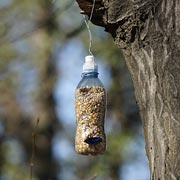
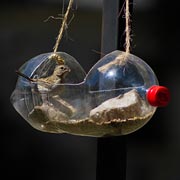
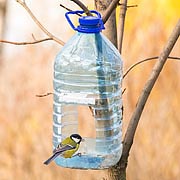
 Pine cone bird feeders are great fun for children! You first need to forage outdoors for a large pine cone. Ideally, it needs to have its many splines open, although that’s not critical. Children should smear peanut† butter all over the pine cone, ensuring it gets pushed into the cone’s many crevices. The whole thing should then be rolled around in a bowl of bird seeds, which will then stick to the sticky covering that was just applied. The completed pine cone bird feeder can then be suspended by string outdoors, somewhere suitable for the birds (usually at least 1.5m off the ground but under the protection of a tree canopy or similar so that feeding birds avoid attack from predators like sparrowhawks).
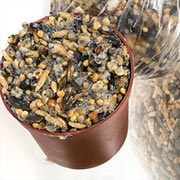 Seed cake bird feeders are a firm favourite for children to make. They’ll need some small, empty pots — plastic flowerpots would be perfect. With adult help, attach a string or garden twine to the base of the pot(s), for example, by threading it through the flowerpot drainage holes, and secure with a knot. Ensure that most of the string is left on the outside of the pot. Next children will need to mix bird seed in a suitable bowl with something to bind it together. For this part, adults will need to help by melting some lard† or beef suet† on the stove for children. They will then need to supervise to ensure it’s cool enough before children have access to it. Once mixed with bird seeds into a thick, gloopy mixture, children should fill the pots. A wooden spoon is perfect for the purpose. Once the mixture has cooled and set, the filled pots can then be turned upside down and dangled somewhere suitable for birds outdoors, for example, suspended high above the ground from a tree branch or on the side of a bush.
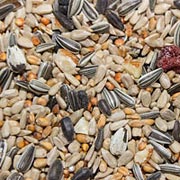 There are lots of different seed mixes available and each will attract a different range of birds. Our personal favourites are sunflower hearts, which are available in most supermarkets, garden centres, and online, and robin peanut cakes, which are similarly available. We’ve found them both to be popular food sources, attracting birds like robins, blue tits, great tits, blackbirds, doves, pigeons, nuthatches, starlings, and more. A small amount of grated cheddar cheese is also very popular, especially amongst robins and blackbirds, but must not be allowed to go mouldy (mouldy cheeses are dangerous for birds). We suggest avoiding mealworms, as each represents a little life lost unnecessarily. In any case, we love
 Following May’s
  Children will need some leaves for these ‘leaf art’ activities. We suggest they collect a wide selection of shapes, sizes, and varieties, so they have the flexibility to undertake any of the leaf art activities below. Our
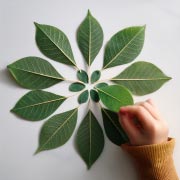
 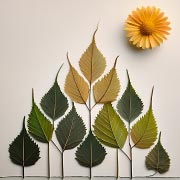 Whether fresh, dried, or pressed (see below), leaf collages can be used to make wonderful pictures and designs. With a little imagination, leaves can suddenly resemble little trees and landscapes, or be combined into formations that depict a flower head or a graphical design. The accompanying images show a couple of examples to get children’s creative juices flowing.
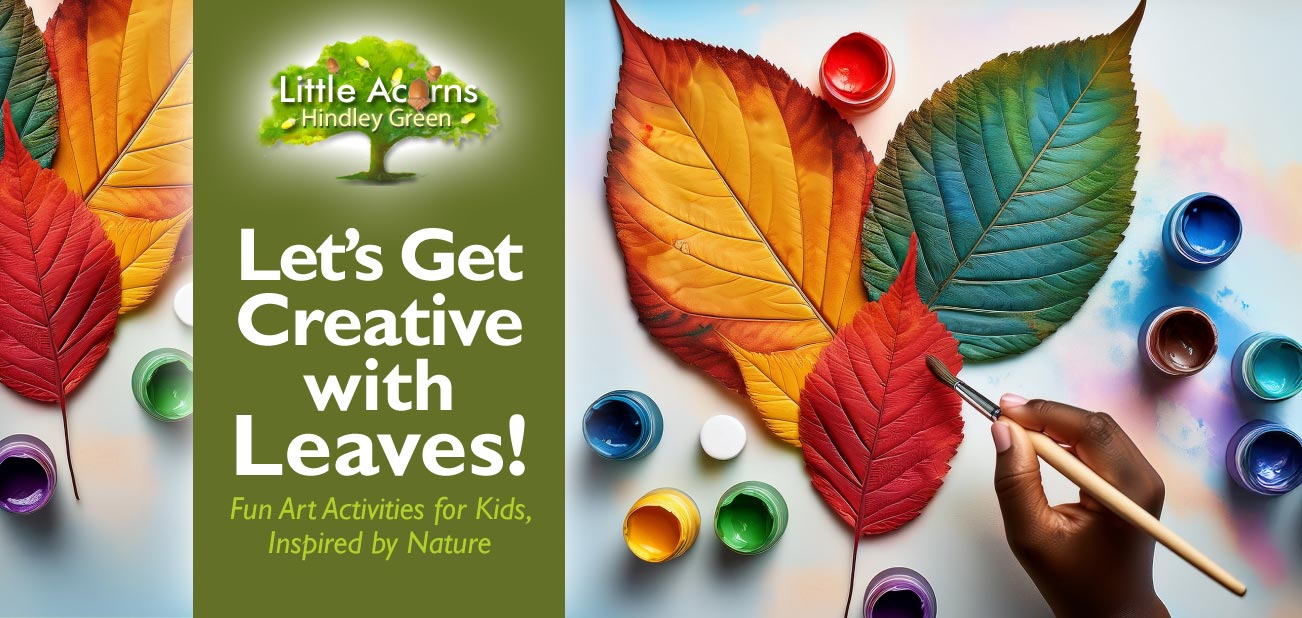
 One of the most straightforward creative activities with leaves is simply to paint and decorate them with coloured paints. Doing so can create highly attractive groups of leaves that are fun and cheerful to look at. Experiment with flat colours or more intricate decorations such as polka dots, stripes, stars, or zigzags. Glue the finished leaves to paper or card once dry to use them as part of a leaf collage (see above).
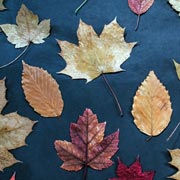 Leaves and small flowers can be dried, flattened, and kept longer by pressing them. Once pressed and dried, they’re like little works of art in themselves and are quite delightful. They can be kept as bookmarks or keepsakes, or used as art and collage components for some of the other leaf activities outlined today.
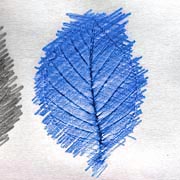 Leaf rubbing is a simple yet effective art activity involving leaves. First, simply place a leaf under a sheet of fairly thin paper. Holding the paper still with one hand, children should use their writing hand to rub a crayon, pastel, charcoal stick, or soft pencil lead over the area where the leaf sits, scribbling from left to right in closely aligned lines. A ‘picture’ of the underlying leaf will gradually appear!
 Leaf printing is super-easy and fun for little ones. Find a suitable leaf and, using a broad brush or — better still — paint roller, paint the most textured side of a leaf with a thin layer of paint, ensuring it covers the whole side of the leaf. Then, while the paint is still wet, place the painted side carefully over a sheet of blank paper. Without moving its position, press all parts of the leaf down so the paint makes contact with the underlying paper. Another way to accomplish this is to use a clean roller to ‘roll’ over the leaf so it connects the paint with the paper. Carefully remove the leaf and — hey presto — you should have an image of the leaf structure and texture right there on the paper. Try different leaves, various colours, and overlapping experiments to accomplish different outcomes.
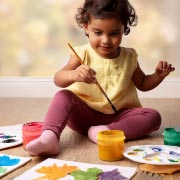 Instead of painting or using leaves directly, children can also try to depict them with their own paintings and drawings. These are a good way to encourage children to focus on getting the shape and details correct, fine-tune hand-eye coordination, and bolster technical mark-making skills. And, because children are free to paint or draw however they like, they can let their imaginations run riot and perhaps invent their own leaf shapes, leaf patterns, and natural worlds on paper.
 Children can use some of the creative skills they’ve learnt in the activities above to make greeting cards that feature their leaf art. For example, they can forage for heart-shaped leaves and paint them cerise pink to use as part of a simple Valentine’s Day or Mother’s Day greeting card. More general greeting cards for other special occasions can also be accomplished using leaves and dried flowers — for example, arranged to depict a leaf or dried ‘bouquet’ on a card sent for a birthday.
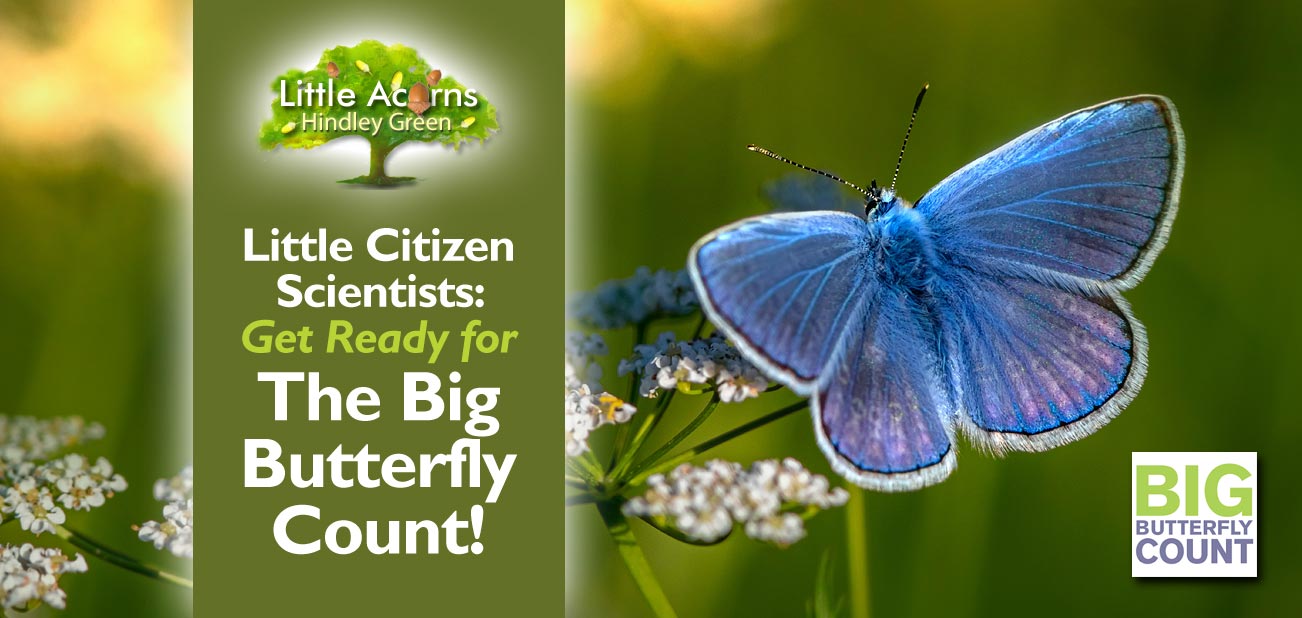
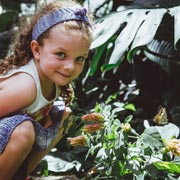 Calling all children and their families — people of all ages are needed this July and August for the world’s biggest wildlife survey — the Big Butterfly Count! So, whether you’re a child or an adult, you can play your part. This is a great activity for under-fives too as it’ll be fun, educational, and incredibly worthwhile. What’s more, they’ll become little citizen scientists by taking part. The nature-based activity takes as little as just 15 minutes and costs nothing at all. Children don’t need any special abilities other than a little patience and good observation — both great skills for them to practise. Let’s take a look and see what the Big Butterfly Count is all about and how children can take part this year.
 The Big Butterfly Count is a nature survey that anyone can take part in during July and August each year. For 2025, it takes place from Friday the 18th of July to Sunday the 10th of August, a period in which temperatures are usually warm and butterfly populations are likely to peak. In essence, all that is required is for butterflies to be counted during a 15-minute period (more detail follows later in this guide). The survey event is open to everyone and, indeed, the more people who take part, the better. So, if you, your child, your family, or your friends want to play a part in protecting butterflies and nature as a whole, please get involved.
 The populations of butterflies can be used as a barometer for the health of pollinator numbers and nature as a whole. With some butterfly species already disappearing from our gardens and countryside and others nearing extinction, there is no time to lose. Only by identifying the issues can we, as a nation, begin to reverse some of the decline. By reversing it, it will be good for butterflies, good for other pollinators like bees, good for nature as a whole — and good for humans too! After all, without pollinators, the supply of foods like cereals, fruit, vegetables and legumes would start to run out. So, taking part in the Big Butterfly Count is extremely worthwhile and we urge little ones and their families to take part.
 First, ensure you have downloaded and printed out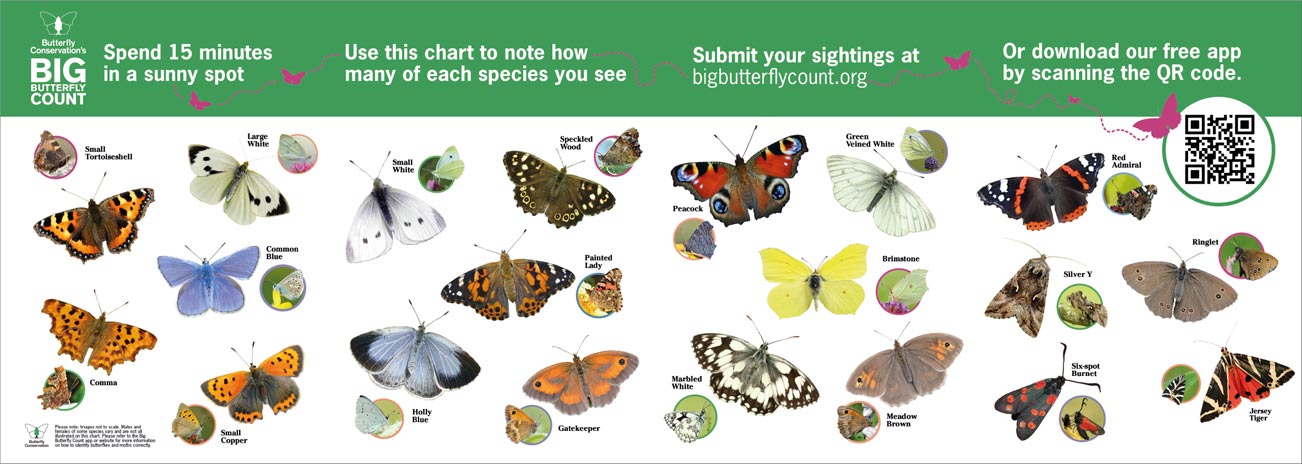
 Choose a spot for your butterfly survey. It should be somewhere outside where butterflies are most likely to be seen. Sunny, sheltered spots are good, particularly where a variety of different sizes and types of flowers or blossoms are in bloom.
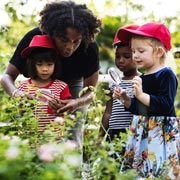 Sometime in the period from Friday the 18th of July to Sunday the 10th of August, you/your child should spend 15 minutes making a note of how many of each type of butterfly you can see. Concentrate only on the species included in the event organiser’s reference from Step 1. You must count how many of each single species you see at the same time. So, if you see three Painted Ladies at the same time, then record that as 3. However, if you see one Painted Lady on three separate occasions during the 15 minutes, that would only count as 1 — otherwise, it could simply be the same butterfly revisiting.
 Did You Know?
 Nature and outdoor play feature significantly in children’s time at
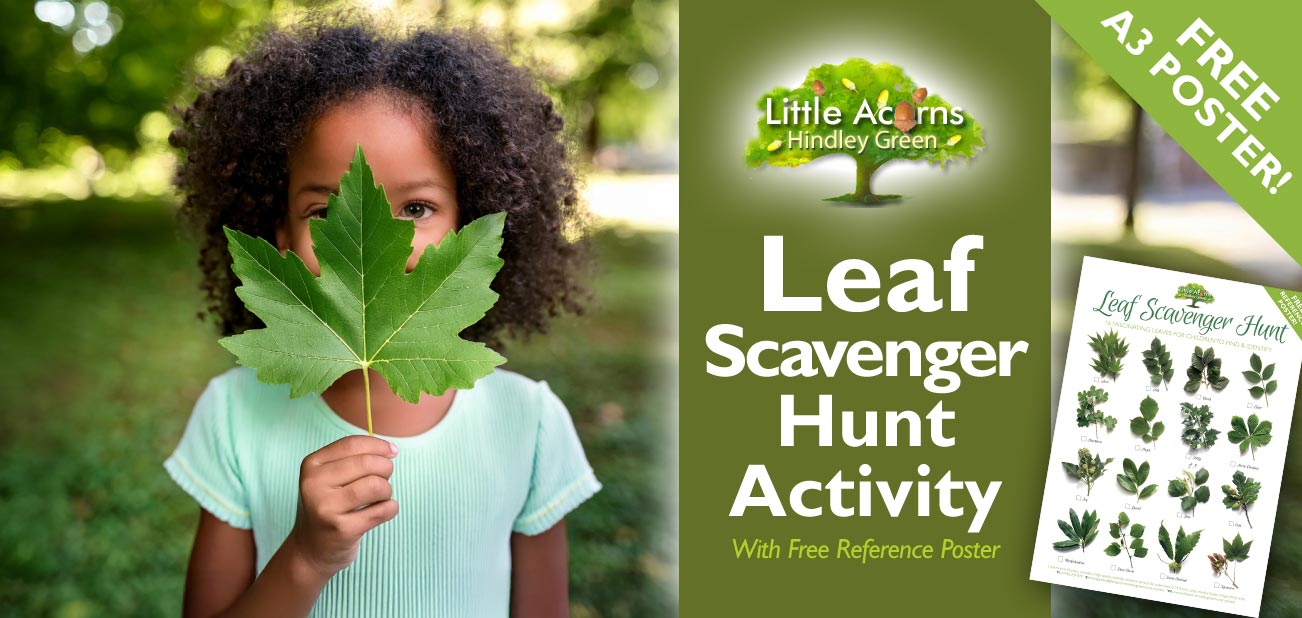
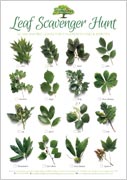
 Wherever you look, nature’s flowers and trees are bursting with life during spring and summer. This got us thinking about the many nature-based activities that are possible for children and under-5s to enjoy at this time of year — under appropriate supervision, of course. One of them is a simple leaf-hunting activity that’ll get little ones exploring the outdoors, enjoying the fresh air, having some fun, and learning about the natural world. With this in mind, we’ve put together a Leaf Scavenger Hunt reference poster for children and families. It can serve as inspiration for some common leaves to look out for during the warmer months of the year. The poster is free to download, right here today, and highlights 16 different types of leaves. Included are oak, sycamore, beech, lime and many more. Children will probably be familiar with some — especially oak leaves with their wonderful little acorns — while others may be unfamiliar. However, all of our examples were sourced on a single morning’s outing, so it’s feasible to find all 16 kinds with a bit of eagle-eyed persistence! So, download the poster for your children, print it out, and explore the outdoors to see how many of the 16 leaf types your little one can find. See if they can identify the differences which make each species of leaf/tree/plant unique — and learn their names if they can. The free identification poster and some help from an adult should help. Have fun out there!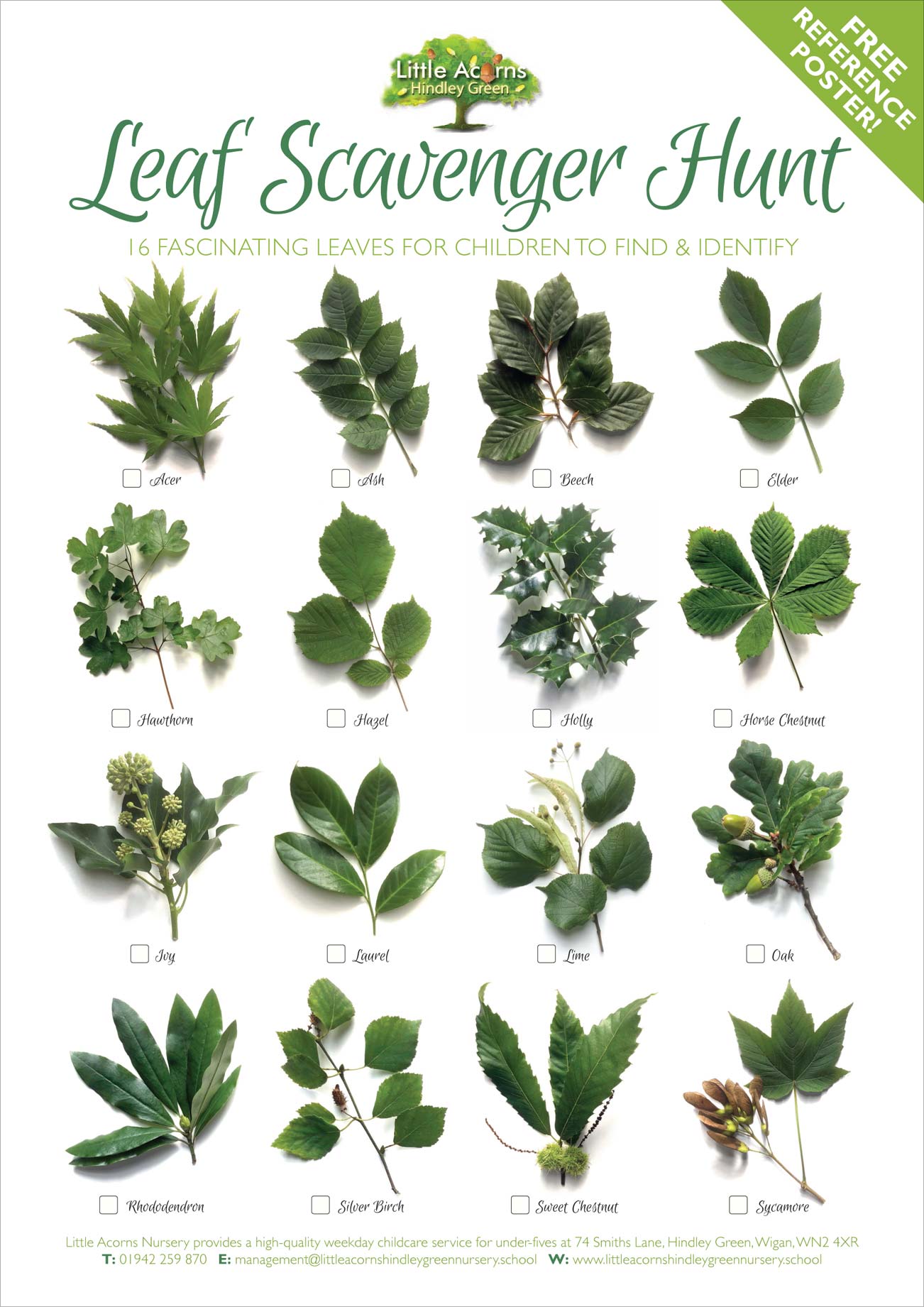
 Some of the leaves will be easier to identify than others. For example, Horse Chestnut (a.k.a. ‘conker tree’) leaves are quite distinctive with their fan of multiple sections (see the 2nd row, last image on the right on the poster for our example). In contrast, hazel and lime leaves are quite similar to one another. One easy clue to tell them apart is that lime leaves are slightly shiny, whereas hazel leaves are extremely matt. And, of course, they have very different seeds once those appear (the lime seed clusters are quite beautiful as you can see on the poster in the 3rd row, 2nd image from the right).
 Another interesting factor to point out to children is that some of the leaves come in different colours. Beech leaves, for instance, can be green or deep burgundy, brown or dark purple depending on which variety of beech a child locates. It’s similar for acers, which can be green, yellow, red or a deep purple/maroon. Acers however, are more likely to be found in gardens and parks than in the countryside. Some are a little like miniature sycamores, only rather more delicate and fancy! And, come
 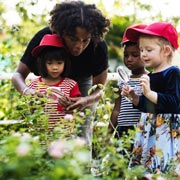 This activity is a great opportunity for children to open their eyes to the natural world. By looking at nature more deeply, they’ll see the finer details that may have been overlooked. Nature is incredibly varied and interesting when you take the time to look closely and discover it properly. It’ll teach children about the natural world, the seasons, the changes in plants and trees at different times of the year, the circle of life, and so much more. Getting out, close to nature, is also incredibly beneficial to children. From busting stress, improving well-being, supporting the EYFS and boosting exercise, to improving concentration and even academic grades,

