


Starting school is a huge milestone for families. If you’re a parent or guardian of a child who will soon start primary school in the UK, you’ll need to have made an application for their school place at the right time. Today’s guide is designed to help you understand just about everything you need to know about the process of obtaining a preferred school offer for your child and what to expect on National Offer Day — specifically for primary school places.
Primary School Offers Day: 16 April*
There are two key ‘school offers’ days each year. The first arrives usually on the 1st of March* and is for secondary school places. The second, which we’ll focus on in today’s guide, usually arrives on the 16th of April* each year and pertains to offers for primary school places in the UK.
* The exact date may be slightly later if the usual ‘offer’ date coincides with a public holiday or weekend. In such cases, the offer date will be delayed until the next working day. Note, too, that applying late, by post, or ‘in-year’ (for a start date other than in the September term) is likely to result in offers being received at a later date.
Apply for a Primary School Place at the Right Time
Whether you want your under-five child to start school at 4 or 5 (more about that below), you should make the application for a school place when they are 3 or, at the very latest, when they have just turned 4. For more details and key dates, check out our excellent guide to applying for your child’s primary school place.
Should Children Start School at 4 or 5?
Starting Primary School at Age 4
Most children in the UK start in ‘Reception’ year at primary/infant school at the age of 4. This is before the age required by law and usually starts in the September term. For these children, families will need to have applied for their place between September of the previous year and the 15th of January in the year they begin.
Deferring until Age 5
However, children born between the 1st of April and the 31st of August can legally begin school a little later if their parent/guardian/carer so chooses. This could be, for example, if the child’s parents believe the child is not yet ready for the challenges associated with school.
What Does the Law Say About Starting School?
The law states that children reach what’s known as Compulsory School Age in the UK on the 31st of either December, March or August following their fifth birthday (whichever arrives soonest). It’s worth noting, however, that schools and admission authorities have the right to decide whether children starting at five (rather than four) will begin in Reception year one year later than most other children of their age, or skip Reception completely and go straight into Year One with their matching age group. The child’s best interests will affect the decision, including factors like their individual needs and abilities. More information about deferring until five is available here.
Criteria Affecting Primary School Offers
Local authorities will first process applications made on time, so those stand the best chance of success. Late applications will be processed after all the ‘on time’ applications have been allocated places.
Either way, the criteria affecting whether a child receives a primary school place at their preferred school may also include factors like the following:
- Their home’s proximity to the selected primary school;
- Whether your child has a sibling already at the school;
- Whether you, the parent, have worked at the school (2+ years);
- Whether it’s a faith school matching your child’s religion;
- Whether the child is eligible for the Pupil Premium or Service Pupil Premium.
- … and other potential factors.
If, for any reason, your child is not offered a place at any of your preferred primary schools, your local authority will have to offer you a place at an alternative school. This will usually be the closest available school to your child’s home. However, it’s worth noting that such a scenario is quite rare, with only 1.4% of applicants not receiving offers from one of their ‘preferred’ schools in 2023.
Primary School Offers & National Offer Day
The majority of applicants, particularly those who applied on time, will receive primary school offers on National Offer Day, which arrives on 16 April or soon afterwards if that falls on a weekend or public holiday. Those who included an email address as part of their application will receive offers during that day while those who are informed via post may receive offers via 2nd Class post a couple of days or so later. However, some local authorities also allow parents to log into a portal to view primary school offers.
Accepting, Rejecting or Appealing a Primary School Offer
Primary school offer confirmations will include a deadline by which the offer must be accepted if that’s the parent’s intention. Failure to accept an offer by that date may mean that the primary school place is instead offered to someone else, for example, a child on a waiting list for that school (we’ll come to waiting lists shortly).
If you are one of the small proportion of families who did not receive an offer from a preferred primary school, you can appeal the decision and offer confirmations will include details about the appeals process. Learn more about appeals here. However, it’s usually wise to first accept any offer provided so that, if your appeal is rejected, your child has a school place to fall back on. Doing so should not affect the outcome of your appeal.
Waiting Lists
Waiting lists are an option for those families who:
- don’t receive an offer for a preferred primary school, or;
- receive no school offer at all (rare), or;
- decide they simply want to switch to a different primary school for one reason or another.
To apply to be put on a school’s waiting list, contact your local authority and perhaps also register your interest directly with the school itself, so they are aware. Having an existing school offer/place does not preclude you from going on an alternative school’s waiting list, by the way.
Good Luck from Little Acorns Nursery School, Hindley Green, Wigan
We hope you receive the ideal primary school place for your child when the offer day finally arrives.


The staff at Little Acorns Nursery in Hindley Green wish all families with children starting primary/infant school the best of luck on primary school offers day. We do hope everyone receives an offer for their preferred school.
We’re convinced that all preschoolers leaving Little Acorns to begin school will have the very best start, having become as ‘school-ready’ as possible during their time with us. This preparation will help them to really hit the ground running from the moment they arrive at school. For tips on how best to prepare your child for starting school, don’t miss our guide Tips for a Smooth Transition to Reception.
Meanwhile, if you have a baby, toddler or preschooler that requires high-quality childcare and a good ‘early years’ education near Hindley Green, Wigan, get in touch:
As well as offering a high-quality childcare service in Hindley Green, Wigan, WN2, we are also conveniently located for families in Bickershaw, Leigh, Atherton, Westhoughton, Ince-in-Makerfield, Platt Bridge, Tyldesley, and Bolton.






















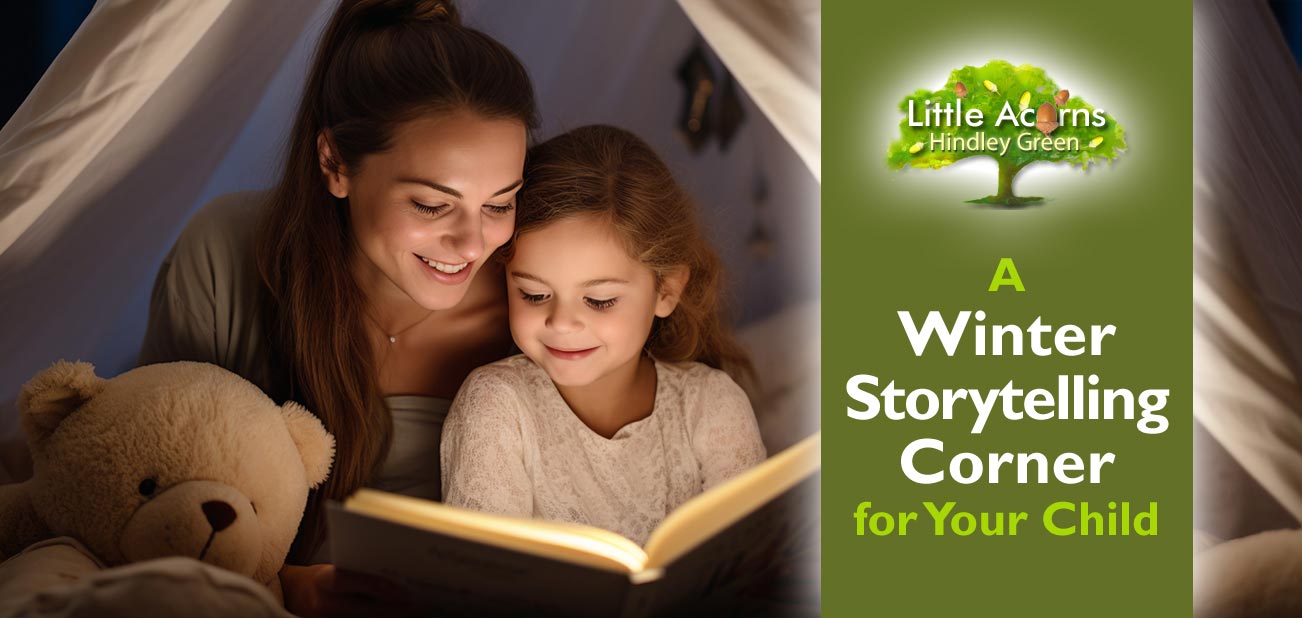
 Once winter arrives in December and cold winds start to breathe the landscape to sleep for a season, little ones will be less inclined to venture outdoors. Parents, too, will no doubt appreciate them avoiding the rain, cold, and inclement conditions that may occur. As such, winter is the perfect time to transform dreary days and dark evenings into a haven of warmth and cosiness indoors. An enchanting children’s activity that goes hand-in-hand with this is that of storytelling. With that in mind, today’s post guides you through the delightful process of creating a Winter Storytelling Corner tailored for the youngest members of the family. A storytelling corner is a wonderful way to make these winter nights cosy, magical, and filled with high-quality shared moments. Shared
  Start by selecting a cosy corner or nook in your home – for example, a secluded and quiet space somewhere that’s away from busy activity, cold draughts and suchlike. It will need to have somewhere comfortable for you and your child(ren) to sit or ‘nest’ once you get to the storytelling part. Once you’ve found somewhere suitable, it could be adorned with soft blankets, plush cushions, and perhaps even a few twinkling fairy lights. The goal is to create an inviting spot that beckons little ones and you, their parent or caregiver, to snuggle up and feel the warmth together as the winter tales unfold.
 Curate a collection of timeless winter stories that capture the spirit of the season. Consider classics like “The Snowman” by Raymond Briggs or “The Mitten” by Jan Brett. These stories, with their simple yet captivating narratives, are perfect for engaging young minds and sparking their imagination. These are just a couple of examples, though, and there are lots of winter-themed books to choose from, whether online, in book stores, in charity shops, or swapped amongst family or friends.
 Perhaps incorporate simple props that relate to the story. If the tale involves animals, have soft toy animals on hand for little ones to interact with as the story unfolds. Other alternatives are hand puppets and finger puppets. Try using them to act out characters from the stories as you read them, or get your child to do so. Adding an interactive and visual element in this way will encourage children to participate actively and immerse themselves in the storytelling process. This approach can be creative, captivating, and sometimes even comical. As such, this is very entertaining for children and will help to make the whole activity enjoyable and fulfilling.

 The transition from preschool to Reception marks a significant milestone in any child’s life. It can be emotional for parents and, for children, it can be a period filled with excitement, curiosity, and perhaps a bit of apprehension. Ensuring a smooth transition involves a combination of careful planning, practical strategies and emotional support. With that in mind, today’s guide outlines more than twenty simple, actionable ways to ensure your child has a seamless transition and a positive start to school life.
 Use positive reinforcement to create a positive association with the idea of school. For example, highlight the exciting aspects of learning, making friends, playing new games, and discovering new things.
 Organise play dates with future classmates to build social connections before the first day. Encourage interactions with other children to develop essential social skills. Attending a nursery, preschool, or playgroup will provide excellent opportunities for this.
 Foster self-reliance by allowing your child to perform simple tasks like dressing themselves, tidying up, using the toilet, and organising themselves. Also, assign small responsibilities to them at home to instil a sense of accountability and responsibility. Such skills will serve them well once at school.
 Read age-appropriate books together, particularly those that introduce topics they’ll be introduced to in Reception class. This not only sparks excitement and teaches them new things but also helps children understand what to expect. Instil a love for reading through interactive reading sessions. Visit the library too and explore a variety of books.
 Ensure that your child understands basic time concepts, such as morning, afternoon, and evening. This, in tandem with our next tip below, will help your child better understand the structure of the school day.
 Ensure your child can manage basic self-care tasks independently. Such skills will be invaluable to them once they have started school.
 Ensure sufficient sleep by establishing a calming bedtime routine. This not only gets them used to a pattern but will also help them to maintain focus and energy levels once at school.
 The journey from preschool to the first day of school is a significant milestone for both parent and child. Preparing children for school involves a holistic approach that addresses emotional, social, and practical aspects. By incorporating these strategies into your family’s daily routine, you can contribute to a positive and confident transition for your child and set the stage for the most successful start to their school journey.
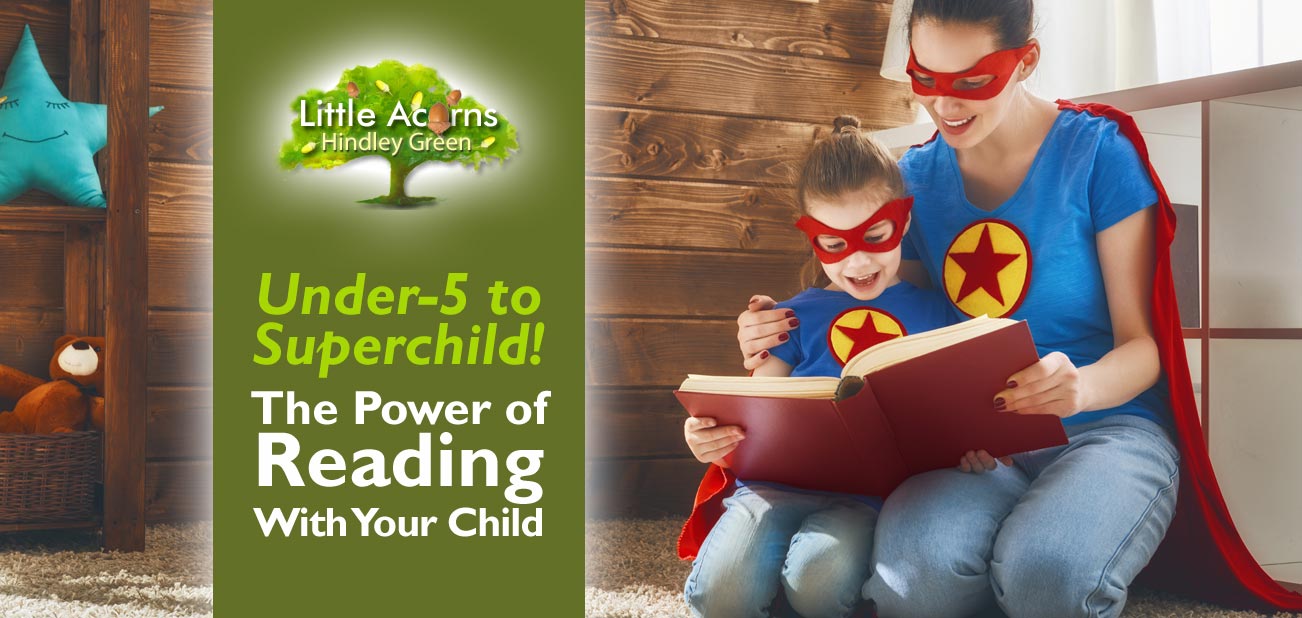
 In the journey of childhood development, there is a simple yet powerful tool that supercharges learning, imagination and even life outcomes: reading with your child. While a magical connection with books is a cherished tradition in many families, it is also a proven way to optimise a child’s cognitive and emotional development — and even to give some a social boost. With that in mind, we explore today the incredible benefits of reading with children in the early years and learn how study after study has proven how transformational it is to their lives.
 One of the most notable benefits of early reading is the rapid expansion of a child’s vocabulary. Indeed, research suggests that children who are exposed to a diverse range of words in books tend to perform better in language assessments, spelling, and overall literacy development. With reading to children opening up whole new worlds of information and vocabulary to them, this positive outcome makes total sense.
 Reading with children also contributes to the development of enhanced empathy and emotional intelligence. Stories often feature characters experiencing a variety of emotions, and by engaging with these stories, children learn to empathise and connect with the feelings of others. That’s because exposure to complex characters and their emotional experiences in books helps children better understand and relate to the emotions of people in their real lives.
 Reading is not just about the words on the page; it’s also about the quality time you spend together. The connection you build during reading sessions is priceless, fostering stronger bonds between you and your child.
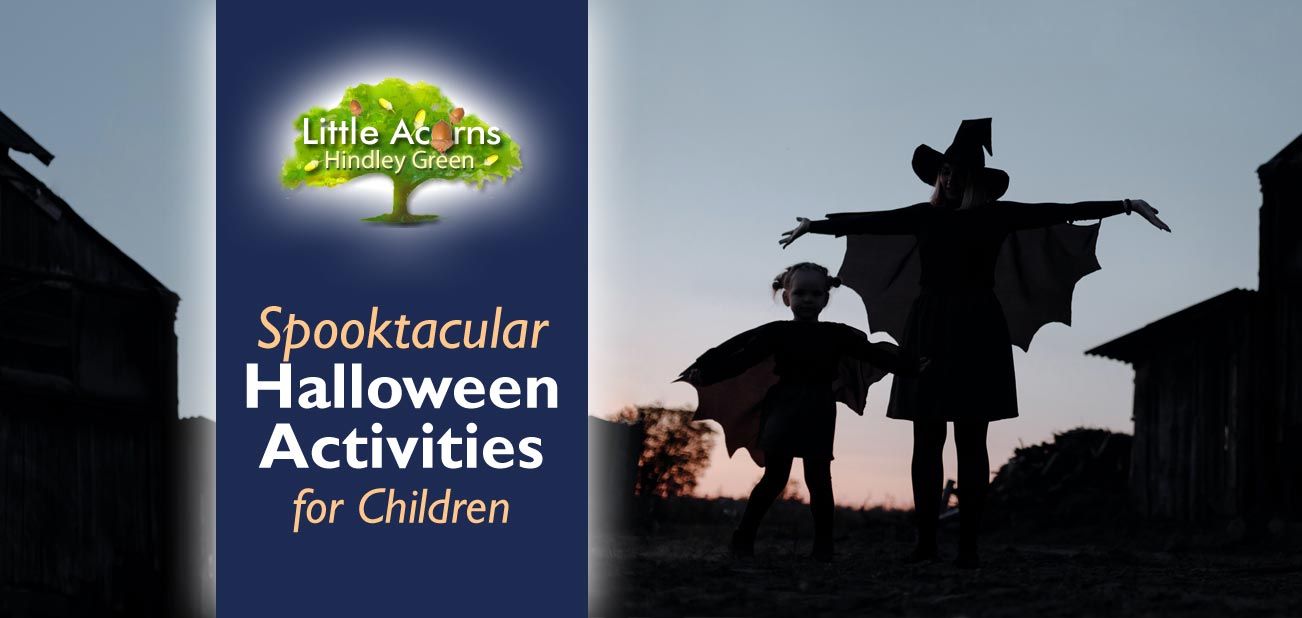
 Autumn’s arrival means that Halloween is just around the corner, coming on the 31st of October each year. The run-up to that date is a great time to start preparing for some fun Halloween activities for children to take part in. Whether dressing up for Halloween-themed parties, putting carved pumpkin lanterns and spooky decorations out at night, or playing Trick or treat locally, children of all ages will find Halloween a time of unique fun! It’s also a great opportunity for children to strengthen bonds with friends and for families to start getting creative! With that in mind, here are our top picks for spooktacular Halloween activities for kids!
 Dressing up in Halloween costumes is hugely popular amongst children. While purchasing costumes from stores is quick and easy, encouraging children to make their own Halloween costumes (with adult supervision) is likely to be not only cheaper but also much more fun. They’ll also be able to get creative and learn new skills in the process.
 Kids will also love dressing up as spiders. All they need is some black tights — or a pair of skinny trousers — and a black top that’s belted at the waist and then stuffed to make the ‘spider body’ fat. Extra spider legs can be made by stuffing more black tights and attaching them to the belt.
 Your children can take this a step further and add Halloween-themed food into the mix, so there’s something to nibble too!
 The Halloween tradition of ‘tick or treating’ has its roots in Medieval times. It is a playful remnant of the practice of “souling,” where the poor would go door-to-door during what was then known as ‘Allhallowtide’ (around All Saints’ Day and All Souls’ Day) asking for food in exchange for prayers for the deceased. Over the years, this evolved into what we now know as Trick or treat. Children, usually in full Halloween fancy dress, knock on neighbourhood doors and say Trick or treat? Then, homeowners typically give them sweets or other treats — or become the target of a playful trick from the children! It’s great fun for little ones, especially if one or more neighbourhood parents can organise the evening in advance. By doing so, the neighbours are warned and can opt out if they prefer. In this way, lots of fun, laughter and treats will ensue and nobody gets a trick that they weren’t expecting!
 Many towns and villages will have ‘pumpkin patches’ during October. These are typically found on local farms and similar that set a field aside, chock-full of pumpkins. Families can come along and children will be able to scour the field and pick their favourite pumpkin. They can take it home in exchange, usually, for an affordable fee. Such pumpkin patches often also have wonderful photo opportunities where children can pose amongst pumpkin displays. In this way, children enjoy a morning or afternoon activity at the farm and end up with a hand-picked pumpkin too.
 Hollowing out and carving spooky and creative faces into pumpkins is a classic Halloween activity enjoyed by thousands of families each year. For safety purposes, supervising adults will need to do any carving, though, as it’ll likely involve the use of a sharp knife. They can also loosen the seeds and flesh and then, if able, children can help to scoop it out. Once hollowed out and eyes, nose and mouth have been carved, children can have great fun decorating the outside and turning the pumpkin into a lantern using tea lights (again, under adult supervision or using LED lights for safety purposes). Nothing quite says ‘Halloween’ like a pumpkin face that glows in the garden at night. Children will naturally love the whole experience, end result, and feeling of accomplishment associated with this activity.
 Families can combine all or just some of these Halloween activities into one event by hosting their very own Halloween party for friends, relatives and neighbours. With spooky fancy dress costumes, Halloween-themed decorations, flickering pumpkin lanterns, and themed food and drinks, it’s sure to be huge fun and a spooktacular evening for everyone! Ghostly music and ghoulish games can be added to the event too, perhaps along with a period where children and adults can tell spooky stories and ghost tales. What’s not to love?

 Today’s ‘Discover Minibeasts’ post is the third in our series of nature-based activities for children. And, as with the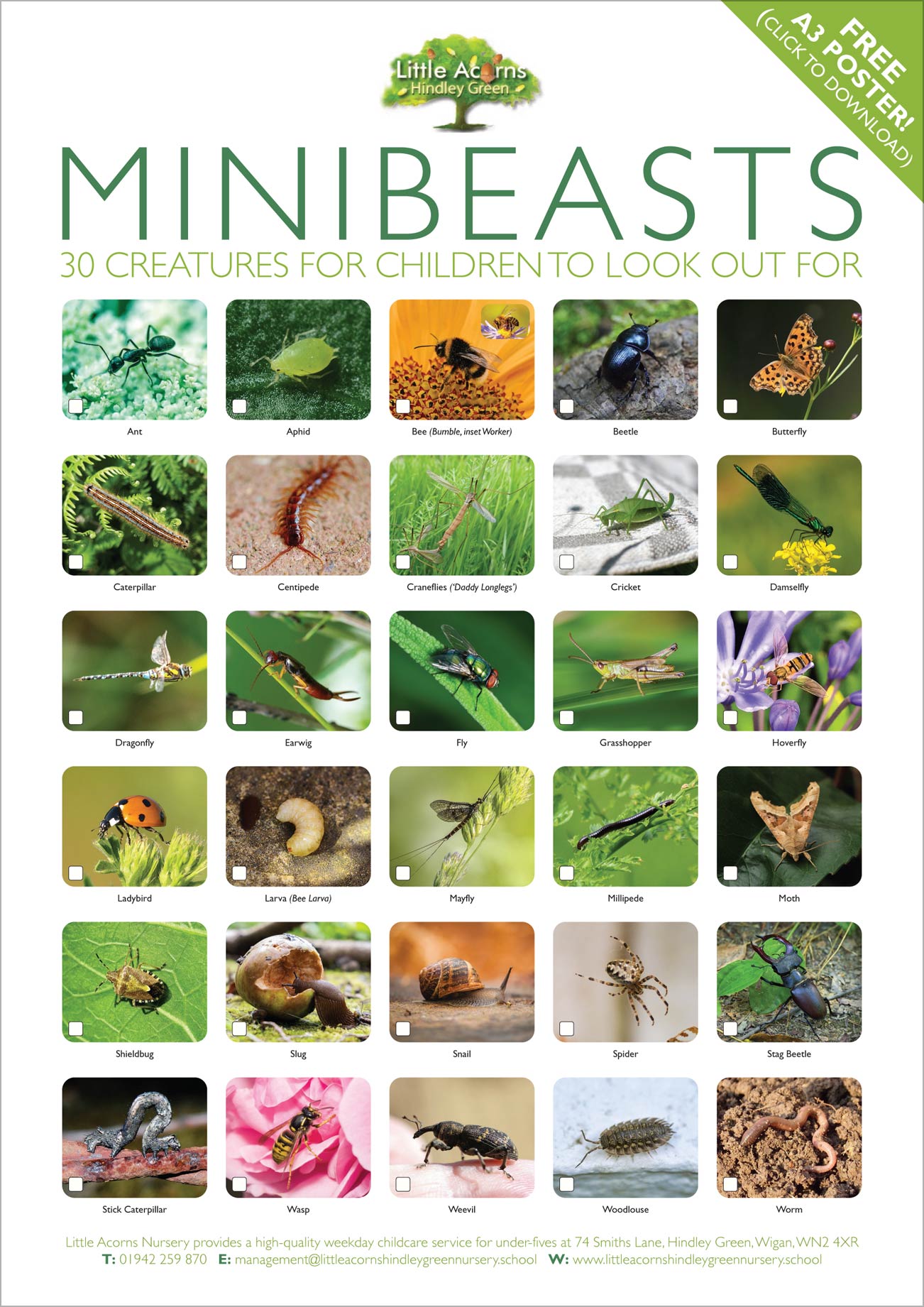
 Today, in a follow-up to the

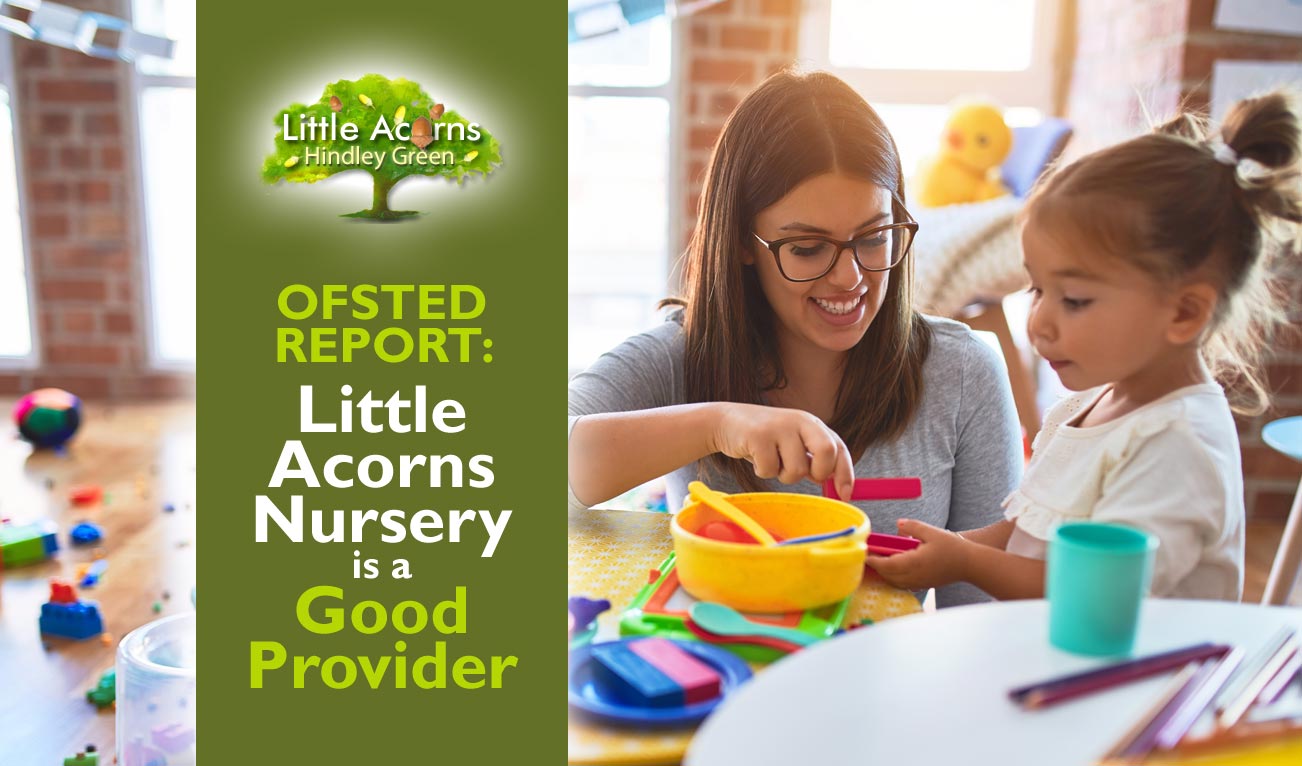
 We’re delighted to announce that Little Acorns Nursery, Hindley Green, has passed its first Ofsted Inspection — and with flying colours! The Ofsted Report was published recently following the Ofsted inspection in late April this year. It is our first since we took over the nursery from Kate’s Kindergarten in 2022. So, it’s now official — Little Acorns Nursery is a ‘Good Provider’ of childcare and early-years education. Let’s take a look at the Inspector’s findings and some of her lovely comments. We’ll see why the nursery/preschool achieved such consistent, positive feedback and good ratings in every area. Doing so is incredibly important to the children under our care and, of course, to their parents and caregivers.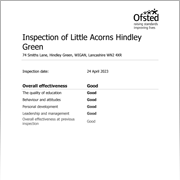
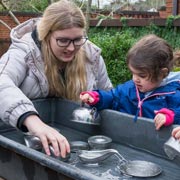 Opening comments in the Ofsted Report are particularly positive. Not only are the findings welcomed by nursery staff, who work so hard and so professionally — as evidenced in the report — but they’ll also be welcomed by parents/caregivers of children attending the setting. After all, it’s good to know children are in good hands and that their choice of childcare provider was a good one.
 As you can see from the comment above, staff are methodical and strategic in their approach to activities organised for the children. Activities are tailored to each child’s individual interests, making playing, development of skills and learning of new knowledge all come naturally.
 Ofsted also recognised that leaders and staff plan improvements for the future. In their report, they describe how leaders “plan how they can make the quality of education even better […] working closely with staff to design building improvements that will have the most benefit for the children”.